
Lots Highlights | The most expensive Chinese painting and calligraphy of 2019, why so good?
On Dec. 2nd, starting at 98 million (RMB) and after rounds of fierce bidding, Li Keran's Long And Arduous Journey finally dropped the hammer at RMB 180 million, with auctioneer's commission adding up to a transaction price of RMB 207 million in total. As becoming the world's most expensive Chinese contemporary painting of 2019 at one stroke, it has created the highest price of Li Keran's works at the auction in recent 8 years. It's also Li Keran's second-most expensive work, right below the Mountains in Red which sold for RMB 293.25 million in the 2012 Spring Auction of Beijing Poly's.
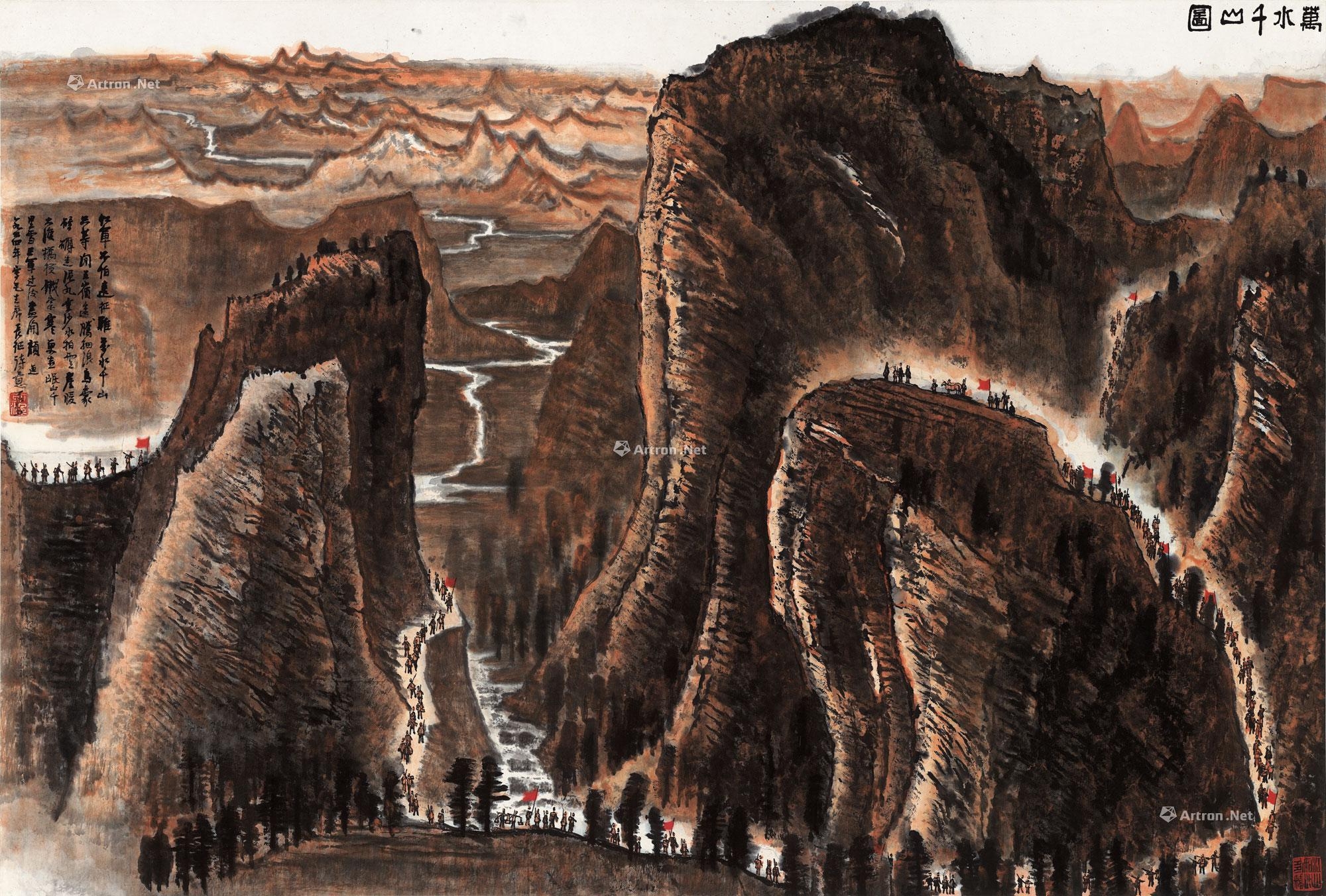

It was the painting's debut in the market. Long and Arduous Journey was created by Li Keran in 1964, based on Mao Zedong's famous poem Long March. The painting horizontally depicts a spectacular view of mountain ups and downs, piling on the top of each other and the lines of the Red Army goes on and on. The mountains are structured by thick ink in heavy color, dyed with warm ochre red, leaving thin whites for the paths and waters. The whole painting is done in orderliness with majestic and grand prospect – a milestone in the art history of New China, as well as a pivotal masterpiece of Li Keran's personal creations.
The painting not only contains the pattern of ancient Chinese landscape painting, but also integrates the light and shadow effects of western oil paintings into it – a masterpiece combining literariness, artistry and modernity with important aesthetic and historical value in Li Keran's innovative expedition of landscape painting as he named as "a biography of rivers and mountains for the motherland".
Li Keran was born in Xuzhou, Jiangsu province in 1907, and started to paint at the age of 13 by copying Wang Hui's landscape paintings. He was admitted to the Hangzhou National Academy of Arts in 1929 and studied oil painting with Lin Fengmian, and later switched to Chinese painting. His early works are greatly influenced by Shi Tao, Zhu Da and the four Wangs (Wang Shimin, Wang Jian, Wang Yuanqi, and Wang Hui) of the early Qing Dynasty. As the pioneer of new Chinese painting, he keeps on exploring new ways of Chinese painting.
He once said: "I do not rely on gifted talents, but to learn by getting confused. I am an assiduous disciplinant. Any achievements in my work would be the result of my close study on tradition, detailed observation of objects to depict, deep thinking and great practice. It's impossible for a man to create anything without nature or tradition. I often ask myself, am I creating paintings, or am I learning or studying paintings? Conclusion drawn: I am learning and studying painting. I'm on this journey for lifelong time."
On the whole, Li Keran's landscape painting is closer to the perceptual reality of the subjects than that of the Ming and Qing dynasties, serving as a kind of supplement and breakthrough to the increasingly formalized and programmed tendency of landscape painting since the Ming and Qing dynasties, and it's also consistent with the trend of thoughts in literature and art that attaches great importance to realism since the May Fourth Movement.