
In-depth | Art Market from an Economic Perspective: Downward Pressure and Recovery Potential (Part 2)
3. Exploration of the turning point in the downward period
Exploration of the Inflection Point During the Downturn Period
Although we have initially grasped the correlation between economic development and art market conditions after analyzing the influencing factors and mechanisms, it is not easy to infer the development trend of the art market in the future. When will the depressed art market get out of the downward haze, and when will it show a long-term positive growth trend? This is a question we need to think about further.
first,We can transform this problem into a prediction of future economic development trends based on the positive correlation between the art market and the economic cycle. From the perspective of quantitative analysis, we hope to extract data indicators that can clearly reflect the intuitive causal relationship between the macroeconomic cycle and the art market from the complex influence mechanism between the macroeconomic cycle and the art market as the basis for predicting the future development of the art market, that is, to find "sentinel indicators",In this way, the issue is shifted from the research scope of cultural economics to the pure economic scope. Secondly, generally speaking, after being affected by a major economic shock, the art market will experience three stages: a period of oscillation and decline (the oscillation is determined by the reaction characteristics of the non-effective market to the shock signal), an adjustment platform period, and a recovery and growth period.During the adjustment platform period, the art market itself will undergo a systematic reassessment of value and reconstruction of its structure, which will be specifically manifested in the bursting of the art price bubble and the reshaping of the market order. These signals reflect that the art market is accumulating strength for the upcoming growth and are the key to our prediction of future development trends.Below we will start from these two aspects and try to explore the sufficient conditions for the art market to see a growth turning point during its downward period.
1. Economic cycle analysis
Business cycle stage analysis is an important research area in business cycle theory, including cycle measurement and turning point identification. The National Bureau of Economic Research (NBER) of the United States determined the business cycle stage through "peaks" and "troughs" and developed the widely used "valley-to-trough" method and "peak-to-peak" method. The location of the peak and the bottom of the wave is regarded as the turning point of economic expansion and contraction, and the relevant driving factors are also deeply analyzed. Hamilton (1989) first used the nonlinear Markov regime transfer model to identify the turning point of the business cycle, and this model was subsequently widely used in related research on the business cycle. However, this model often assumes that the changes in the business cycle are jump-discontinuous and have discrete characteristics, while ignoring the transition stage. Therefore, accurately dividing the business cycle stages and turning points helps to comprehensively analyze economic fluctuations. Liu Jinquan and Zheng Tingguo (2008) provided a three-stage division standard for China's business cycle through a threshold autoregressive model. Liu Heng and Chen Shuyun (2003) constructed a short-term volatility composite index and divided the Chinese economy into four stages: recession, depression, recovery and prosperity. In addition, Garcia-Ferrer and Queralt (1998) identified different stages of the economic cycle by measuring economic cycles of different lengths and analyzing cycle intersections and trend trends. Economic cycles of different lengths can overlap, and the combined effect of impacts may lead to long-term severe depression.
Taking China as an example, Liu Han, Wang Lijun, and Liu Jinquan (2023) selected the output and price levels from the first quarter of 1990 (2004) to the second quarter of 2022 as the research object, and used the dynamic harmonic regression method to measure my country's economic cycle and identify the turning points. The economic downturn period of my country identified in this way is shown in the shaded figure (Figure 7), which includes the turning point from the recession stage to the depression stage during the downturn period.
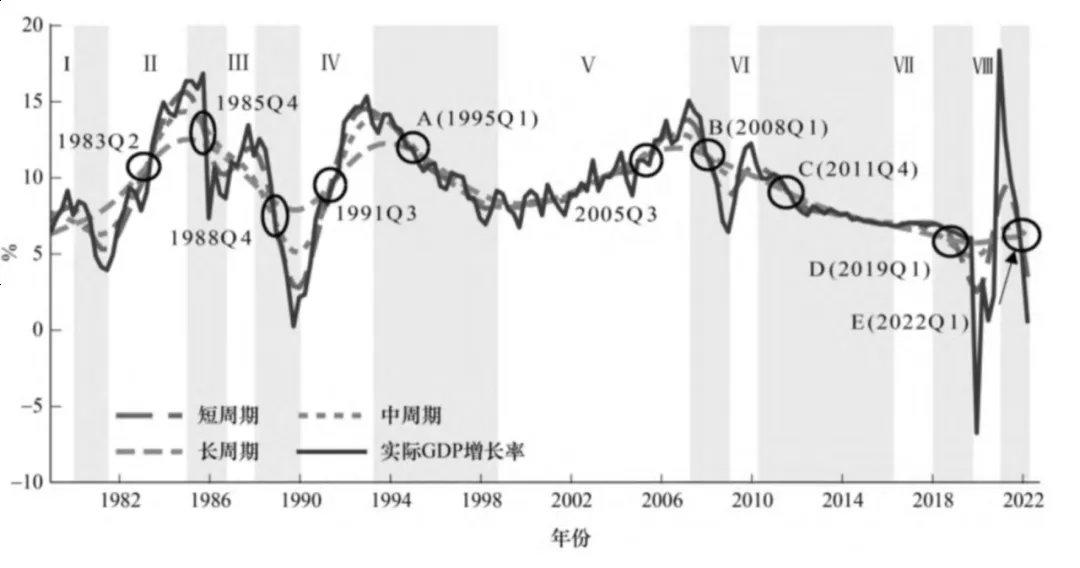
The article further breaks down the economic cycle into the superposition of short-term, medium-term and long-term fluctuations. The short cycle mainly reflects the cyclical fluctuations caused by short-term factors such as exogenous shocks, market supply and demand, seasonal factors, market confidence, etc., with large fluctuations and high frequencies; the medium cycle mainly reflects the cyclical fluctuations caused by macroeconomic factors such as monetary policy and fiscal policy; and the long cycle reflects the cyclical fluctuations caused by structural factors such as technological innovation and population changes, which manifest as long-term economic growth or recession trends. At present, my country has entered a stage of high-quality development, and development has gradually shifted from factor-driven to innovation-driven. The economic growth rate has slowed down and the fluctuations have become smoother.From a long-term perspective, my country's economic growth rate is still hovering at the trough, with the actual GDP growth rate at around 5%, and a sustained upward trend, proving that the long-term positive state of my country's economic fundamentals has not changed.However, as the domestic and external situations have become more severe and complicated in recent years, my country is likely to enter the recession stage of the growth economic cycle. If the disadvantage of continued decline in economic growth rate cannot be reversed, it may even lead to depression.
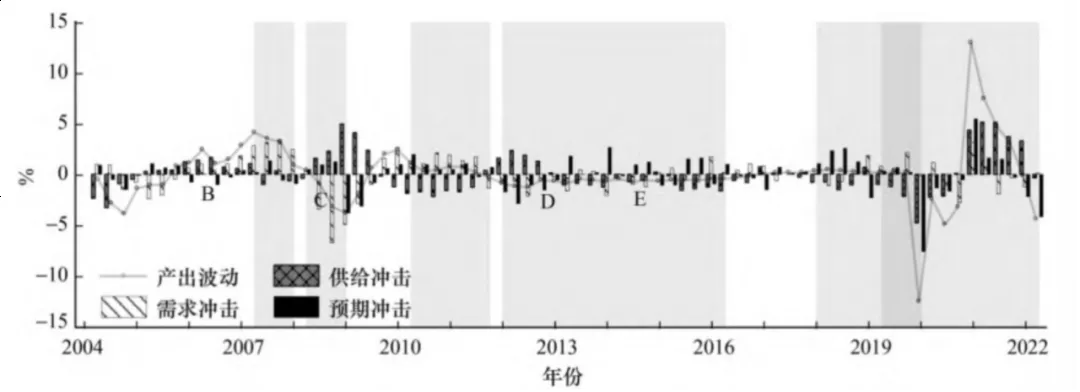
The Central Economic Work Conference in December 2021 proposed that the Chinese economy is currently facing three key issues: demand contraction, supply shortage, and weakening expectations. Therefore, researchers decomposed output fluctuations into three parts: supply shock, demand shock, and expectation shock, and explored their impact on economic growth (Figure 8). Some time ago, the Federal Reserve's interest rate hike caused the dollar to flow back to the United States, harvesting global wealth and producing a "blood-sucking effect", which weakened China's external demand, directly affected exports and aggravated supply shocks, and ultimately led to a slowdown in domestic economic growth.
At the same time, international instability factors such as the Russia-Ukraine conflict have pushed up commodity prices, increased corporate production costs, and further worsened supply conditions. In addition, the weakening of market players' expectations for the future economy has led to a contraction in demand, and the driving force of residents' consumption, investment, and net exports of goods and services on demand has weakened. Residents' and companies' expectations for income and profit growth have declined, significantly suppressing consumption and investment, further exacerbating demand contraction and lowering expectations, forming a "vicious cycle."Research shows that expectations are the main source of output fluctuations during the disturbance cycle caused by the COVID-19 shock, and are the most explanatory of the three shock factors. Since the beginning of the new development stage, the weakening of expectations has significantly affected the financing willingness of the real economy, as reflected in the divergence between the scale of social financing and the broad money M2 and the downturn in consumer loans.
Furthermore, the analysis of the economic cycle allows us to clarify the two-way interaction between economic development and expectations. Expectations about economic development can easily spread among markets through various channels in a short period of time, including the art market, so we make the following assumptions:In post-epidemic China, economic fluctuations mainly affect the trend of the art market by influencing expectations. In this way, quantifiable causal relationship indicators (economist expectations index, entrepreneur expectations index, etc.) are found, and the expected diffusion time and the non-efficiency hypothesis of the art market also make the indicator have a certain degree of foresight and predictiveness.
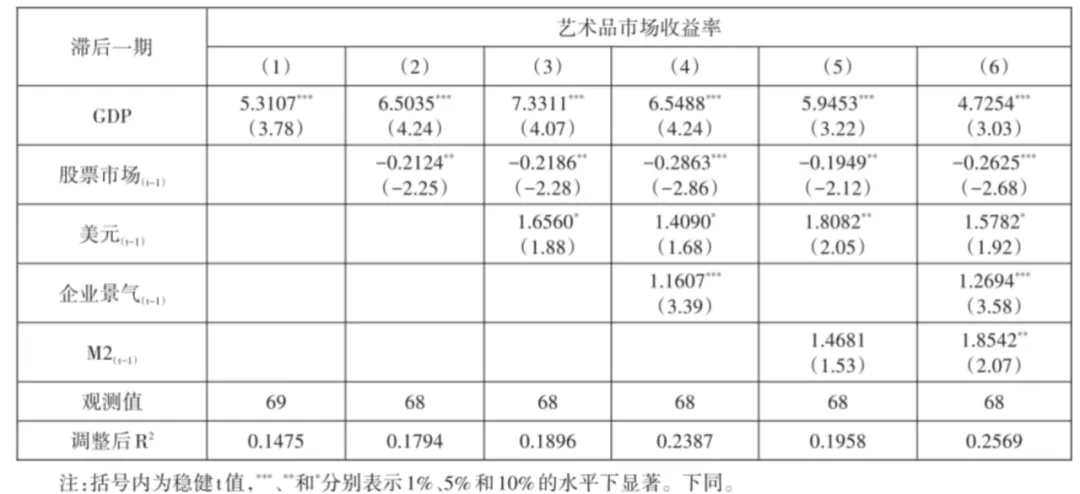
We can find evidence to support this hypothesis in existing research: Cheng Xiaomin (2014) proposed that there are two ways in which the economic cycle affects the art market: one is by affecting income, thereby affecting investment and consumption and other behaviors; the other is by affecting expectations, affecting the judgment of companies and individual investors on future development prospects, thereby affecting supply and demand. Huang Jun and Li Yuexin (2020) used the business climate index and entrepreneur confidence index as business climate data to regress the market price index of Chinese art. The results showed that the changes in the two were positively correlated, and the lagged term of business climate conditions could also explain the rate of change in the art market (Table 1), which shows that corporate and institutional allocations play a pivotal role in the demand for the Chinese art market.
Beyond the special case of China, we need to pay attention to the need for a specific analysis of the two-way influence mechanism between different economies and the art markets they foster, and then find effective leading indicators to reasonably describe the phenomenon of economic expectations being transmitted to the art market. In addition, in addition to using economic indicators for forecasting, establishing the confidence index of the art market itself is also a key task to regulate market order.So far, although my country's development in the field of art financialization has achieved initial results, and indicators such as the Artron Confidence Index and the Prosperity Index that reflect market conditions have been introduced, these indicators were built relatively late after all, and there is much room for improvement in terms of standardization, systematicness and foresight. The institutional construction of the art market needs to be further improved.
2. Research on the Art Market Bubble
At present, the research on asset bubbles mainly focuses on the stock market and the real estate market, while the research on price bubbles in the art market is slightly insufficient. And because investing in art does not provide a fixed cash dividend (Campbell, 2008), it is not feasible to test bubbles by calculating their basic value. At present, the academic community mainly judges the period of bubble existence by testing the explosive stage of prices. Kraussl et al. (2016) used the SADF method to study the price bubble phenomenon between 1970 and 2014.
Assaf (2018) used the Markov switching ADF test (MSADF) to analyze the international art market from 1998 to 2015 and found no significant bubbles. However, the SADF and GSADF tests showed that there were bubbles in 2002-2005 and 2011, which was attributed to the distortion of prices by geopolitical risks after the economic crisis. Ender et al. (2018) studied 32,391 transaction data in the Turkish market from 1990 to 2016 and found that there was no bubble in the Turkish painting market. In contrast, quantitative research on art market bubbles in China is relatively scarce. Wen Xin (2013) and Liao Can (2014) both used different methods to analyze the bubble of the Chinese art market, taking Tianjin Cultural Exchange as an example. Wang Fang (2018) used MSADF, right-tailed unit root test and self-service sampling to evaluate the bubble of modern and contemporary calligraphy and painting works. Cai Yao (2022) drew on Assaf (2018) and chose the SADF and GSADF methods to test bubbles in the art market.
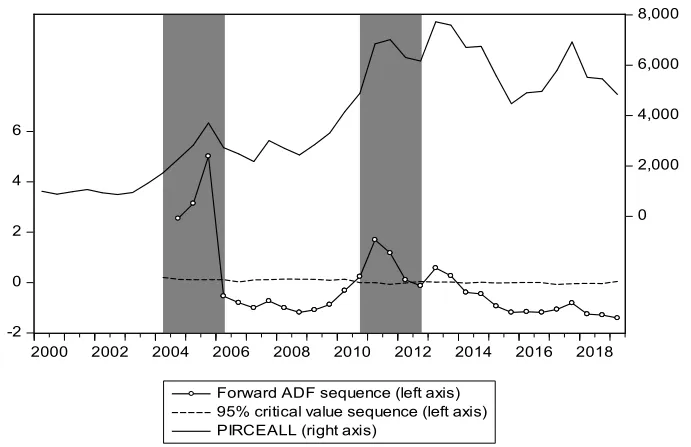
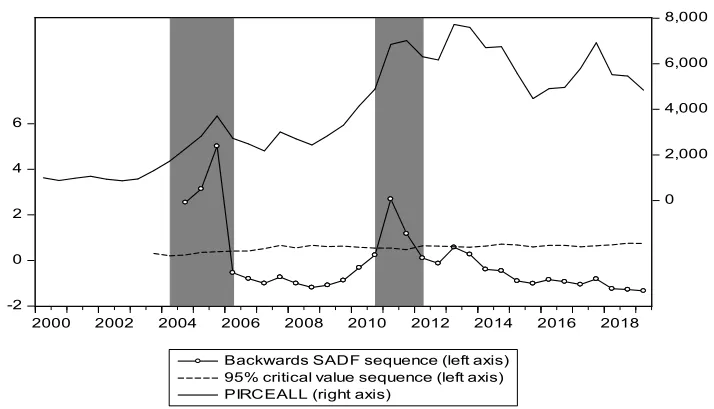
Taking China's art market as an example, Cai Yao (2022) pointed out that my country's art market has formed two bubbles, and the bubble duration was from 2004 to early 2006 and from the end of 2010 to early 2012 (Figure 9, Figure 10). After comparing with the historical decomposition diagram of output fluctuations under the "triple shock", we can find that the periods of the two bursts of the bubble in my country's art market do not coincide with the growth period of the macro economy. Specifically, the two bubble periods are both in the stage where the supply shock turns from negative to positive. The difference is that the demand shock in the former period turns from positive to negative, while the demand factor turns from negative to positive in the latter period. In comparison, the change in the direction of the demand shock is better reflected in the fluctuation of output. This shows that in these two stages, China's overall economic growth is more dependent on the promotion of demand factors, while the bubble in the art market is not synchronized with the change of demand shock. The reasons for this phenomenon are as follows:
First, among the changes in demand factors from the end of 2010 to the beginning of 2012, the sharp reduction in investment and net exports was the main driving force behind the reduction in demand, and it had little to do with consumption; second, the correlation between the consumption factor in total demand and the art market is also relatively low. China's economic development was better explained by supply and demand shocks in the previous period, and better explained by expectations shocks in the recent period after the epidemic. That is, after decomposing the economic shock factors, the expectations factor is likely to play a role in predicting the trend of the art market (the same frequency diffusion of expectations), while the supply and demand factors cannot well explain the cause of the bubble (the macroeconomic supply and demand and the art market supply and demand are relatively independent).
In other words, we are currently unable to use empirical research to separate the impact of macroeconomic factors into specific mechanisms dominated by supply and demand, and use them to study the causes of the bubble in the Chinese art market.The difference in statistical caliber, the defects in the available data structure and the relatively independent supply and demand relationship in the art market make it logically difficult to use empirical methods (such as Granger causality test) to test the causal relationship between macroeconomic factors and art market bubbles.
According to existing research, the bubble part of art asset prices is a nonlinear function of dividends, which leads to price deviations. In the art market, due to the imperfection of the market, it presents the characteristics of weak effectiveness, which makes the bubble overreact to dividends, thus affecting the price of art. In addition, the overconfidence of investors is also an important factor affecting asset price bubbles. With the cyclical fluctuations of economic factors, investor sentiment and confidence will change cyclically, and bubbles will also fluctuate cyclically. Generally speaking, in the period of overheated economic and financial development, people's consumption and investment desires are high, inflation is relatively high, and art asset prices will be at a relatively high level and contain more bubble components.
On the contrary, when the economy is negatively impacted, the weak effectiveness of the art market will cause different entities to react slowly or have excessive negative feedback (blind optimism or pessimism), making it difficult for the market to return to equilibrium in a short period of time, and the direction of price fluctuations is more difficult to predict than in relatively efficient financial markets. Sometimes, during an economic recession, when the substitution effect is greater than the wealth effect, investors may find alternative ways to explore alternative investment products to adjust their asset portfolios to resist market risks when various financial products are in a downturn, and then temporarily choose the art market. At this time, art assets show countercyclical risk aversion characteristics (as described in Dorota's research), which also explains to a certain extent the divergence between my country's output fluctuations from the end of 2010 to the beginning of 2012 and the bubble in the art market.
As the consensus that the economic situation will not recover in a short period of time gradually becomes a consensus, people’s expectations of the uncertain development prospects of the art market may continue for a longer period of time, thus forming a habitual pessimistic forecast. With the contraction of supply and demand, the bubble of the art market will eventually burst.(The sharp decline in expectations in 2012-2013 was transmitted to the art market in 2015.) Sometimes, even when there are obvious signs of real "economic dividends", the art market in the cold winter will slowly wake up. This characteristic of weak market efficiency also explains to a certain extent the time lag effect of the correlation between some macroeconomic indicators and art market price indices.
Specifically, the development process of the two bubbles in the Chinese art market is as follows (Figure 11). The first bubble began in 2004-2006, when the economy developed rapidly, the cultural industry emerged, and people's living standards and market order gradually recovered after SARS. In addition, with the guidance of policies, the domestic art market absorbed a large amount of foreign funds, giving rise to bubbles; but in 2006-2007, the art market was in chaos due to the lack of policy regulations, causing investors to gradually lose confidence. At the same time, China's real estate market and stock market were hot, and hot money took the opportunity to withdraw from the art market, causing consumers and investors' expectations to further decline, resulting in the bursting of the bubble.
The second bubble began in 2010-2012. After the financial crisis, the country took active measures to rescue the market. Fiscal and monetary policies were relatively loose, market M2 supply increased, GDP growth accelerated, and in order to stimulate consumption, the country controlled the stock market and the property market. The increase in inflation expectations and the reduction in alternative investment products caused the art industry to continue to rise, and art prices soared. The country also intended to vigorously develop the cultural industry at this time, and the attempt to financialize art reached a peak. The establishment of Tianjin Cultural Exchange Center in 2011 attracted a large number of investors, and the development of the art market was in full swing. However, after 2012, with the tightening of monetary policy, market liquidity decreased, the economy faced downward pressure, and the expectation of rising prices gradually disappeared. At the same time, the state stepped in to rectify the chaos of cultural exchanges, declaring that this attempt at art finance had failed.
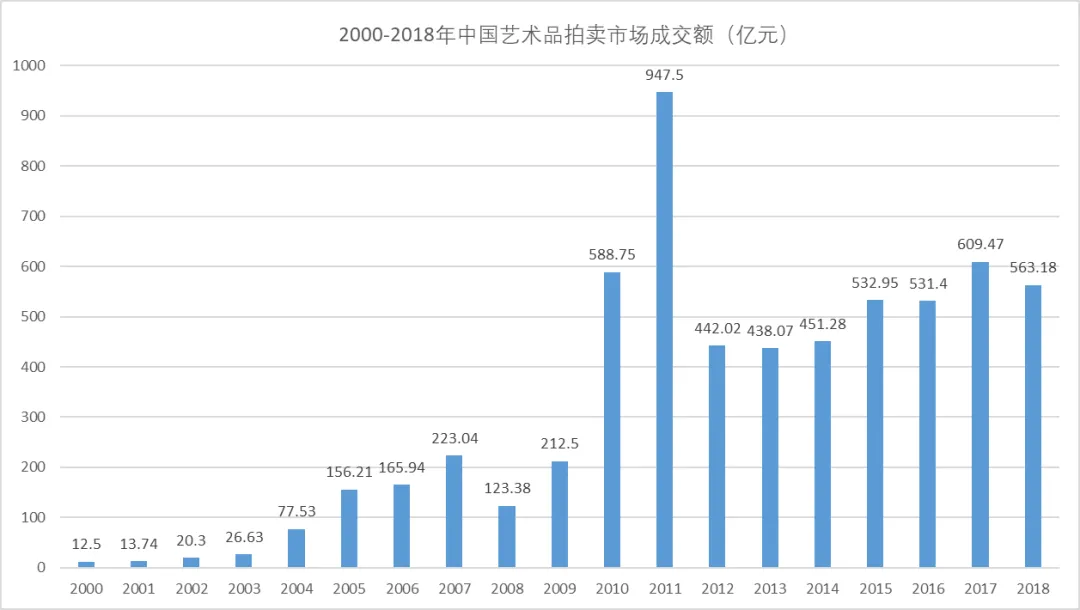
However, existing research can only help us identify whether there is a bubble in the art market, as well as the specific reasons for the formation and disappearance of the bubble, but cannot tell us when the bubble can be effectively squeezed out during the market downturn. Therefore, we can only analyze the overall price structure of artworks based on market transaction data.
According to the 2024 Art Basel and UBS Global Art Collecting Survey, one of the key factors in the slowdown in the global art market in 2023 is the shrinking sales of high-priced works at auctions, most notably those priced over $10 million. During the 2020 pandemic, prices in all market segments fell significantly, while the recovery in 2021 was biased towards the high end of the market, with sales of works priced over $10 million showing the strongest growth momentum.
In 2022, the growth rates of works at different price points in the market have become more differentiated. Auction data show that the price segment above US$10 million is the only segment that is still growing in 2022, while all other segments below this price are declining.This shows that there is a widespread bubble accumulation phenomenon in the global art market, and most of it is concentrated in the high price range.
The change in 2023 therefore marks a clear reversal of this trend. Specifically, while there will still be a series of very eye-catching multi-million dollar works sold in 2023, the high-end market, especially the price range above $10 million, is one of the segments with the weakest year-on-year growth. In comparison, lower-priced works have shown greater vitality in both the secondary auction market and the primary gallery field.
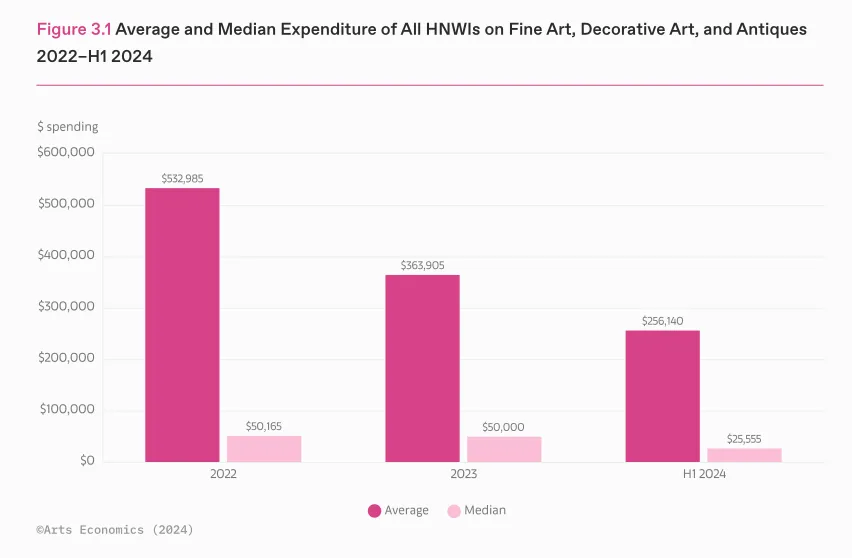
Data shows that the average expenditure of high net worth individuals on art in 2023 has declined, from $532,985 in 2022 to $363,905 in 2023, a decrease of 32%. The decline in the average value reflects the decline in spending in the highest-end market. But when we focus on the median expenditure, we can find that in 2023, the median expenditure on art and antiques in all markets will reach $50,000, a slight decrease from $50,165 in 2022.
Spending reported for the first half of 2024 is $25,555, which could reflect a stable annual level if this trend continues into the second half of the year (Figure 12).This data structure shows that the art market serving high-net-worth individuals has not experienced a systematic decline in prices in the past two years, but only a shrinkage in the value of the high-priced market, which is manifested as an orderly bursting of the price bubble.
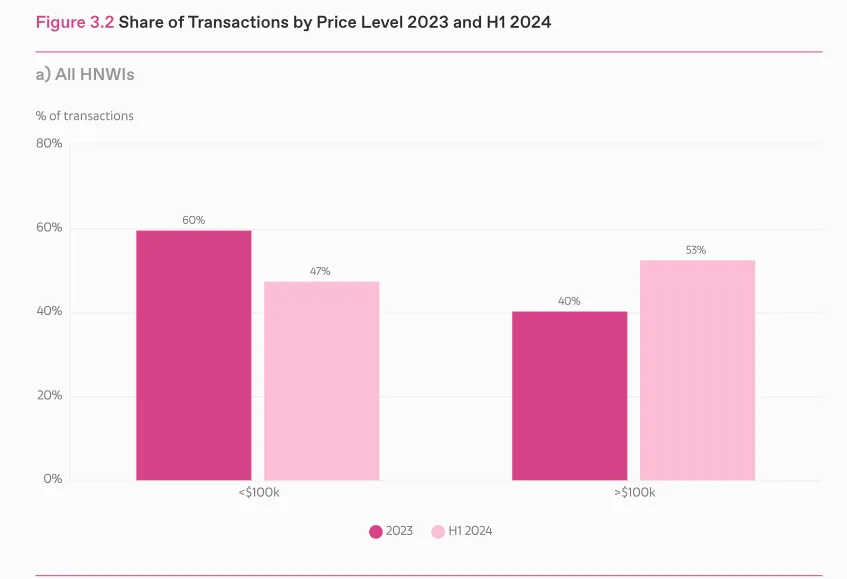
Although we observe an increase in the proportion of works with transaction amounts above $100,000 in the first half of 2024, from 40% in 2023 to 53% (Figure 13), this phenomenon is mainly due to a decrease in the number of transactions below $100,000.This shows that the high-end market will shrink in 2023 and the low-end market will shrink in the first half of 2024. However, after excluding high-priced bubbles and low-quality works, the supporting capacity of the mid-price market remains relatively strong. This seems to give us hope for a better art market in the future.
According to the "asset shortage hypothesis", we know that with the development of finance, the degree to which asset prices deviate from their true value gradually decreases. Therefore, we have reason to believe that the bubble in asset prices in the market is likely to disappear. Returning to the art market, excluding cyclical fluctuations, with the development of the economy and the maturity of the financial industry, in the long run, the price of art will gradually return to its own value, which is also a placebo for the art market, which is still in a depressed period.Artworks that have become assets due to their financial attributes will not eventually float above the laws of the market like castles in the air. As excessive price bubbles are effectively squeezed out during the economic downturn, and the art market loses its marketing cloak and the craze, it will undergo a deep reshuffle and form a more rational judgment on the value of existing works on the market, which will help build a future art value system.
IV. Conclusion
Conclusion
After combing through the existing research results, we can draw the following conclusions: there is a significant long-term positive correlation between macroeconomic fluctuations and art market trends, and in the short term, the impact of economic fluctuations mainly affects the overall price trend by affecting the supply and demand relationship in the art market. At the same time, we must not forget the adjustment of market structure and the role of liquidity in the local market. After decomposing the impact factors of total economic output, we found that the expectation factor may be an effective indicator to explain the positive correlation between the economic cycle and the long-term fluctuations in the art market, and can be used to predict the emergence of the growth turning point in the downward period of the art market. At the same time, whether the price bubble in the art market has been effectively cleared can also be used as an auxiliary indicator and one of the necessary conditions to judge whether the market has the potential for growth.
Among the major branches of art market research, this article does not include the impact of the characteristics of artworks on their prices in the scope of discussion, but in fact, this is also a key point that needs attention. The basis of art transactions will eventually return to the intrinsic value of the artworks themselves. As the saying goes, the price of artworks "should be determined by supply and demand in the short term, wealth in the medium term, and value in the long term." After removing the aesthetic satisfaction of the buyer's individual visual experience, emotional experience, and the added value of brand marketing, the price of artworks will eventually return to its cultural value and art history value. Only high-quality artworks that have survived layers of economic cycle fluctuations and market screening will have the possibility of reaching the peak of value in the future.
Author: Qi Hongyi
School of Art Management and Education, Central Academy of Fine Arts
Arts Business Management Master's degree
Source: CAFA Art Business Management Studio
Please continue to follow ArtPro for more latest developments in the global art market.