
[2026 Autumn Auction] After 20 years and 3 changes of ownership, Zhu Da's "Miscellaneous Paintings of Geshan" sold for a remarkable HK$61.29 million at Sotheby's Hong Kong.
On October 8, 2026, at 2:00 PM, Sotheby's "Painting Zen: Bada Shanren's Miscellaneous Paintings" auction was held in Hong Kong as scheduled.
Zhu Da's "Miscellaneous Works of Geshan" was hammered down at HK$49.5 million, and sold for HK$61.29 million including commission.
Bada Shanren, Miscellaneous Paintings of Geshan, Ink on paper, nine leaves (with an additional leaf of colophon by Rao Zongyi) total 24 × 37.8 cm. 14 ⅞ × 9 ½ in. (9)
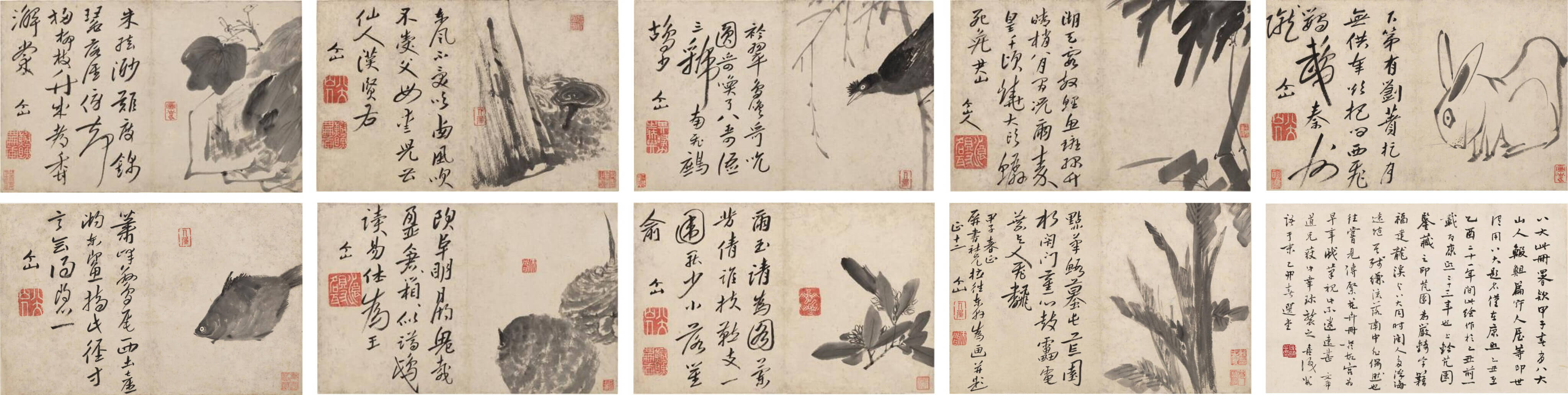

The provenance of this lot:
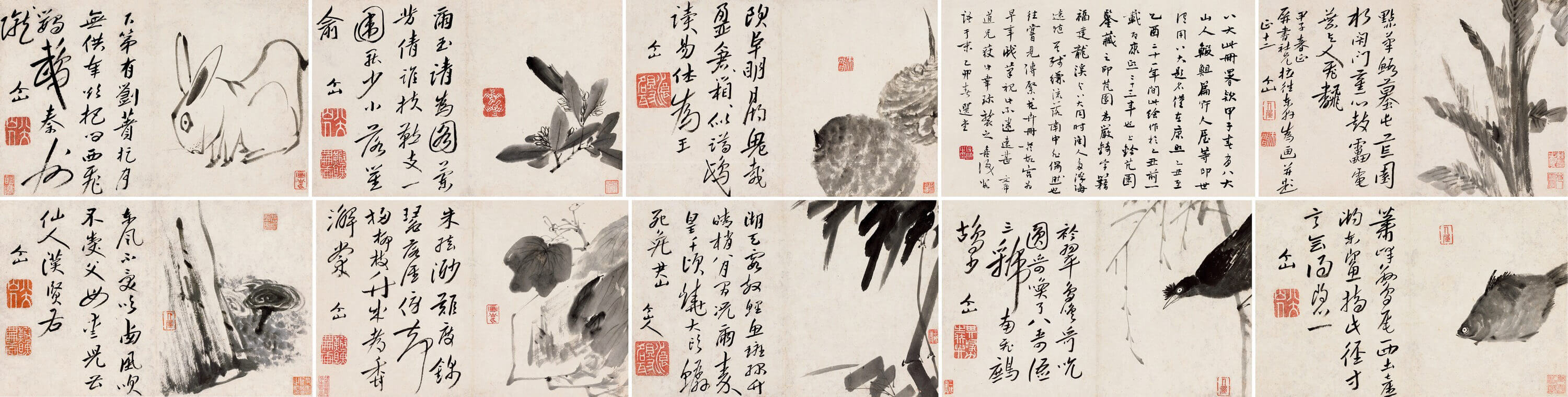
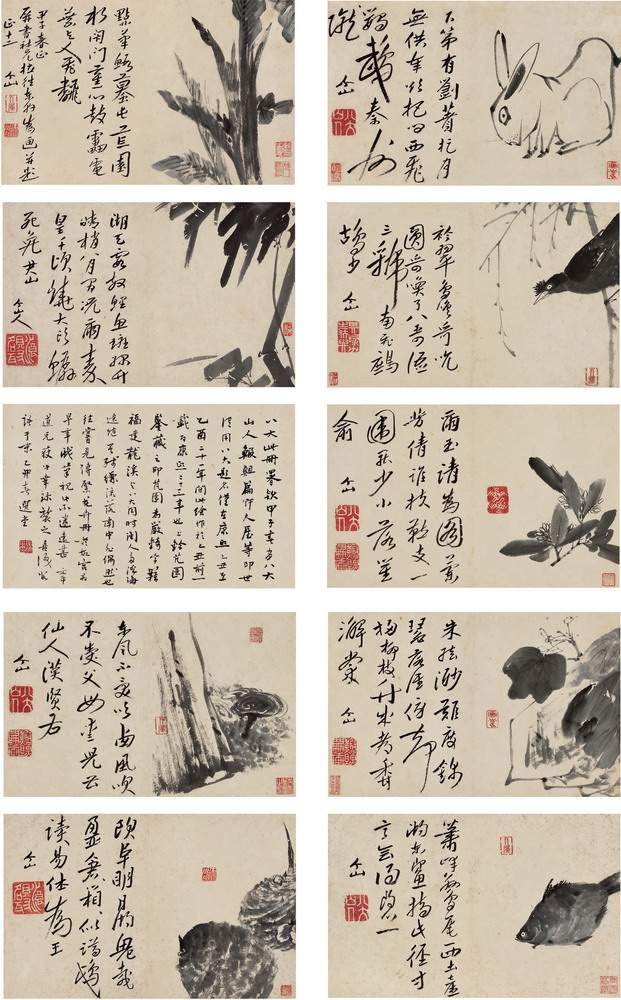
Translation:
(I) The zither's strings are difficult to read, the brocade zither falls to whose side? Yet, the willow branches and bamboo are swept away, the fragrant crabapple blossoms of Chengdu remain. Geshan. Seals: "Xiaqi Pianxuan", "Hua Weng"
(II) Neither the east wind nor the west wind blows. Parents love their children, and immortals and sages alike admire them. [Signature] Seals: "Bada Shanren", "Xiaqi Pianxuan", "Renwu"
(III) The kingfisher calls to its brother, its beak ringing out. The myna sings in the three states of Guo, few partridges fly south. [A mountain]. Seal: "The speed of its beak," "Human house."
(IV) The lake and sky are ablaze with the rosy glow of carp, the green bamboo tips gleaming in the August sunshine. How much more so when Qin Shi Huang's thousand acres were burned, and the big-headed fish died a limp death on Mount Jun. — Ge Shanren. Seal: "A Name Worthless"
(V) Liu Fen failed the imperial examination, yet he received no reward for trying to catch the moon. He wanted to ask about the westward-flying parrot, but it flew to Longzhou, Qin Province. Geshan. Seals: "Bada Shanren" (Eight Great Mountain Men), "Painter of the Old Man"
(VI) West of Xiaofeng and Luanwei, the local product is the crucian carp from the eastern lake. Holding this brief statement, one can understand the heart of the beloved. [Signature] Seal: "Bada Shanren" (Eight Great Mountain Men), "Renwu" (Human House)
(VII) Oufu Bright Moon Lake, ghosts fill the granaries. The granaries resemble crouching owls, reading the Book of Changes, one should not be king. Ge Mountain.
Seal: "Wang Deming Er", "Fu Xian" (8) Er Yu asked for a picture, Lan Fang asked who would help. Yan Zhi is finished, Shao Xiao fell into Qu Yu. Ge Shan.
Seals: "Bada Shanren", "Xiaqi Pianxuan", "Donkey" (Nine) A brushstroke at Xiaqitun, a desolate garden with its gate closed by water. Banana leaves thunder and lightning, leaves and people flying and turning. In the spring of Jiazi (1684), my brother Ping Shushe took me to Dongxuan to paint and inscribe the twelfth. Geshan.
Seals: "Renwu" (人屋), "Fuxian" (夫閑) Collector's seals: (Cao Buxun) "Pengyuan Cao Shi Pingsheng Zhenshang" (芃園曹氏平生真賞), "Pengyuan Jianshang Zhi Yin" (芃園鑒賞之印), "Pengyuan Baozang" (芃園寶藏), "Chen Buxun Yin" (臣芃閒印), "Cao Buxun Yin" (曹芃閒印), "Pengyuan" (芃園), "Bitong Zuike" (碧桐醉客), "Sanhuaitang" (三槐堂) (two seals in total), "Tushu Ziyi" (图書自怡), "Yulou" (雨涓).
Colophon: This album by Bada is signed "Spring of Jiazi" and bears the seals of "Bada Shanren", "Xiaqi Pianxuan", and "Renwu". It is said that the use of the name "Bada" in the title only occurred between the 21st year of the Kangxi reign (1685-1695). This painting was created one year before the 1685 reign, that is, the 23rd year of the Kangxi reign. The seal of "Pengyuan" is affixed above. "Pengyuan" is the courtesy name of Yan Qi, who was from Longxi, Fujian, and was a contemporary of Bada. Many people from Fujian went to sea to settle far away, and it was not accidental that their remnants ended up in the south. I once saw the "Chuanqi Flower Album" in the Palace Museum, which was an early playful work, and it is far inferior to this. I am glad that my friend Wenxi acquired this and cherished it. I am happy to write a few words at the end. Spring of 1975, Xuantang.
Seal: "Seal of Zongyi" (square seal in white characters) Source: Tianxitang, etc.
Collector's Profile: Cao Buxun (Qing Dynasty), courtesy name Pengyuan, sobriquet Yulou, studio name Guxiangge, later known as Pudong Jushi, was a native of Yangyi (now Taigu County), Shanxi Province. He was a renowned bibliophile, connoisseur, and official. He came from the prominent Cao family of Shanxi merchants during the Qing Dynasty (he was the 18th generation of the Cao family). In 1834, during the Daoguang Emperor's reign, he passed the imperial examination in Shuntian Prefecture, becoming one of the earliest members of his family to achieve this distinction and enter officialdom, serving as a principal officer in the Ministry of Works. During the Kangxi Emperor's reign, Cao Buxun built the "Sanhuaitang" in Yangzhou. This album was formerly in Cao Buxun's collection.
Brief Introduction of the Postscript Author: Rao Zongyi (1917-2018), born in Chao'an, Guangdong, with ancestral roots in Meixian, Guangdong, was a sinologist, classical scholar, archaeologist, paleographer, translator, writer, calligrapher, painter, Dunhuang scholar, and cultural historian. He was an academician of the French Academy of Far Eastern Studies, a foreign academician of the Academy of Inscriptions and Fine Arts of the French Academy, and an academician of the International Eurasian Academy of Sciences. Before his death, he was an honorary chair professor of the Institute of Chinese Culture and Department of Art at the Chinese University of Hong Kong, an honorary chair professor of the Department of Chinese at the Chinese University of Hong Kong, a member of the Central Research Institute of Culture and History, and the president of the Xiling Seal Engraving Society.
Stay tuned to ArtPro for the latest updates on the global art market.
For more details on the auction items, please click to view the special session.