
In-depth | Art Market from an Economic Perspective: Downward Pressure and Recovery Potential (Part 1)
In the post-epidemic era when the global economy continues to be sluggish, the art market is also facing unprecedented challenges and showing a clear downward trend. From the sharp decline in the resale price of artworks in the primary market to the significant decrease in the transaction volume in the secondary auction market, it is clear that the art market is in a stage of deep adjustment.
This article will start from an economic perspective, deeply analyze the complex relationship between economic development and art market conditions, and explore the influence of different economic factors on the art market and the paths of their action.
By analyzing the structure of the art market itself, examining the impact of external economic shocks, and exploring new growth points that may be nurtured within the market, we hope to provide interpretations of the current development status of the art market from different perspectives.
1. Description of the current status of the art market
Description of the Current Situation in the Art Market
Looking around the world, the aftermath of the Federal Reserve's interest rate policy, the continued turbulence in geopolitics, and the drama of the US presidential election have all brought huge uncertainty to the development of the art market in the post-epidemic era. Currently, the primary market of the art industry is facing severe tests.
As the global economic situation fluctuates, a large amount of speculative capital has withdrawn from the primary market, which has manifested itself in a significant decline in the resale price of artworks, slow sales or even stagnation, causing a huge impact on the operation of the gallery industry., many international galleries are facing increasing operating pressure and are forced to withdraw from the market or re-position. For example, in April 2024, the famous Mesozoic Gallery Clearing announced that it would be divided into New York and Europe; in July, Li Wei Ge announced that it would close its Hong Kong space at the end of the year. ArtTactic's July 2024 report showed that the art market confidence index reached its lowest point in four years.


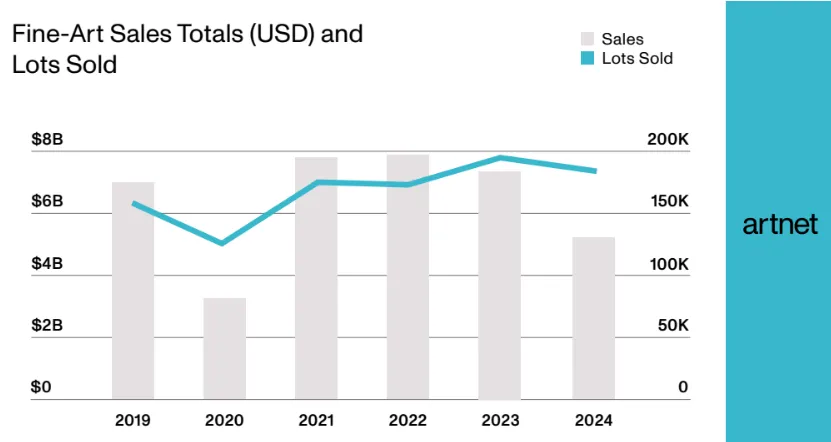
The secondary auction market has also been severely affected. According to statistics from Artnet Art Market Intelligence in the first half of this year,In the first half of 2024, the total global art auction turnover fell sharply to US$5.05 billion, a decrease of 29.5% from the same period last year.(Figure 1).
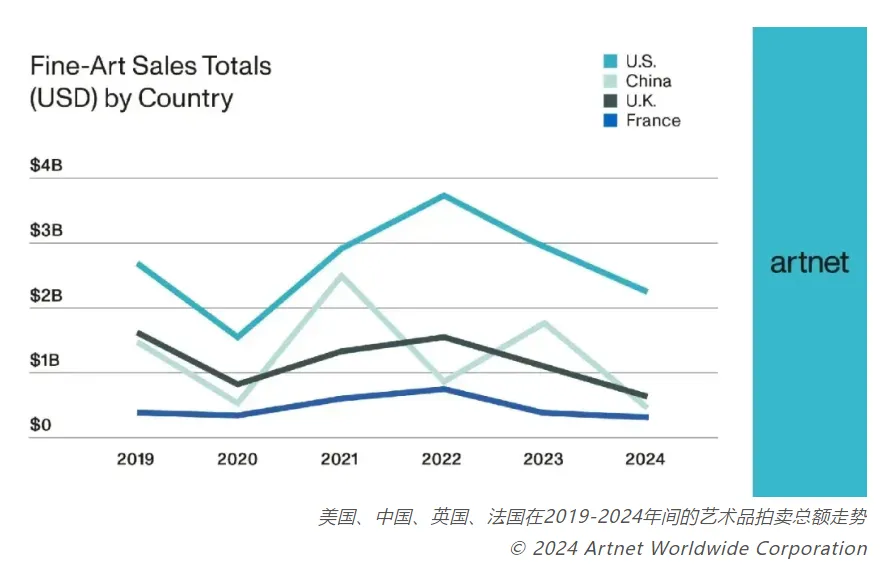
Specifically, sales in major secondary markets around the world have declined compared to 2023.Total art auction sales in the United States in the first half of 2024 fell 24% to $2.2 billion compared with the same period in 2023, becoming the third lowest half-year figure in the past decade;
The UK fell 26% to $827 million, mainly affected by the internal and external environment such as the increase in transaction costs caused by Brexit, high inflation, the weakness of the pound and the outflow of wealth;
China's data fell sharply by 49% to only US$825 million, and was once again overtaken by the United Kingdom in the rankings.
Affected by domestic epidemic prevention policies, China's auction market transaction data jumped twice in 2021 and 2023, butIn 2024, as the domestic real estate market continued to be sluggish, the short-lived prosperity of the art market was finally submerged in the haze of economic downturn.(Figure 2).
The sales results of major international auction houses also continued the downward trend in 2023.According to the latest data from the Financial Times, total sales at Christie’s, Sotheby’s, Phillips and Bonhams in the first six months of 2024 fell 26% year-on-year, below pre-pandemic levels in 2019. Performance among major auction houses was mixed.
Among them, Christie’s reported in July that its performance in the first half of 2024 was down 28.2% compared to the second half of 2023;
Sotheby's fell 31.2%. The market outside the highest-end auction houses performed slightly better. At the same time, the structural changes in the auction items are also worthy of attention. As of June 30, the total sales of artworks sold at a price of US$10 million or more this year fell by about 30% compared with the same period in 2023, and the total number of auction items fell by 18%, and the high-priced market shrank further.
Looking at the age structure of the artists being auctioned, the sales of ultra-contemporary works by artists born after 1974 have shrunk the most., down 39% from the same period in 2023 to only US$164.8 million.
Overall, the art market seems to have entered a period of deep cyclical adjustments. The superposition of multiple internal and external factors has made the development prospects of the art market even more elusive.
2. Research on the impact of economy on the art market
Research on the Related Impacts of Economics on the Art Market
In fact, the study of art market laws from an economic perspective has yielded fruitful results. Since the 1960s and 1970s, with the development of the economy and the accumulation of wealth, the global art market has prospered, and the art market has become increasingly integrated with modern business and financial capital, which has attracted the attention of the academic community.
Today,The art market has become a key branch of cultural economics research., its research directions mainly cover the following aspects:
The first is to sort out the development history of the art market and its operating logic;
The second is to explore the diverse characteristics of artworks;
The third is the exploration of factors that influence the price of artworks;
The fourth is to treat artworks as "art assets" and conduct research on their financial attributes.
On the basis of existing research, we regard economic development as an external shock to the art market. Based on different focuses, we integrate the results from two aspects: economic influencing factors and the paths through which they affect the art market. The former mainly relies on relevant macroeconomic indicators to describe the relationship between economic development and art market conditions, in order to identify patterns and predict changes; the latter mainly explores the essential mechanism of economic factors acting on the art market, in order to find the crux and solve problems.
1. Influencing factors
1. GDP Gross Domestic Product
According to the basic consensus of the academic community,There is a positive correlation between the level of GDP per capita and its rate of change and the development of the art market.
The minimum starting point for a country to nurture a mature art market is a per capita GDP of $1,000 to $2,000;
When the per capita GDP reaches over US$4,000, the art market reaches a turning point of rapid growth.
Only when a country's per capita GDP reaches US$8,000 to US$10,000 can its cultural and art industry enter a period of prosperity.
Taking foreign markets as an example, the United States, Japan and South Korea entered the echelon of per capita GDP of US$10,000 in 1978, 1983 and 1994 respectively. The period of development and growth of the art markets and cultural industries of these three countries coincided with the 1970s, 1980s and 1990s, which proves the universality of this law.
As for the quantitative research on the correlation between GDP and the art market, domestic and foreign scholars have made great achievements in this regard. Among them, Buelens and Ginsburgh (1993) found that the average annual return on art was 0.65% based on transaction data from 1700 to 1961, and its return was significantly affected by the macroeconomic cycle.
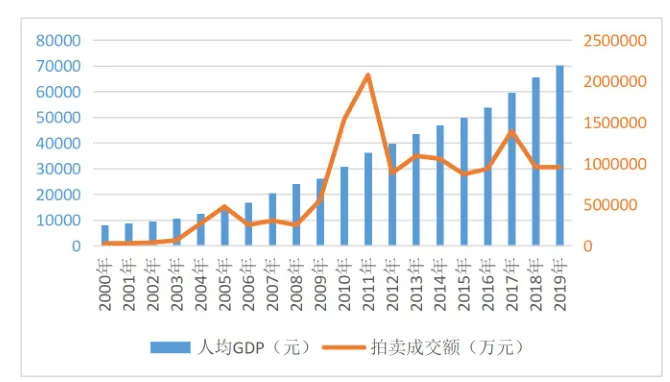
Zhao Yanting (2005), Cheng Xiaomin (2014), Jing Naiquan (2019) and other scholars have studied the relationship between the theoretical and empirical aspects ofPositive correlation between GDP growth rate and China’s art auction market (especially the calligraphy and painting market)(Figure 3). The research by Jing Naiquan, Song Huiwen, and He Lei (2010) further illustrates this correlation.There may be a half-year time lag effect.
The Annual Research Report on the Development of Chinese Art Market (2012) uses auction data from 1990 to 2011 to analyze the relationship between the economic development level of different countries and the calligraphy and painting auction market. The results show thatIn China, GDP growth promotes the development of calligraphy and painting auction market, but this conclusion does not apply to emerging art markets such as India and Russia, which showsThe GDP factor does not have a strong explanatory power for all art markets.
2. Inflation rate
Generally speaking, inflation will lead to an upward trend in commodity prices. During inflation, people will actively seek high-quality assets whose value growth can outperform inflation to resist the losses caused by inflation. Therefore, the "risk-avoidance ability" of art assets under inflation has also become a focus of attention. In empirical research, scholars usually use the CPI data growth rate to measure the degree of inflation.
Research by many scholars at home and abroad has shown that there is a relatively obvious connection between the rate of return on artworks and the inflation rate. Anderson (1974), Baumol (1986), Goetzmann (1993), Mei and Moses (2002) all constructed art market indexes through repeated transaction methods, and concluded that the price and rate of return of artworks are positively correlated with the inflation rate; Stein (1977) used the modified capital asset pricing model to study the investment return rate of oil paintings in the United States and the United Kingdom from 1946 to 1968, and also came to a similar conclusion; Candela and Scorcu (1997) estimated the price index of the Italian art market from 1983 to 1994 based on the "representative painting method", and found that the price of artworks rose with the increase of inflation rate.
Jiang Sai (2018) believes that the short-term impact of inflation on art market prices is positive, indicating that art can be used as an effective investment tool to resist inflation. Zhang Ruiyun (2019) used the mixed autoregressive moving average model (MARMA) to explore the relationship between the macroeconomy, the stock market and the Chinese painting and calligraphy market. The results show that when the inflation rate increases, the painting and calligraphy market has more investment value than the stock market. Zhang Zhiyuan (2020) constructed a Markov zone switching model under the three-zone system to more carefully analyze the correlation between the investment return rate of art and the inflation rate in my country under different inflation conditions from 2000 to 2018.The research shows that the return on investment in my country's art is higher during mild inflation, the return is highest during creeping inflation, and the return is lowest during deflation. This reveals a nonlinear correlation between the return on art investment and inflation.
3. Money Supply
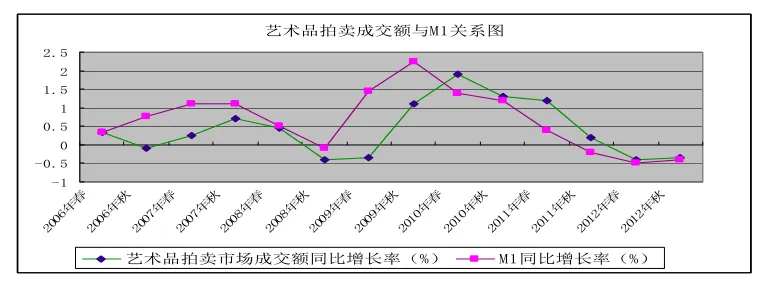
According to the continuous observation of AMMA (Art Market Monitoring Center of Artron Art Group), there is an inevitable linkage between the monetary policy environment and the art market, although there may generally be a lag effect of half a year (Figure 4). Carlo Marie Boyer (2011) regressed the art auction price index with money supply, employment rate, stock market yield and exchange rate from 1976 to 2009 as explanatory variables. The results showed that in addition to the stock index, other factors including money supply have little influence on auction prices. Shi Yang and Li Yao (2013)It is believed that there is a long-term positive relationship between art prices and money supply, and that prices are highly sensitive to the influence of money supply.Since the growth rate of money supply should theoretically be close to the sum of GDP growth rate and inflation rate, the increase in money supply is generally higher than the inflation rate.The empirical results show that a 10% increase in money supply will lead to a 13.5% increase in art prices. This shows that changes in art prices are mainly monetary phenomena and are very sensitive to money market liquidity. A small change in money supply will cause large fluctuations in art prices.
Huang Jun (2013), Deng Wei (2014), and Cheng Xiaomin (2014) also reached similar conclusions, confirming the positive correlation between money supply and art market development. Li Yuexin, Cui Xintian, et al. (2024) found that after controlling for indicators such as GDP growth rate, stock and bond market returns, and corporate prosperity growth rate, there is a significant positive correlation between the return on China's art market and the growth rate of broad money supply (M2), and there is a half-year time lag effect.
(Data source: statistics compiled by Artron Art Network)
4. Other financial assets
Going further, to include art as a financial asset in a basket investment portfolio, it is also necessary to study the correlation between its returns and those of other financial assets.
Generally speaking, we hope that the correlation between the art index and other financial assets is small or negatively correlated, which will be more conducive to investors' risk hedging.
For example, Michael Tucker, Walter Hawischka, and Jeff Pieme (1995) selected the Sotheby's Art Market Index from 1981 to 1990 to prove that there is a negative correlation between the art market and the stock market and bond market. Mei and Moses (2002) found thatArt has an extremely low correlation with the S&P 500 of just 0.04, suggesting that art may play a role in portfolio diversification.Similarly, Campbell (2004) found that the correlation between the May/Morgan Stanley Index and the S&P 500 was low or even negative between 1875 and 2002. Worthington and Higgs (2004) found thatThe correlation coefficients between the Art Index and common financial assets range from -0.3058 (small company stocks) to 0.3009 (Treasury bills), indicating that art investment has the potential to contribute to portfolio diversification..
Taylor and Coleman (2011) collected auction data from Australia and New Zealand between 1982 and 2007 and found that the Australian Art Index was negatively correlated with major traditional asset classes (stocks = -0.3, real estate = -0.21, government bonds = -0.15) as well as alternative asset classes (gold = -0.1, hedge funds = -0.39).
In addition, there are also studies showing that there may be a positive correlation between art and other financial assets. Chanel (1995) collected data from New York, Paris, London and other places and found that stock indexes can indeed lead the trend of art market indexes. The price fluctuations in the art market lag behind the price fluctuations in the stock market by about a year. Goetzmann (1993) showed that from 1900 to 1986, there was a high positive correlation between art and the London Stock Exchange Index and bond yields. Renneboog and Spaenjers (2013) also concluded that art is positively correlated with gold, commodity prices, real estate prices, and the lagged stock returns of the S&P 500 index.
In general, researchers have not reached a consensus on the relationship between the art market and the financial market. Kraeussl and Logher (2010) conducted a study on three emerging art markets: Russia, China, and India. They found that there is a positive correlation between the Russian art market and the financial market.In China and India, however, there is a negative correlation between the two.Guo Yugang et al. (2013) selected the Dow Jones Index, the Meimo Index, the FTSE Real Estate Index and the international gold price as indicators to reflect the development of various markets. The results showed thatThere is a significant positive correlation between the international art market and the stock market, while the Chinese art market and the securities market are relatively independent, and even show a negative correlation.
Judging from macroeconomic indicators such as GDP growth rate, inflation rate and money supply, there is a significant correlation between the level of economic development and the art market, and the art market is pro-economic cyclical in the long run. However, as a special asset, the correlation between the yield of art and other types of financial assets is very complex. Different researchers have drawn different conclusions based on the markets of different countries and regions and different stages of economic development.
2. Impact Path
After clarifying the correlation between major macroeconomic indicators and art market development, we need to explore the logic behind the correlation between the two based on the unique structure of the art market itself, as well as the theoretical mechanism by which economic shocks act on the art market and spread.
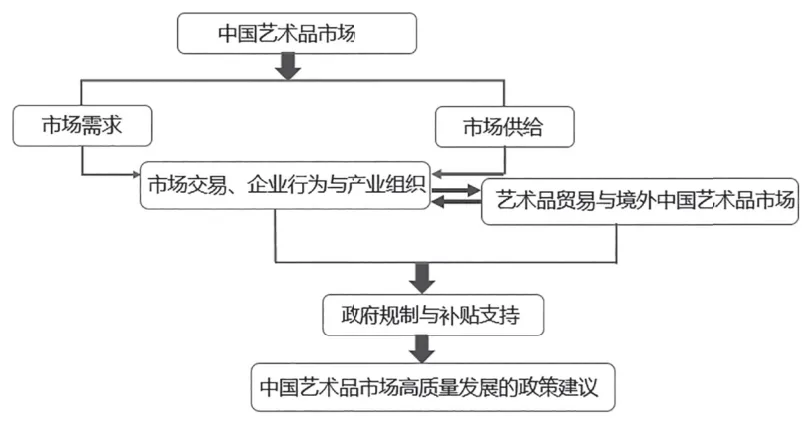
Professor Huang Jun (2021) believes that to build a theoretical system and research context for the art market, we can start from the perspective of economics and integrate theories and analytical methods from multiple disciplines such as art. This will help build a theoretical analysis framework for the art market and sort out its internal development logic. As can be seen from the above figure (Figure 5):
When we study the overall operation of the art market,We must start from the supply and demand relationship at the bottom, explore the degree, direction and duration of the impact of economic factors on the supply and demand of the art market, and make judgments based on the characteristics of the unique supply and demand structure of the art market;
Secondly, we can move up to the more macro level of market transactions, corporate behavior and industrial organization.Observe whether short-term supply and demand changes trigger long-term structural adjustments in the market;
In addition, although regional art markets have a certain degree of independence and entry barriers, the circulation of artists and works on a global scale makes it impossible for the art market to exist in isolation.The interaction between domestic and foreign art markets can sometimes explain the different responses of different markets to the same shock.
Finally, the cultural policies of the country and the government play an important role in macro-control of the art market..
1. Supply side
Broadly speaking, the art market can be divided into artists, collectors, collection institutions, handicrafts, designs and derivative product manufacturers, art business institutions, etc. according to the supply channels of artworks.Whether it is the direct producer of the artwork, the actual holder of the artwork, or the entrusting party of the artwork transaction, they can all use the existing market mechanism to choose different channels to put the work on the market when the market changes.
From the perspective of artists, although artistic production in the economic sense is constrained by wealth effects and income levels, the artist's creation is the result of inspiration, imagination and creative passion.Although the works are eventually presented in the form of commodities in the market, the artists’ creations are not entirely driven by monetary rewards, that is, the motivation for creation does not completely conform to market logic, which makes the artists’ response measures in the face of economic downturns more worthy of further study.. Focusing on the micro-creative state, the artist's education level, living conditions, creative techniques, style evolution, agency and income level are all objects that need to be studied; in recent years, topics such as gender issues and regional characteristics have gradually entered the researchers' field of vision. According to statistics, in the first half of 2024, the proportion of works by female artists in the collections of high-net-worth individuals increased to 44%, reaching the highest level in seven years, and the richer the collectors, the more they prefer works by female artists.
From the perspective of the overall market, the degree of coordination between the primary and secondary markets and the perfection of the value discovery function are important factors in determining whether the supply side of the art market can effectively respond to economic shocks.Taking the Chinese market as an example, the inverted structure between the primary market and the secondary market may increase the risk of price fluctuations, and short-term bubble expansion and value evaporation add uncertainty to investors.
A rise in art prices typically encourages living artists to create and collectors or institutions to release their works, leading to an increase in market supply; while a fall in prices will reduce supply accordingly.In terms of supply elasticity, the supply elasticity of the low-end market is usually higher than that of the high-end market. This phenomenon is due to scarcity.This also means that under the same degree of demand shock, the price fluctuations in the high-end market are greater.From a macro perspective, the supply elasticity of the art market is lower than the demand elasticity, and the demand side is more sensitive to price changes and economic shocks.This endogenous difference in supply-side and demand-side elasticity is an important consideration when analyzing art prices.
Today, as the art innovation model changes with each passing day, technological progress has greatly changed the way art is created, making the creation cycle of works more flexible. At the same time, the rise of new media has promoted the diversification of art marketing, and the traditional dealer model has also undergone profound changes under the supplement of multi-channel purchasing methods. These changes are profoundly affecting the supply curve and production function of the art market.
2. Demand side
According to the traditional definition,According to the purpose of purchasing artworks, we divide people's demand for artworks into three categories: collection, consumption and investment..
The art consumption market is mainly aimed at the general public and is the cornerstone for the art market to maintain its vitality and sustainable and stable development.
The collection and investment market mainly attracts middle- and high-net-worth individuals and institutions.
As the financialization of the art market increases, the art market has gradually transformed from an era dominated by private collections to corporate and institutional collections, which means that investment demand has gradually become dominant in the market.
From a macro perspective, the demand for artworks has multiple characteristics, such as high level, low frequency, sporadic and differentiated.The most direct manifestation of economic fluctuations on the demand side is that they affect people's willingness to consume and invest in art through their impact on personal income and wealth levels. We can use the "wealth effect" and "credit effect" to explain this transmission mechanism.
Along with the fluctuations of economic and financial cycles, in the economic downturn phase, wage levels decrease, social unemployment rate increases, financial market development cools, and the prices of assets held by people fall.
According to the consumption life cycle theory, the spending level of consumers and investors will decline as their wealth decreases and their pessimistic expectations of future income increase.At the same time, according to Maslow's "hierarchy of needs theory", when our economic level is not enough to support the high-level needs of self-realization such as improving our artistic accomplishments, people will retreat to pursue more basic physiological needs. This makes the demand curve of art appear inward and elastic in the case of shrinking social and personal wealth. Small price changes will cause drastic fluctuations in demand. This phenomenon is particularly prominent in the low-end art consumption market, because the wealth level of the audience in this market is most susceptible to macroeconomic fluctuations.
The credit effect mainly describes the impact of the bank's money creation ability on market liquidity and asset prices.During the economic downturn, the amount of hot money in the market decreases, and the decline in investors' willingness to invest reduces the amount of funds flowing into art asset allocation from the source.
Secondly, as mentioned above, if art is used as an asset to meet investors' needs for value preservation and appreciation,The unique risk-return structure of artworks and the relationship between artworks and other financial assets have become issues that investors need to consider when allocating assets during economic downturns.
The so-called "risk hedging ability" of different market segments and different types of artworks depends on the ability to improve the risk-benefit curve boundary by placing artworks in a basket of financial assets. This is the result of a trade-off between the wealth effect and the substitution effect. Sometimes, when the impact of an economic downturn comes, the enhancement of the substitution effect will cause investors to choose artworks with a better return structure and that are temporarily not affected by financial risks to improve their asset allocation structure. This also explains to a certain extent the short-term countercyclical characteristics of art assets in some studies.
3. Market structure
Changes in the market environment, fine-tuning of policy directions and changes in market structure usually bring about more macro and profound impacts. Starting from the industrial organization model, the art industry chain includes production, marketing, appraisal, valuation, circulation, transportation, storage, copyright and other operational links (Huang Jun, 2021). The heterogeneity of artworks and the prevalence of private transactions lead toSmall and micro enterprises account for a high proportion of the market, and most of them maintain their daily operations through specialized, customized and personalized service and management models. On the other hand, the concentration of galleries, art fairs and auction houses is very high.
Head enterprises are strong in academic research, marketing communication, appraisal and valuation, warehousing and transportation, etc. Their perfect operation mode, high-quality customer resources and strong market power have led to more and more resources tilting towards head institutions. High-priced artworks generally come from well-known galleries, fairs and auction houses, and art masterpieces are highly monopolized.
The inherent information asymmetry of the art market makes it easy for consumers and investors to accept information guidance from industry leaders. This "herd effect" further causes the market to become hierarchical, with large tops and small bottoms, and an unstable foundation. At this time, bottom-level dealers represented by galleries are easily affected by economic downturns and find it difficult to continue.
According to the 2024 Art Basel and UBS Global Art Collection Survey, high-net-worth individuals have shown a strong willingness to cooperate with new galleries.88% of HNWIs purchased works from at least one new dealer in the past yearIn 2024, respondents purchased works from an average of 17 galleries, significantly higher than the 13 galleries in 2019 before the pandemic. Combined with the difficult operating conditions of galleries in many parts of the world in recent years and the frequent rectification and changes, the reasons behind collectors' constant change of purchasing channels can be seen.
From the perspective of the structure of market entities, the interactive relationship between the art market's demand, supply, services, and transaction intermediary platforms (private markets, galleries, art fairs, auction houses, e-commerce, etc.), the industrial chain, and the circulation chain constitutes the art ecology. Macro factors such as economic development patterns, cultural policy environments, mainstream values, and social trends mostly change the supply and demand structure of the art market in the medium and long term by acting on the demand side.
Art collectors of the same generation tend to form similar subject structures under the influence of similar times and social environments. The changes in the wealth levels, collection tastes, behavior patterns, and market-leading capabilities of art collectors of different generations can usually dominate the development trend of the art market over a long period of time.
Therefore, when the cyclical adjustments in economic development are sufficient to affect market players, led by high-net-worth collectors, our analysis of the impact mechanism and path of action must go beyond short-term supply and demand fluctuations and rise to a higher dimension.
In history, the emergence of new wealthy groups caused by wars and changes in social production methods is often accompanied by profound transformations in the art market. According to statistics, as of now, about 91% of high-net-worth collectors worldwide have inherited artworks, and 72% of them will choose to continue to keep these works. Most of the ones they sell are not due to changes in aesthetic preferences.This means that the overall collection tastes of high net worth individuals will remain basically stable for at least the next twenty years due to the inheritance of family wealth.
At the same time, in 2023, compared with Generation X, young high-net-worth individuals represented by Millennials and Generation Z showed a clear downward trend in art spending due to the impact of economic fluctuations during the epidemic.From this, we can see that it will take some time for this generation of collectors to grow into the backbone of the art market.
4. Circulation between markets
In today's highly developed globalization, the profit-seeking nature of financial capital will make art works and investment hot money transcend geographical barriers and go to the global market to seek excess returns. Prior to this, the economic downturn and the current situation of deep adjustment in the art market discussed in this article are overall trends over a period of time. This does not prevent the "local prosperity" phenomenon caused by the flow of funds between different regional markets during this period. This is also one of the important reasons for the differentiation of art market characteristics and different development frequencies in different countries and regions.
The factors that affect the cross-regional and cross-border flow of artworks mainly include: economic development, level of openness, price and exchange rates, import and export tax rates (such as free ports or free trade zones), cultural distance, institutional differences, scientific and technological levels, and the laws and regulations of various countries on the entry and exit of cultural relics and artworks.
When studying the regional market and the internationalization of local artists, it is necessary to focus on the following points:
The first is the geographical distribution characteristics of artworks in important global markets, exploring the evolution of the internal circulation and external expansion of the core market;
The second is to deeply explore the differences in the acceptance of artworks in different markets, analyze the needs and preferences of buyers and sellers in the domestic and foreign art markets, and find potential development opportunities;
The third is to study how the financial benefits and spiritual returns of art investment influence the flow of funds and changes in aesthetic trends in the global market.
According to Artnet's 2024 Art Market Semi-annual Report, there are still significant regional differences in the global art market. New York remains the primary market for post-war and contemporary art, and high-priced segments of all genres mainly exist in the New York market; London is the center of ancient masters; Hong Kong is a hot spot for decorative arts; Paris continues to benefit from Brexit, with moderate price growth, and auctions and galleries maintaining relatively stable cash flow.
The differences in characteristics between these regional markets are not only the result of the historical evolution of the art markets in different countries, but also an important reference for the future direction of capital and artwork flows in the context of increasing economic uncertainty.
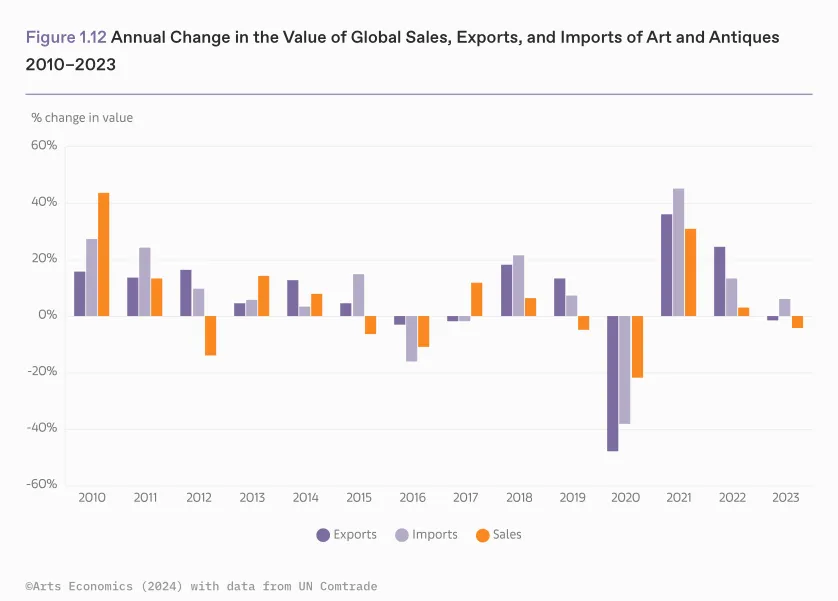
Combined with the data from the "2024 Art Basel and UBS Global Art Collecting Survey Report", with the decrease in global art sales, the growth of global art imports and exports in 2023 also slowed down, and the number of countries participating in the international art trade also decreased. The growth rate of total imports slowed to 6%, while exports showed a slight negative growth (down 1%). Although this change is relatively mild compared to other industries, it still shows that the art industry has also been affected to a certain extent by the anti-globalization trend caused by economic uncertainty (Figure 6).
Specifically for core countries and markets,The United States remains the world's largest importer and exporter of art, mainland China's art exports fell sharply by 48% in 2023. This performance is particularly worthy of our attention given the general growth of Asian countries' international market share, because to a certain extent it illustrates the shrinking external demand for Chinese art. In comparison, the scale of art imports and exports in Hong Kong, China has been expanding year by year.
5. National and government policies
As an important area where culture and economy are intertwined, the prosperity and development of the art market are deeply influenced by national and government policies.The impact of relevant policies mainly plays a positive role in the development of the art market from four aspects: regulation and guidance, financial support, market environment optimization and promotion of international exchanges.When the market faces downward pressure, the support of policies can effectively ensure that the long-term positive fundamentals will not be shaken.
Policy guidance is the core driving force for the development of the art market. The state and the government have formulated a series of laws, regulations and policy documents, which not only provide a clear development direction and regulatory framework for the art market, but also provide strong support for its adaptation to the market economy environment. By supervising and supporting the art industry, the government can enhance cultural identity and cohesion, maintain market order, and establish an intellectual property protection mechanism, thereby promoting the healthy development of the art market.
Financial support is an important guarantee for the prosperity of the art marketArt creation and art transactions often require a large amount of capital investment, and the financial support of the state and the government plays a vital role in this regard. The government provides financial guarantees for art creation and art transactions by establishing art funds, providing tax incentives, subsidies and tax cuts, etc., attracting more social capital to enter the art market, thus forming a diversified investment pattern.
Optimizing the market environment is the key to the healthy development of the art market and an important goal of policy guidance.The state and the government have created a favorable market environment for the art market by strengthening market supervision, improving the market system, optimizing tax policies, and strengthening the integrity of the art market. This not only reduces the tax burden on the art market, but also effectively combats counterfeiting and shoddy activities, maintains market order, and provides a strong guarantee for the prosperous development of the art market.
Promoting international exchanges is an important way to expand the art market.In the context of globalization, the internationalization trend of the art market is becoming increasingly obvious. The country and the government have provided a broader development space for the art market by organizing international art exhibitions, promoting cross-border art transactions, and strengthening exchanges and cooperation with the international art market. This can not only promote the internationalization of the country's art market, but also enhance its international influence and competitiveness.
Therefore, during the market downturn, the state and government should continue to strengthen policy support and guidance for the art market, improve the relevant policy system, and provide strong guarantees for the continued prosperity and development of the art market. At the same time, all parties in the art market should also actively respond to national policies, seize development opportunities, and promote the prosperity and development of the art market.
Author: Qi Hongyi
School of Art Management and Education, Central Academy of Fine Arts
Master's degree in Arts Business Management
Source: CAFA Art Business Management Studio
The pictures of the works and the key content are all editors' notes.
Please continue to follow ArtPro for more latest developments in the global art market.