
Exhibition site | Wang Xiangyang & Hu Jiebin's double exhibition "Evolution" re-understands how lacquer can be contemporary

Yan - contemporary lacquer language by Wang Xiangyang and Hu Jiebin
Driving from Yuting Road in Chenghai to August Lake Road in Nanchang, I crossed the three provinces of Guangdong, Fujian and Jiangxi, and passed through various dialects and time in dialects. The landforms and landscapes were reflected in the various prompts of the navigation and in the emotion of speed limit. Unfolding one by one, the fragments of regional cultural memories emerge and disappear behind at certain moments, which prove the historical existence of the passing places, remind the differences of one's own cultural background compared to another region, and empirically outline a specific social life. modality and the framework for subsequent dialogue. This self-drive became a metaphor because of the theme of the exhibition.
Wang Xiangyang and Hu Jiebin belong to two generations in an intergenerational sense, both are engaged in the contemporary creation of lacquer art and have gained a lot. They have many common points and areas of intersection at the technical and ideological levels.From the historical background and language memory of lacquer, they explore ways to deeply connect with current cultural issues and carry out personalized and effective transformation in creation.This premise makes it possible to present the works of two generations together and create a profound dialogue. In the scene where they are mirror images and reference to each other, the topic "How can lacquer be contemporary?" was generated and further discussed. The works have become two prominent cases in the topic. At the same time, these two paths have expanded more possibilities and various problems that lie between the possibilities.
"The primitive and simple ontological language of lacquer seems to reveal the original way of existence of the world, and also embodies the realm of the 'invisible elephant'. This prompted me to re-understand the concepts of lacquer properties and space, as well as the relationship between lacquer properties, physical properties and cultural forms. relationship between. At the same timeThe extreme development of modern human civilization has also given lacquer a new artistic mission.Facing the world and the universe, how do human beings integrate in the vast and boundless world and how do they follow nature?The deep expressive art of lacquer is also the best choice for me. "Wang Xiangyang said,This proves his perception and trust in the profound historical heritage of lacquer. At the same time, he also found the best place and technique to express his personal life perceptions and emotions in the "lacquer nature". Move by faith, be humble by love.
Wang Xiangyang’s works are always full of fiery emotions, in the repeated painting and polishing, in the intersection and replacement between the inside and outside, the hidden emotional scale is delicately and accurately presented.The new work "Gap" reveals the common reality that contemporary society is anxious, impetuous and cramped due to the worship of capital.——The representation of the mutual collision of information and interests is transformed into dense brushstrokes and color blocks. The quality-rich paint liquid is glued and entangled. The pitch-like brushstrokes and the gossamer-like gaps between the brushstrokes retain only a little sense of distance. Imagine that the tension of the brushstrokes makes the picture full and full of overflow, warning of the danger of implosion. andAnother new set of works, "The Extension of Ignorance" is more abstract, an unnamed object rises from the solidified image, like growth or explosion, and the cracked time and space is solidified at the moment when the lacquer stops flowing. After Wang Xiangyang moderately broke or misplaced the language paradigm of lacquer, he gained a new dimension of technical expression, and his concepts are quite inspiring.Wang Xiangyang's works retain the spiritual background and formal sense of the idealism of the people born in the 1960s, and are filled with a strong atmosphere of mysticism.Use abstract language to express confusion and reflection on the representation of reality. At the same time, it also retains the inspiration of the lacquer language in the creative process and the surprises brought by the flash of inspiration inherent in the physical properties.
Late spring this yearHaving just finished his solo exhibition "Anti-Ding Qinhe" at Shanghai Powerlong Art Center, Hu Jiebin further clarified his relationship with lacquer, which clarified the relationship between him and his works, just like the exhibition "An Ding Qin He" was dedicated to his father. He found the emotional fulcrum of his art from the tradition of respecting heaven and loving benevolence in his hometown, that is, the local giving For him, creation is like a kind of induction. Each work is a hometown, and this kind of "psychic" style of inspection and creativity is the appearance of respect and control. performance.
Lacquer has been the "image of a temple" that connects heaven and earth since ancient times. Its characteristics of constantly changing with the migration of time and space correspond to the logic of Jie Bin's creation, and there is a certain sense of fate and self-consistency that "it must be this way".In his new works "Pulse" and "Words Pulse" series, while retaining the "doorway/monument" image of his previous works, he also implanted more subtle thoughts and prayers for divinity., the language is elegant yet simple and profound. All kinds of details can withstand all kinds of scrutiny and taste. The work is named with the word "mai", which not only reveals Hu Jiebin's respect for the traditional lacquer language, but also hints at the underlying subtext of bloodline and family persistence.Hu Jiebin retains the broad cultural vision and sensitive talent for information acquisition that he was born in the 1980s, and retains the balance of tradition and innovation in his relaxed and relaxed atmosphere.Inspired by the local divinity, Hu Jiebin is both persistent and detached from the world, and his open-mindedness of being awe-inspiring and indifferent gives Hu Jiebin a sophistication that his peers do not have.
Art on the timeline, in the constant shifting of coordinates, in the transformation of the positions of the referrer and the referent, what happens and what does not happen are all problems and challenges. "Carving a boat to find a sword" is a methodology and a fallacy, but the world I often look at the people and things around me with a still gaze. The same is true for art. If one stagnates or stops observing and criticizing, it will inevitably result in a lack of cognitive dimension and exploration, and will inevitably lead to emptiness or intolerance. Works are born from problems, and problems may arise. The pain and accidents in any creation often herald one or several new beginnings. People who are afraid of change are often a manifestation of inner courage. The practice at each stage is a cocoon. and breaking the shell, practicing the dialectics of breaking and establishing, moving and keeping. The exhibition is named after the word "yan", which is a kind of self-encouragement and informing in the face of life, possibilities and possibilities.
Sun Xiaofeng
Completed in Fuzhou/Chenghai in the autumn of 2023
Exhibition site


Exhibition artworks

Wang Xiangyang Dojo 90×60cm×4 Wood panel lacquer painting 2023

Wang Xiangyang Gap 200×200cm Wood panel lacquer painting 2023

Wang Xiangyang Blue Thread 100×130cm Wood Paint Painting 2018

Wang Xiangyang Chinese Garden 90×120cm Wooden Board Lacquer Painting 2018

Wang Xiangyang The Extension of Ignorance 40×60cm Paint on wood board 2023

Wang Xiangyang Wild Power Series 2 31×39cm Lacquer painting on paper 2018

Hu Jiebin Pulse Series 2 120×160cm Lacquer, Tile Gray 2022

Hu Jiebin Trace Series 1 52×78cm Straw paper, lacquer, tile gray 2023

Hu Jiebin Trace Series 2 52×79cm Straw paper, lacquer, tile gray 2023

Hu Jiebin Pulse Boundary 1 53×80cm Straw paper, lacquer, tile ash 2023

Hu Jiebin Pulse Boundary 2 53×80cm Straw paper, lacquer, tile ash 2023

Hu Jiebin Pulse Series 1 52×68cm Straw paper, lacquer, tile gray 2023

Hu Jiebin Pulse Series 4 52×69cm Straw paper, lacquer, tile gray 2023

Hu Jiebin Silence Series 4 24×33cm Straw paper, lacquer, tile gray 2023
ARTIST

Wang Xiangyang
He is currently a director of the Chinese Artists Association, deputy director of the Lacquer Painting Art Committee of the Chinese Artists Association, vice chairman of the Chinese Sculptors Association, former chairman of the Jiangxi Artists Association, and a professor and doctoral supervisor at Nanchang University and Jingdezhen Ceramics University.

Hu Jiebin
Graduated from Fuzhou Arts and Crafts School. Currently working and living in Fuzhou. Since 2017, I have been thinking about re-deconstructing my relationship with the culture of my hometown. While using lacquer as a medium, I have also given it more applications and concepts.

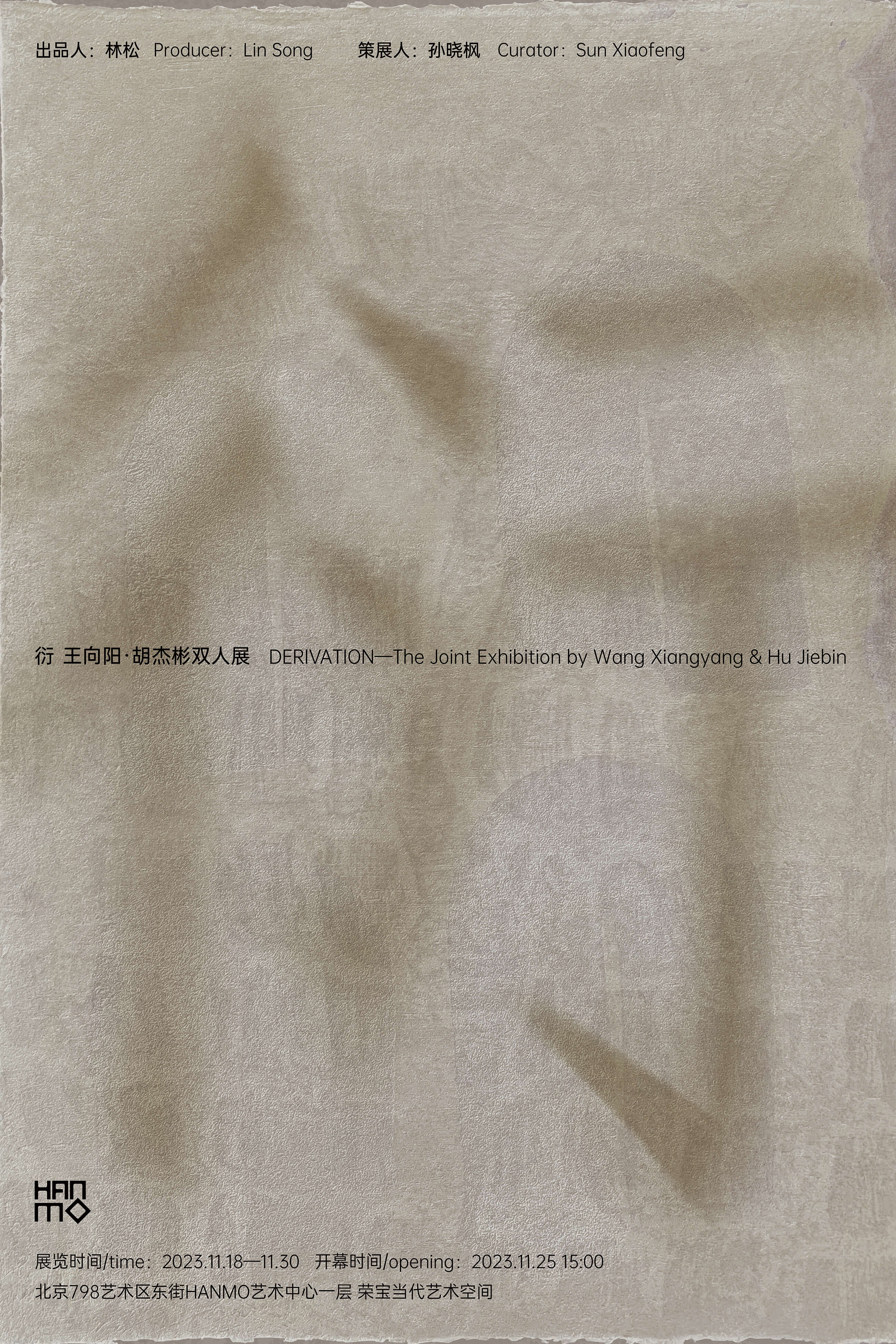
Producer:Lin Song
Curator:Sun Xiaofeng
artist:Wang Xiangyang, Hu Jiebin
Exhibition time:2023.11.18—2023.11.30
Opening time:2023.11.25 15:00
address:Rongbao Contemporary Art Space, 1st Floor, HANMO Art Center, East Street, 798 Art District, Beijing
Please stay tuned to ArtPro for more updates on the global art market.