
Endless Life: Shao Fei’s Dream
Shao Fei participated in the "Stars Art Exhibition" from 1979 to 1980, which symbolized the beginning of China's modern avant-garde art. Deep in her heart, she always nurtured the life consciousness that artistic creation should grow freely. At the beginning of reform and opening up,Shao Fei is exploring the courage to draw on the language and form concepts of Western modern art to create Chinese modern art that incorporates Chinese texts and ideas.. Shao Fei finds resonance in the art of Miro, Picasso and Pollock. Their paintings are simple, direct and passionate. They are art from the inside out and from the heart, and are great creations surging with endless vitality.
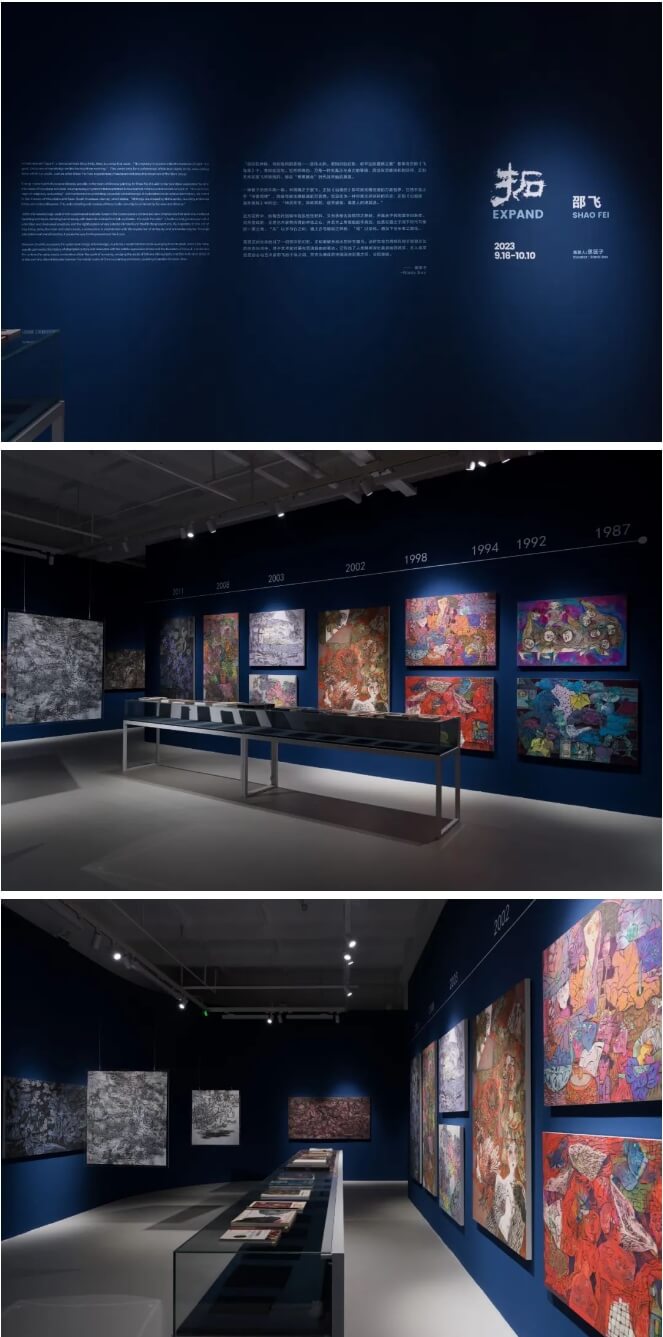
Compared with realistic paintings, Shao Fei feels the primitive power contained in art in these paintings full of imagination, creativity and expressiveness. This is a kind of painting that can get rid of rationalism, pragmatism and historicism and re- The artistic thought of returning to the consciousness of life will. ShaoFei began to draw nourishment from folk art such as paper-cutting, New Year pictures, and clay figurines, and sought inspiration from unearthed Neolithic carvings and other painted pottery patterns. He discovered creative motifs from ancient texts and illustrations, and gradually created his own unique path to modern art.
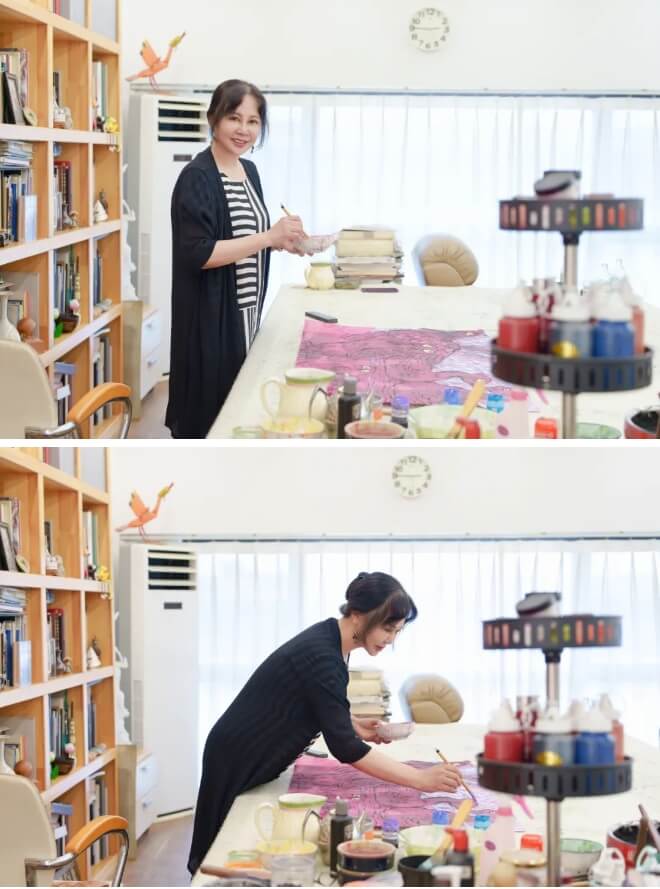
"Go to the people" was one of the resounding slogans of the May 4th New Culture Movement, andPaying attention to the study and absorption of the influence of Chinese folk art and ancient art began in the 1930s and 1940s, especially the art of the Yan'an period, in order to create works of art that are popular among the military and civilians,Jiang Feng, Ai Qing, Gu Yuan, Yan HanArtists have gone deep into life and created a large number of prints that incorporate folk art language forms and aesthetic concepts. Returned from studying in FrancePang Xunqin, Lei GuiyuanCollecting ancient decorative patterns and investigating folk art in the southwest ethnic areas, affirming the value of folk art and gradually introducing it systematically into modern art education.Guan LiangIn creating new themes from traditional opera art, it influenced laterLin Fengmian.
After the founding of the People's Republic of China, fruitful results were achieved in promoting the collection, display and research of folk art at the national level, and launched new art forms such as New Year pictures, comic strips, and peasant paintings. After the reform and opening up, Western modern art trends were introduced, and many artists realized the special value of folk art. It seems that it can be directly grafted with Western modern art in terms of language and concepts, thereby realizing the transformation and reconstruction of Chinese modern art.Zhou Shaohua, Yang Xianrang, Yuan Yunsheng, Lu ShengzhongArtists are receiving nourishment from folk art, among whichLu ShengzhongThey also wanted to explore a new path in folk art by "learning from the folk, loving the folk, using the folk, transforming the folk, leaving the folk, and returning to the folk." They felt the folk art in the paper-cut works of Ku Shulan, Gao Fenglian and other folk artists. The image of endless joy and endless life emerging from folk art.
Shao Fei began to create paintings with the theme of "The Classic of Mountains and Seas" in the 1980s. Compared with the discovery and excavation of folk art in the previous half century, he research-basedly constructed the independent development of the Chinese folk art discipline.She focuses on integrating folk myths and legends, strange stories with Western modern artistic concepts.. Shao Fei did not pay attention to the witchcraft and spiritualism aspects of folk art like her contemporary Lu Shengzhong. She was more concerned about the free growth of images presented in folk art. She was called "The dirt is just Suixincao"Such simple words deeply touched me.
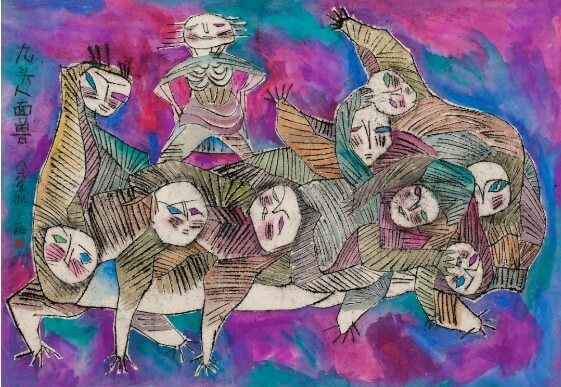
Shao Fei believes that among folk art works,It contains the most precious emotions that are true, pure, good and beautiful, and contains the infinite vitality that allows people and all things to coexist, grow, prosper and share together.. Just like the color and ink painting "Nine-Headed Beast with Human Faces" she created in 1986 based on the article "The Classic of Mountains and Seas: The Western Classic of Seas and Seas" "The body of an enlightened beast is generally like a tiger, and it has nine heads, all with human faces, facing east on Kunlun". The ink painting depicts the fantasy atmosphere of the background. The nine-headed human-faced beast is suspended in the air, with a humanoid elf standing on its body. Shao Fei used ink lines to depict the outline of the body of the nine-headed human-faced beast and the horizontal lines of the tiger stripe. Its form has the simplicity of the chiseling method of Yinshan rock paintings and the simplicity of paper-cut collage. The image is completely free and imaginary, and it is extremely Very imaginative.
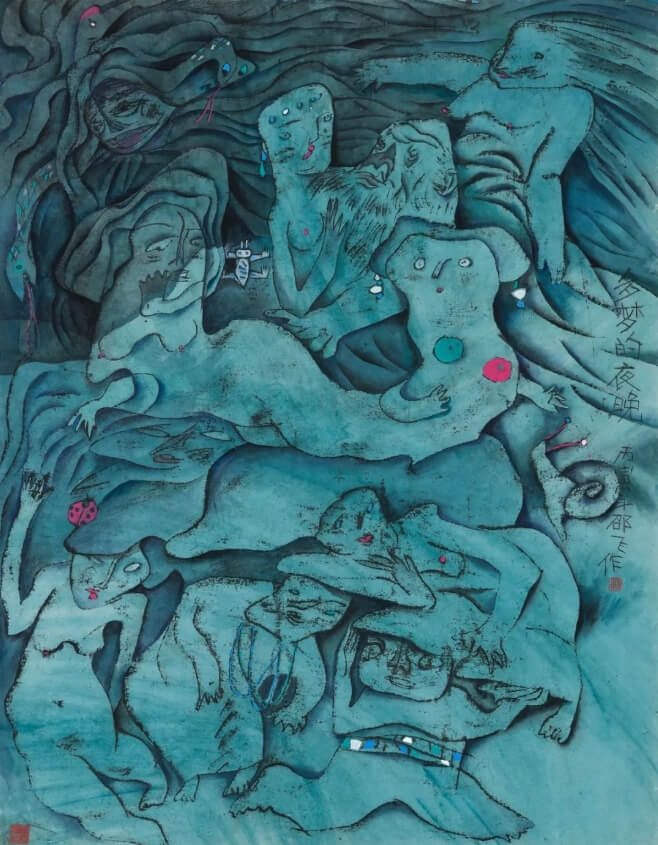
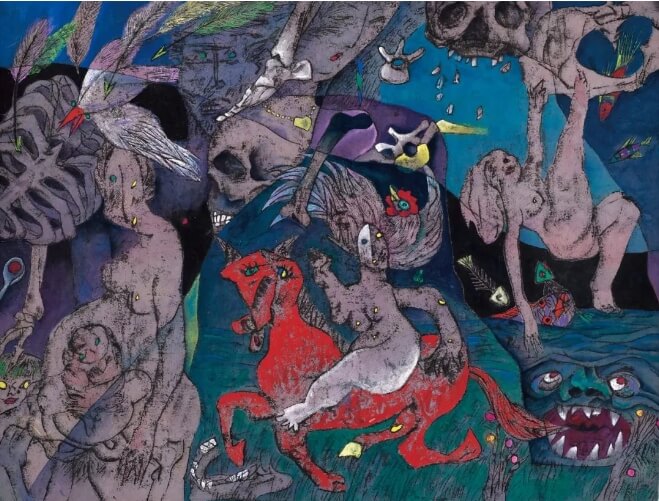
"Dreamful Night" created in the same year is different. Many inexplicable ghosts seem to be distorted by the black hole of time, just like the subconscious suppressed by the rational consciousness during the day described in Freudian psychology. , when he enters the dream, all the grievances, tensions, and uneasiness in his subconscious are released in the whirlpool, and he confides his grievances to the owner of the dream; another piece of "Life and Death" depicts the scene in the night. A naked girl running on a red horse, a mother and her son, a skeleton symbolizing death, and a water monster with fangs spread out. These paintings are not only inspired by the text of "The Classic of Mountains and Seas" or folk myths and legends, and stories of strange things, but also derived from Shao Fei's inner consciousness of pursuing the image of free galloping like "grass as one wishes". It should be said that Shao Fei tries to get rid of the existence of "I" in his creation, and enters into the state of "selflessness" and "blank", allowing the image to grow freely on the picture.
In the 1980s, while the field of Chinese cultural thought widely accepted Western modern cultural thought, it also "quasi-synchronously" accepted the influence of Western postmodernism theory, such as decentralization, deconstruction, etc. in postmodernism theory. Postmodernism The hybridity, anti-normativity and other characteristics of artistic presentation have greatly expanded Shao Fei's cognition. In other words,In the 1980s, Shao Fei discovered and explored new art and new expressions from ancient Chinese texts and images, from folk myths and legends, and texts and images of strange stories. This was a positive move that blended modernist and postmodernist artistic ideas and themes.. At the "Stars Art Exhibition" that Shao Fei participated in, there were many works created by non-professional painters. The core proposition is to express freely, reveal one's heart, and express what one knows, feels, and thinks, rather than shaping and expressing grandeur as in the past. Historical theme. In folk art works that are rarely paid attention to by professional painters in art academies, Shao Fei discovered the broad spatial dimension of the "Classic of Mountains and Seas" theme creation, which links the ancient and the modern, the traditional and the international, the modern and the post-modern. Shao Fei saw the great vitality of primitive art just like Gauguin set foot on Tahiti and Picasso discovered African wood carvings. She was deeply attracted by the texts and images of "The Classic of Mountains and Seas" and folk art, because these arts have not been influenced by modern civilization. What is free from stains and dogmatic disciplines are the relics of the cultural spirit of our ancestors.
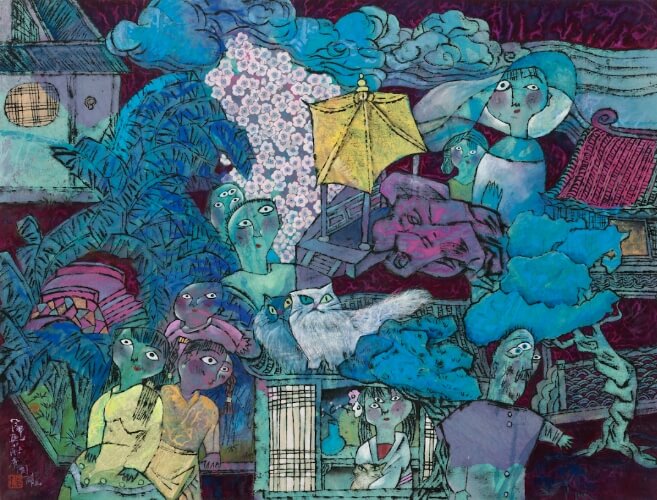
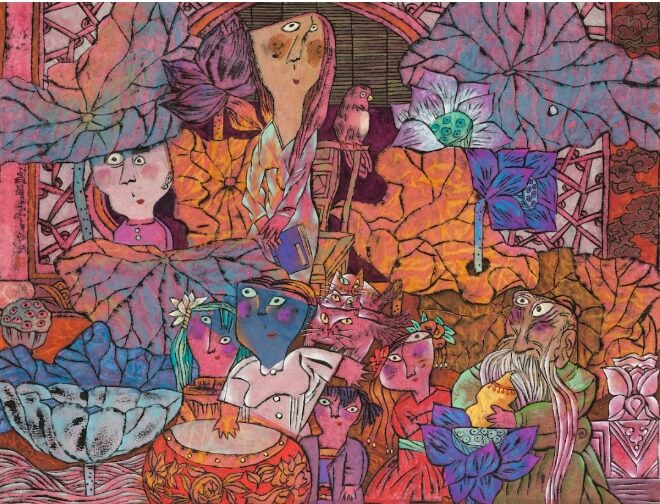
In the 1990s, Shao Fei created a series of color and ink paintings that integrated the imagery of home, such as "Old House", "Hospitality", "Sound of Reading", "Flower Drum", "Flowers Blooming and Fragrant All Around", "Free Wind" and "Summer" etc., depicts a woman living deep in a garden at night, accompanied by lotus ponds and birds. The gorgeous red tone like a New Year painting makes the whole picture change from quiet to noisy. As a female artist, Shao Fei's works seem to present a more complex visual relationship. The visual center of the picture is always a woman looking towards the viewer, making the viewer inevitably think that it is the artist's self-portrait. In other words, these home-themed color and ink paintings more or less incorporate the theme of female consciousness, which seems to be a metaphor for Shao Fei's state of mind during this period. Although these works do not include the exotic beasts in the "Book of Mountains and Seas" themed paintings, some humanoid "elves" can still be seen accompanying the mistress of the garden.The so-called visual center may not exist, and "she" is also a female elf living in the garden. This is obviously related to Shao Fei's understanding of "all things have animism" in his world view.
In the late 1990s, Shao Fei gradually weakened his home-themed creations and instead painted several color and ink paintings on themes such as genetic technology, the information age, and super-time and space.If home-themed paintings are more related to Shao Fei’s personal feelings, thenThe new paintings at the turn of the century were her new attempts to turn to broader new thoughts and concepts.. The color and ink painting "Information Age" created in 1997 seems to have absorbed the influence of Paul Klee. Shao Fei used geometric shapes to compose the picture. Some figures that look like robots or alien intelligent lifeforms stand in the city, their eyes The blue, yellow and white colors emitted when the electrical work indicator light is always on are neither frightening nor dull, but a sign of endless tranquility and harmony. "Time and Space Transformation" created in the same year also uses geometric shapes to form the theme of mother and child. Various images are intertwined with each other and fit the theme of the picture.
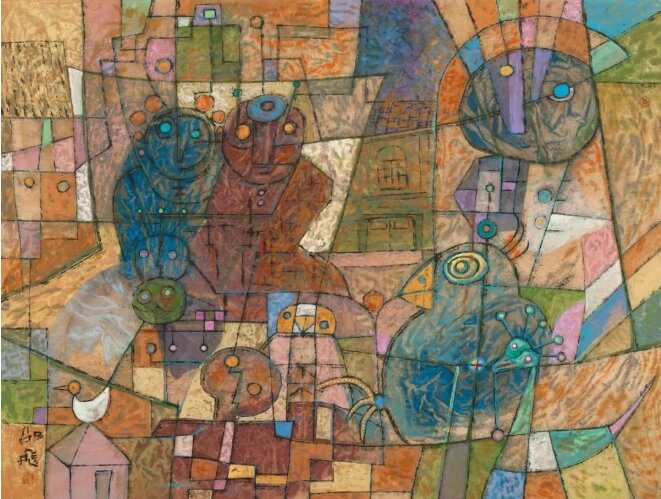
In "The Evolution of Species" created in 1998, Shao Fei reduced the straight lines of geometric shapes and replaced them with more expressive lines. More human and animal faces appeared on the screen, as if they came from ancient times. The ghost, its connection with the text of "Shan Hai Jing" is self-evident. "Symbol of Life" created by Shao Fei in the same year uses continuous lines to outline a layered and surrounding space and volume. The color red symbolizes the blood of life, which is a very special existence in his entire creative series.
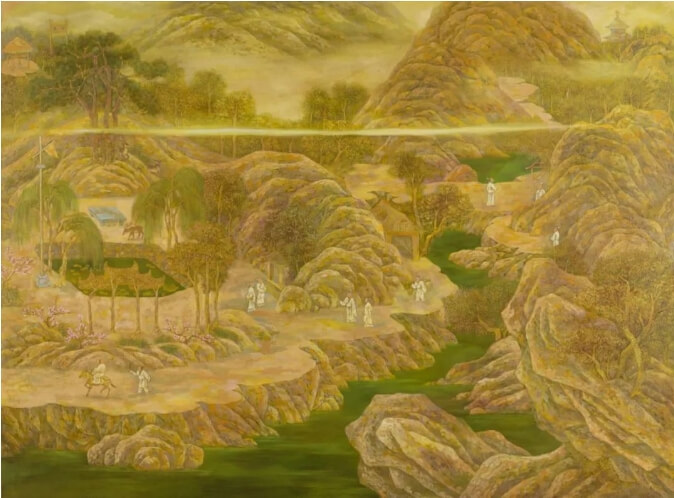
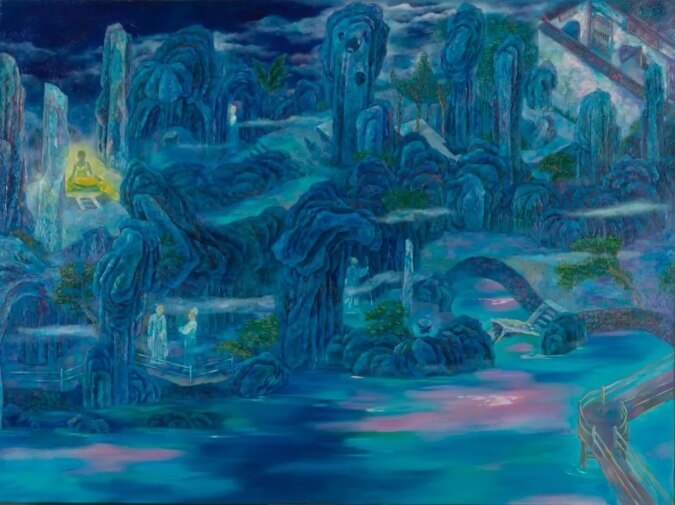
In 1999, Shao Fei began to create a painting 1.3 meters high and 78.75 meters long based on the long line-drawing woodcut scroll "Huancui Hall Garden Scenery" depicting the Zuoyin Garden built by Wang Tingna, the salt transport envoy of the Ming Dynasty, on the outskirts of Xiuning, Anhui.The long oil painting scroll "Dream Returning Home", a total of 45 pieces, was completed in 2013 and took 15 years to complete.. This large-scale painting is completely different from the previous ones in terms of language and form. Shao Fei appears in the painting many times in the form of a self-portrait, wearing a modern white dress. She expresses herself wandering around the Yin Garden in the form of a dream. scene. Obviously, this painting uses the form of a traditional Chinese painting scroll, which is very similar to Gu Kaizhi's "Ode to the Goddess of the Luo". However, the entire narrative does not unfold beside the Luo River, which symbolizes nature, but instead unfolds in the most characteristic Chinese culture. As the Jiangnan gardens slowly unfold, Shao Fei is not only a viewer who can take in the panoramic view, but also a traveler who can directly communicate with the people in the painting. She shows her interest in the social life of scholars relying on gardens, which symbolizes the highest form of Chinese cultural spirit. Yearning, which is related to both her experience of living abroad and the home-themed works she painted in the 1990s. Of course, "Huancuitang Garden Scenery" published by Huicui merchant Wang Tingna Huancuitang itself creates an ideal picture of the life of literati and depicts a beautiful paradise. Shao Fei integrated her self-narration into this picture book to create the long oil painting "Dream of Home", which embodies her return to the Chinese cultural homeland.
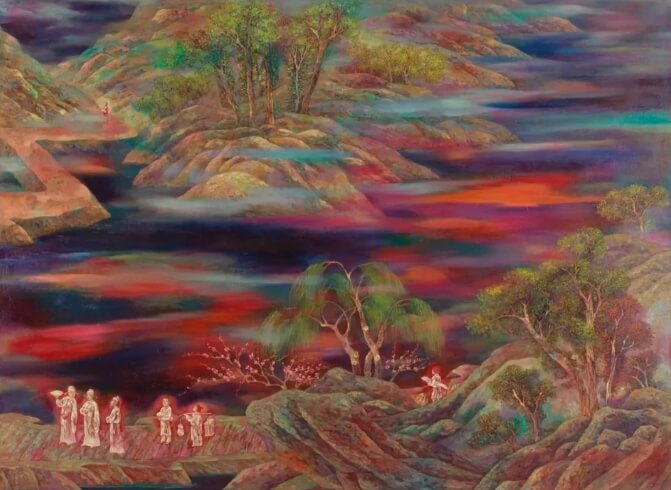
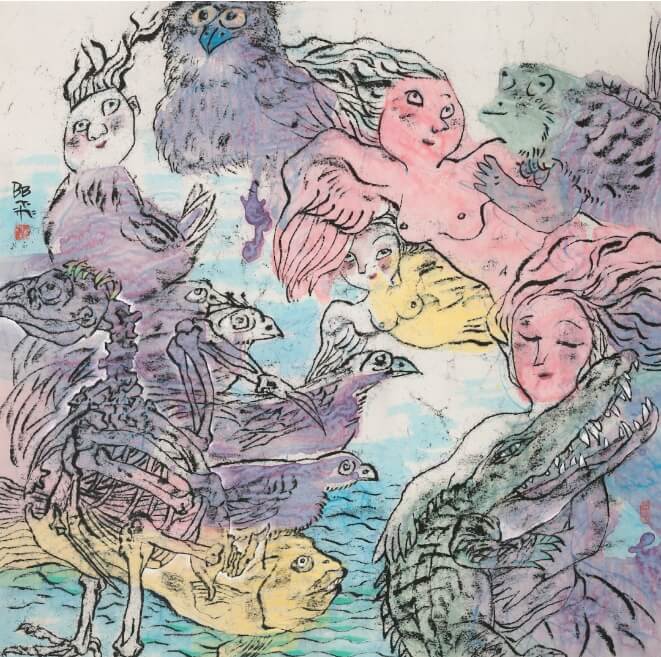
While devoting a lot of time and energy to the creation of "Dream Returning Home", Shao Fei has created a large number of color and ink paintings on the theme of "The Classic of Mountains and Seas" since 2000. It should be said that Shao Fei has never left two main threads in terms of creative themes, one is to build a spiritual home, and the other is to believe that all things are animistic. The latter is reflected in the creation of color and ink paintings on the theme of "The Classic of Mountains and Seas". In fact, many of Shao Fei's works are not named "Classic of Mountains and Seas", but in terms of modeling consciousness, they can be said to be a continuation of the title of "Classic of Mountains and Seas". During this period, Shao Fei's "Classic of Mountains and Seas" themed color and ink paintings tended to be visually complex, with women's bodies intertwined with images of various indescribable beasts, flying fish, and birds. These images may have come from "The Classic of Mountains and Seas" The text may come from folk art, or may be obtained from archaeological excavations of cultural relics from before the Han Dynasty. What is more likely is that these images are the integration of Shao Fei's various textual and visual experiences. She has become familiar with them and can pick them up at her fingertips, just like the flower-cutting lady Ku Shulan sings and cuts paper, all the images They are all born from the heart and inspired by feelings. Just like the clay figurine master said, "Clay products are just grass." For all the images of exotic beasts, birds and flying fish, Shao Fei almost no longer needs any visual reference, but can Outline whatever you want.
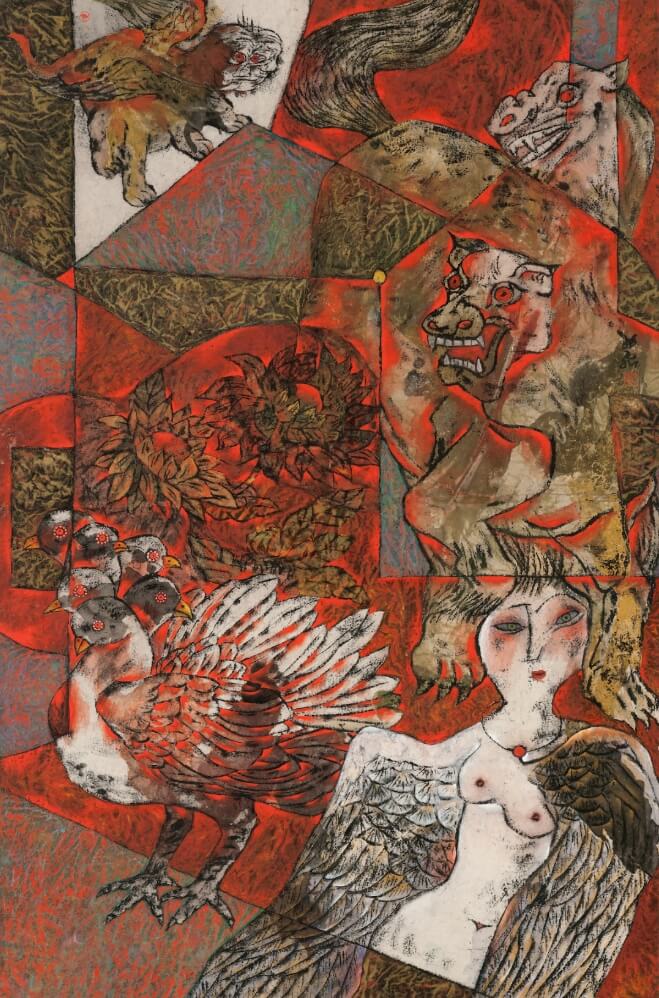
Compared with contrasting sketches with realistic paintings, Shao Fei is more conscious of the modeling consciousness when creating. These images are the elves that are latent in her heart, and what she wants to do is to make them not too realistic. Too noisy, find your place quietly. Some viewers may describe Shao Fei's creations as absurd. This is a complete misinterpretation.Shao Fei deeply loves these strange beasts, flying fish, and birds, as well as these elves and lives. She never thinks that they are absurd. They are the products of human spiritual freedom and the transcendent gains of human beings.Obviously, the female image in Shao Fei's "Book of Mountains and Seas" is her self-portrait. She rides these exotic beasts, flying fish, and birds among the mountains and seas, and she has become a close partner with them.
At this time, integrated into the works with the theme of "The Classic of Mountains and Seas", there are also some color and ink paintings showing the theme of mother and child, such as "Mother's Arms", "Little Bridge and Flowing Water", "Grooming", "In the Garden", "Love" and "Love". "The Kirin Sends a Child", "The Golden Cicada Announces Good News", etc. As a woman and a mother, Shao Fei used the images of mother and son to reshape the theme of "The Classic of Mountains and Seas" and merged it with the theme of home, forming a new creation with strong self-narrative characteristics. Mother and child are important creative themes shared by human civilization, especially in primitive art and folk art creations. The fertility and reproduction significance they symbolize is extraordinary. Whether it is African wood carvings or Chinese folk paper-cutting art, images of mothers and children abound. Shao Fei's creations also incorporate another idea, which is the integration and symbiosis of human beings and all things in the mountains and seas. Mother and son are symbols of all mankind. It is not difficult to understand that these paintings mostly depict images of flowers and birds, which are related to the traditional concept of metaphorical happiness and auspiciousness.
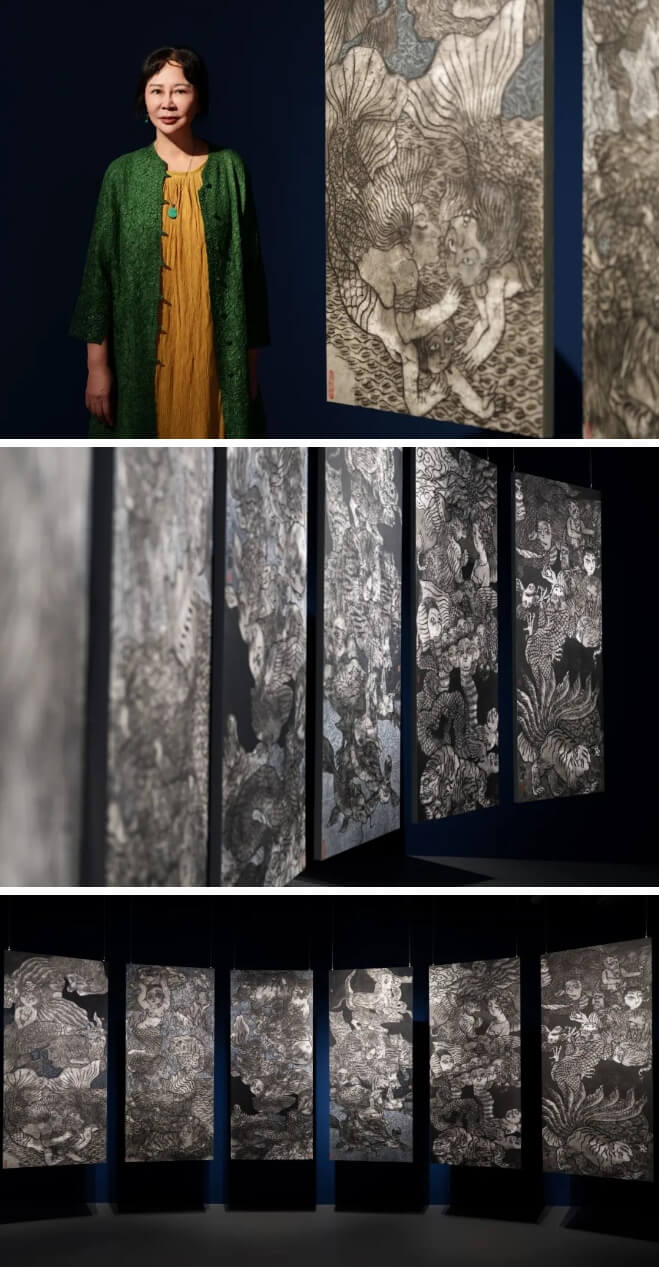
From 2008 to 2011, Shao Fei created a series of 8 color and ink paintings based on the "Materia Medica for Famine Relief" published by Zhu Rui in Kaifeng, Henan during the Yongle period of the Ming Dynasty. Li Lian said in "Preface to "Compendium of Materia Medica for Famine Rescue": "If you encounter a famine, you can ask for it according to the picture. It can be found everywhere. If you get it without difficulty, you can survive if you eat it according to the law. This book will also be of great help to people's livelihood. ." Shao Fei has focused on collecting folk texts and illustrations in her creations since the 1980s. "Famine Relief Materia Medica" has a more important value in her mind as a tool for rescuing disaster victims, hungry people, refugees, and refugees. and meaning. Shao Fei painted a crowd of people behind the plants that symbolized all living things and the people, thus expressing man's dependence on nature.
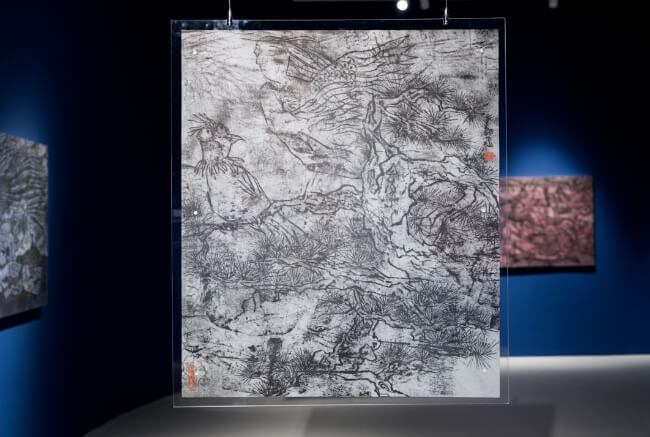
In the past three years, Shao Fei has mainly created the new "Classic of Mountains and Seas" series and the "Flying Birds" series.The latest "Classic of Mountains and Seas" series has toned down the previous noisy colors and instead focused on ink line sketches, pursuing a rich visual texture. The images of divine birds, flying fish, and strange beasts are more complex and detailed. It seems that It is closer to the text of "The Classic of Mountains and Seas". Nanji Erjing Mountain God with a bird head and a dragon body, Jumang with a human face and a bird body, a shark with a human head and a fish body, a dragon fish with a fish head and a dragon body and four legs, a fish with a bird head and a fish body, and nine human faces. The snake-body Xiangliu, the six-legged and four-eyed beaded frog fish, the eight-headed Tianhao with a human face and a tiger body and ten tails, the snake-holding Yu'er God, as well as feathered men, mermaids and other images fill the entire picture, presenting a It is a magical world landscape in ancient times. From the perspective of the exhibition format, by juxtaposing 6 paintings from the "Classic of Mountains and Seas" series created by Shao Fei in 2022, the audience can better feel that the magical world deep in Shao Fei's heart is presented in a way that gushes out and hits the face. .
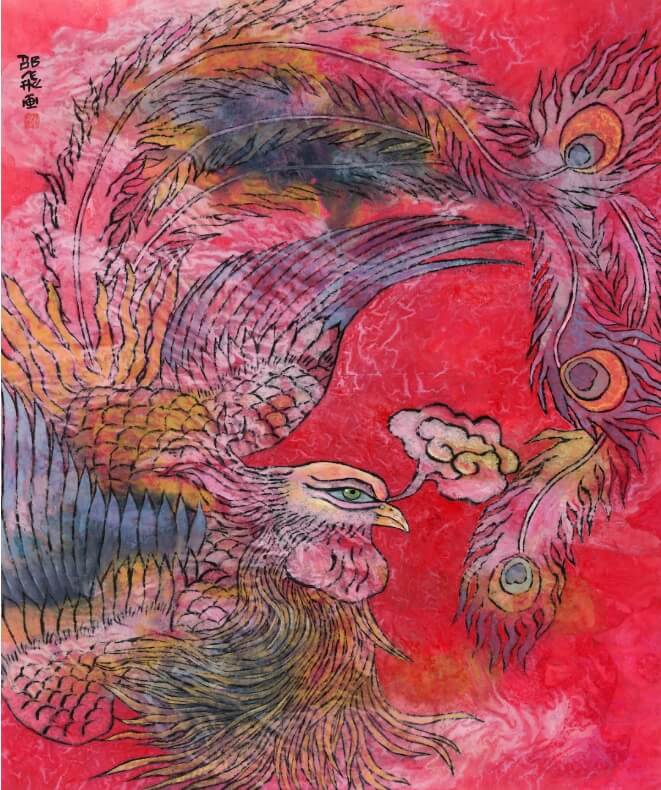
The new works present full shapes and formal tensions, and represent increasingly clear dreams lingering in the heart.Obviously, this is not a frightening nightmare, nor a ridiculous dream, but a summary of Shao Fei's continuous exploration of the original phenomena of the world deep in her heart, and she is awakening these sleeping ancient creatures. There is a fierce conflict here, which is the huge difference between these creatures in "The Classic of Mountains and Seas" and the visual landscape of today's real world. They have non-industrialized silicon-based bodies, but an anthropomorphic ancient carbon-based body. As we continue to use new technologies and new materials to transform the landscape of modern human civilization, these shapes that combine human and animal images also represent a reflection on modern civilization. As Shao Fei's burnt-ink language becomes more intense, its conflict with modern civilization becomes more intense. In terms of image and space, Shao Fei retains the visual characteristics of the map. She does not use these ancient creatures to narrate, but allows the viewer to look at them. These ancient creatures remind viewers of the origin of life, the theory of evolution, and also the forgetfulness and ignorance of human beings.
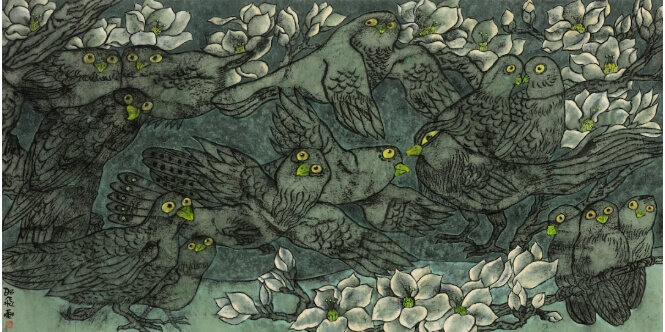
In addition to "The Classic of Mountains and Seas", Shao Fei created more "Flying Bird" series that are closely related to Yuren's beliefs.Flying birds symbolize auspiciousness, happiness, freedom, ascension and immortality in the history of Eastern and Western cultures. Shao Fei's "Flying Birds" series mainly depicts birds and flower branches, which evolved from the traditional flower-and-bird painting motif. By combing through Shao Fei's creations, we can see that the themes of "Flying Birds" and "Classic of Mountains and Seas" have been parallel since the beginning of his creation, but they are not as clear as in the "Classic of Mountains and Seas" series. The viewer may even mistake the paintings with the theme of "Flying Birds" Included in the "Classic of Mountains and Seas" series. For Shao Fei, there is no difference between the "Flying Birds" and "The Classic of Mountains and Seas" series, because they both share the symbiotic ideological value. Shao Fei expresses family, affection and blessings in the "Flying Birds" series, which can be seen in "Nurture", "Playing in the Lotus Pond", "Escort", "Departure Instructions", "Guardian", "First Flight", "Spring News", "Little Family", It can be clearly seen in paintings such as "New Life" and "Family". There are reunions and partings in the picture, which should be Shao Fei's sentiments when he was touched by life. At the same time, she also depicts freedom. For example, in "Let Go", she encourages birds to bravely escape from their cages and constraints and fly to a world where all things coexist. In "Rebirth from the Fire", she depicts the rebirth of a phoenix. Rise or perish in a bath of fire" corresponds to. There is no longer destruction here, but the ascent of life.
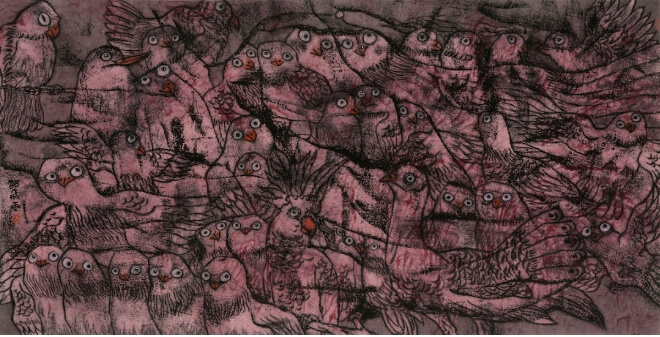
What is very special in the "Flying Birds" series are four paintings with the style of "night scene painting", "Returning to the Forest on a Summer Night", "Moonlight Night", "Magnolia Spring" and "Pear Blossoms with Rain".The moonlight or the flock of birds nestling in the morning light show the warmth of a big family. Especially in "Returning to the Forest on a Summer Night" and "Moonlight Night", Shao Fei uses burnt ink and thirsty brush to outline, chafe and stippling, which are closest in language to the new "Classic of Mountains and Seas" series of paintings. Shao Fei first sketches the bird with almost random ink lines, and then "finds" the form of the bird in the space between these lines, as if it "emerges" independently, a fusion of carefree brushstrokes and painstaking work. This is an important method for Shao Fei's artistic creation, which is the combination of sensibility and rationality, virtuality and reality. These pictures that look simple and lush from a distance but are gorgeous when you look closely, seem to be rubbings from ancient stone tablets. Their artistic brushwork and shapes are the interpretation of the images from the heart. The "Flying Birds" series is an extension of Shao Fei's "Classic of Mountains and Seas" series. If the "Classic of Mountains and Seas" series is a metaphor for the call to ancient creatures, then the "Flying Birds" series is the expectation of reality or the future world of harmony and symbiosis.
Looking back at Shao Fei's artistic career of more than 40 years from 1979 to the present, we can find that Shao Fei has always adhered to the creative consciousness of individual freedom.She grew up nourished by classical texts, folk art and Western modern art. She cherishes all life and believes that all things have animism, especially the creativity and vitality of folk artists.She believes in the free will of life, and "it's all about what you want." Art should lead people to freedom, not restriction. Shao Fei has not changed her original intention, and she has always shown the face of Chinese culture to others. This is the ultimate proposition put forward by the Chinese modern art trend of thought in the 1980s, which is to construct the subjectivity of modern Chinese art. Shao Fei's artistic thought incorporates a strong female consciousness and embodies infinite emotions. Her creations are gender-specific. At the same time, Shao Fei's art also has the spiritual state of "heaven and earth coexist with me, and all things are one with me", which is his innate heart of compassion and care.
——Wei Xiangqi
(Research Librarian, National Art Museum of China)
September 2023 at Xiyuan, Heping Street, Chaoyang District, Beijing