
[2026 Spring Auction] A God-Tier Lineup ✨ China Guardian Modern and Contemporary Art Auction: Zao Wou-Ki, Qiu Di, and Zhou Chunya Lead the Way, Beijing Auction on May 11th
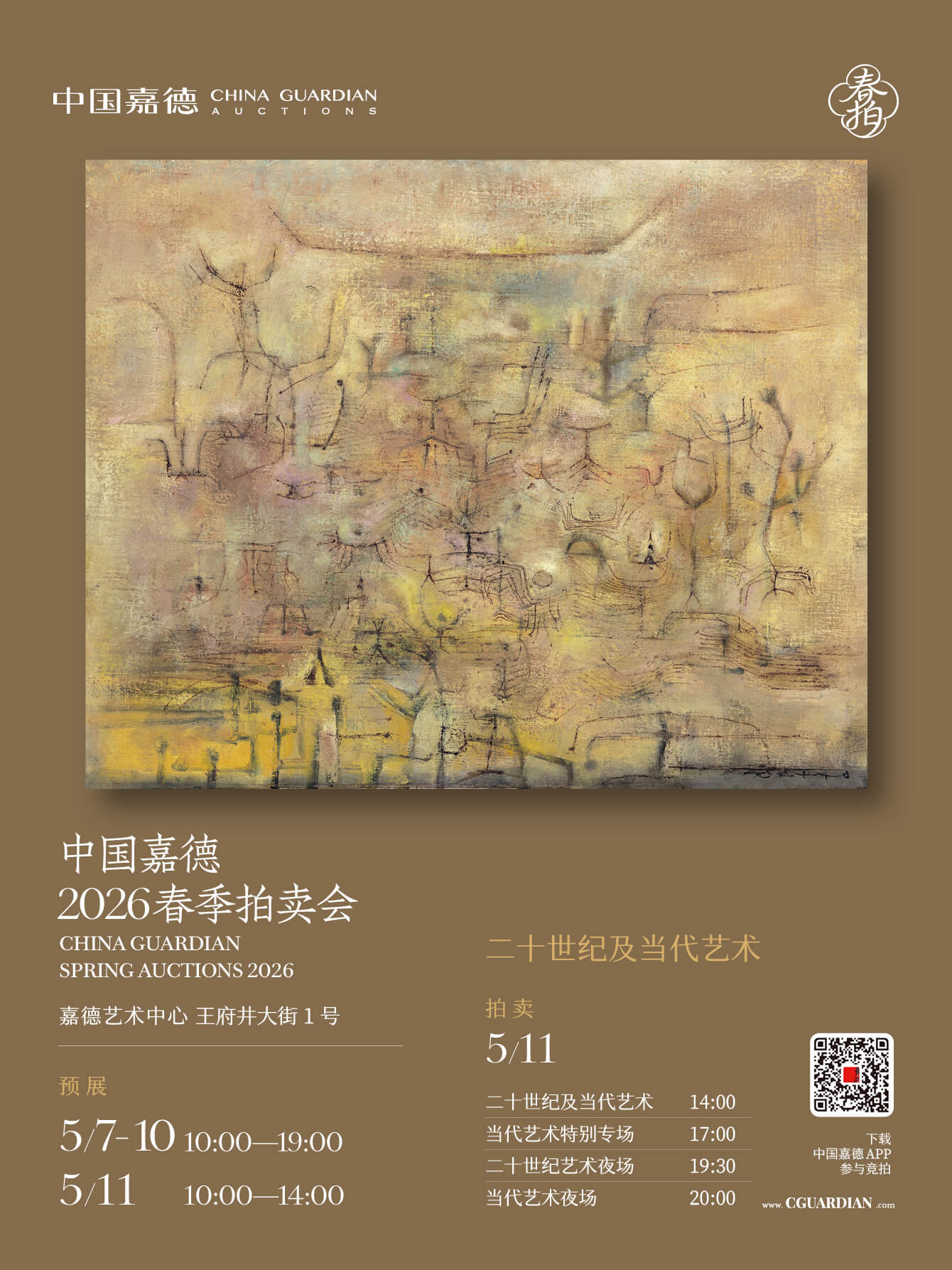
Spring breezes herald a new era for art. China Guardian's 2026 Spring Auction features four specialized sales of Modern and Contemporary Art.A preview will be held at the Guardian Art Center from May 7th to May 10th, and the auction will officially commence at the Guardian Art Center on May 11th.The special exhibition takes the roots of Chinese culture and social narratives as its core thread, selecting milestone works by 20th-century pioneers and benchmark works by contemporary masters, stringing together a spiritual map with modern and contemporary art as its carrier, and outlining a century of cultural heritage.
From the modern translation of Eastern aesthetics to the intertwining of individual destiny and the tides of the times, and then to the contemporary reconstruction of traditional symbols, the evening shows build a dual high ground for both academia and the market with heavyweight masterpieces.
This is not only an auction featuring a collection of exquisite pieces, but also an in-depth exploration of the identity, social memory, and spiritual evolution of contemporary Chinese art and culture, presenting collectors with a feast of art history and contemporary significance.
I. Pioneers of the 20th Century: The Beginning of Cultural Heritage and the Fusion of East and West
• Zao Wou-Ki, *14.12.62*, *In the Botanical Garden*
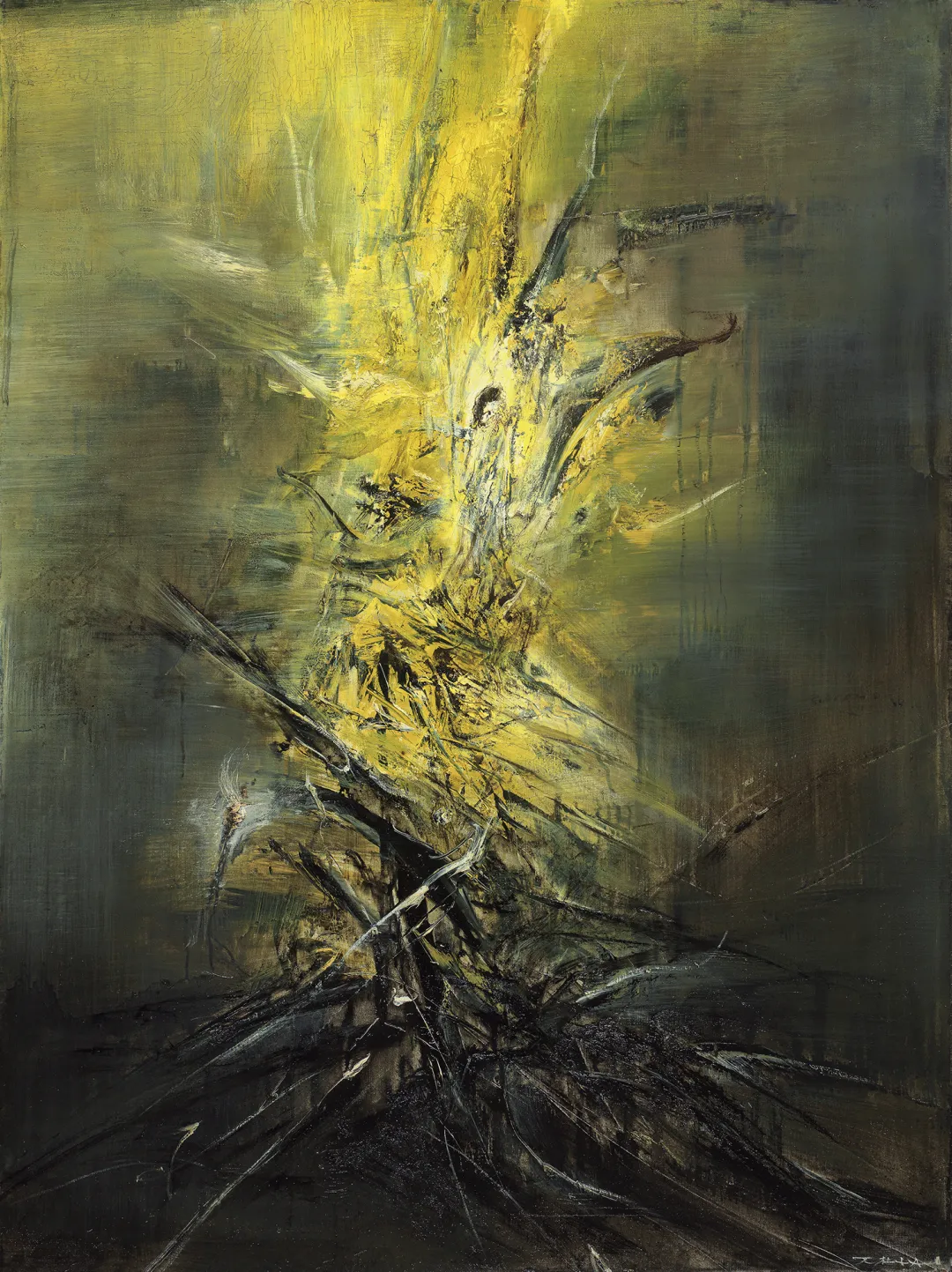
Lot 207
Zao Wou-Ki (1921-2013)
14.12.62
1962
Oil painting on canvas
129.8×97cm
Publish
Zao Wou-Ki, Galerie de France, Paris, 1963, exhibition catalogue
Zao Wou-Ki, Redfinch Gallery, UK, 1963, exhibition catalogue
Zao Wou-Ki, Hier et Demain Editions, Paris and Ediciones Poligrafa, Barcelona, 1978, p. 285
"Zao Wou-Ki", Rizzoli International Publications, New York, 1979, p. 285
Zao Wou-Ki, Editions Cercle d’Art, Paris, 1986, page 325
Zao Wou-Ki's Works Chronological Collection, Volume 2: 1959-1974, Editions Flammarion, Paris, 2023, p. 99, p-0736
display
"Zao Wou-Ki", June 7 – July 7, 1963, Galerie de France, Paris
"Zao Wou-Ki", October 29 – November 29, 1963, Redfin Gallery, United Kingdom
source
Gallery of France, Paris
American private collection
European private collections
Sotheby's Hong Kong, October 5, 2014, Modern and Contemporary Asian Art Evening Sale, Lot 1002
Sotheby's Hong Kong, October 9, 2021, Modern Art Evening Sale, Lot 1046
Important Asian Private Collections
RMB 40,000,000-60,000,000
Zao Wou-Ki is a benchmark for the fusion of Eastern and Western abstract art. This auction presents two milestone works from his creative career."14.12.62" was created during the artist's "wild cursive period" (1959-1972), a period widely recognized as his "golden age" when his creative energy was at its peak and his style was at its most mature.In the art market, Zao Wou-Ki's masterpieces from his "wild cursive script period" have always been the core of hard currency.
The brushstrokes in the painting are powerful and vigorous, absorbing the energy and visual impact of American Abstract Expressionist action painting, while its structure and spirit are deeply rooted in the calligraphic nature of Chinese cursive calligraphy. Each ink line is an instant record of bodily movement and inner rhythm.
This work has been repeatedly included in catalogues compiled by Jean Lemarie, the former director of the National Museum of Modern Art in France and an important critic, and is regarded as one of the representative works of this period.Collecting this work is equivalent to collecting an authoritative sample of Zao Wou-Ki's most free and passionate artistic language, whose coordinate position in the artist's personal lineage and the history of modern Asian art is indisputable.
Also presented at the event was "In the Botanical Garden" (1953), a precursor to the "Oracle Bone Script Period".
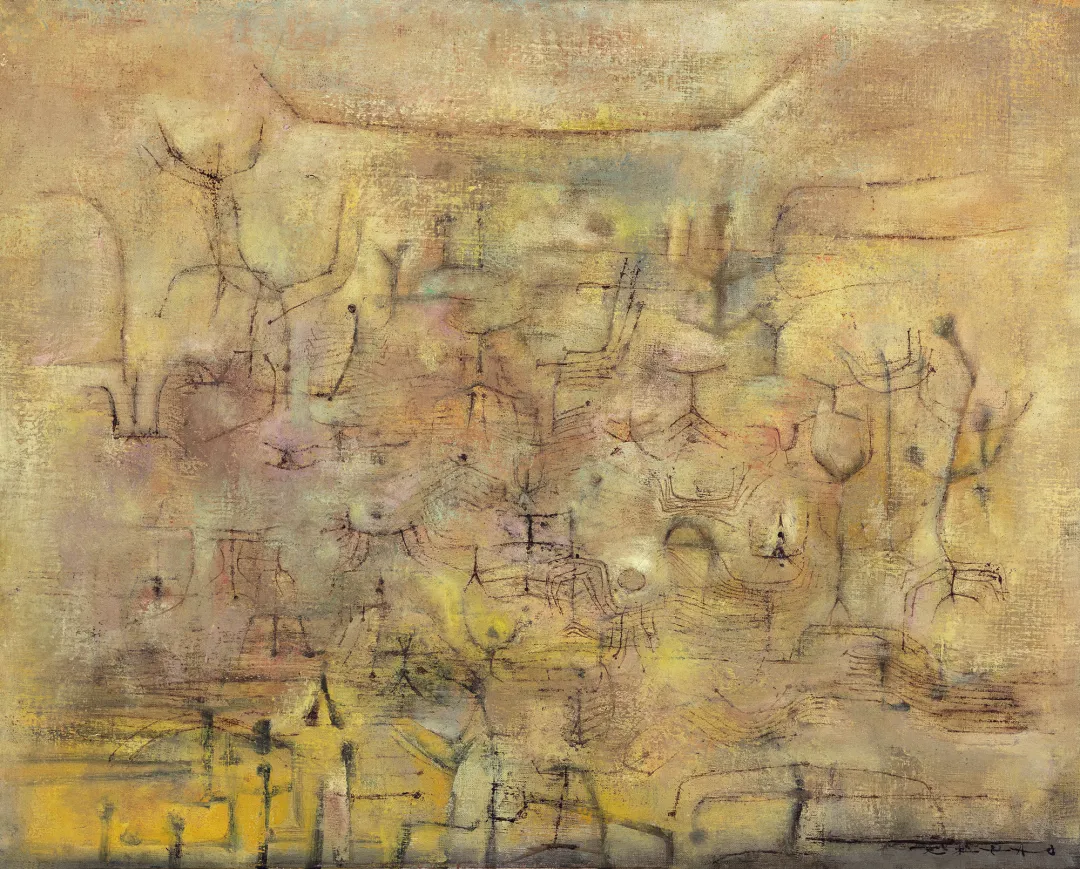
Lot 206
Zao Wou-Ki (1921-2013)
In the botanical garden
1953
Oil painting on canvas
65×81cm
source
Pierre Gallery, Paris
Private collection, California (acquired directly from the above in May 1954)
Sotheby's Paris, Contemporary Art Evening Sale, December 3, 2021, Lot 22
illustrate
This work has been registered in the Zao Wou-Ki Foundation's archives and certified by the foundation.
RMB 14,500,000-20,000,000
The two works were created nearly ten years apart, and both use "yellow" as the main theme. "In the Botanical Garden" is a warm earthy yellow (introverted), while "14.12.62" is a fiery bright yellow (exuberant). One is still and the other is dynamic. They accurately mark Zao Wou-Ki's complete artistic trajectory from deep introspection and seeking the roots of Eastern symbols to passionate outpouring and integrating Eastern and Western writing, presenting a museum-level collection.
"In the Botanical Garden" was inspired by bronze inscriptions, a style Zao Wou-Ki created.Constructing a poetic nature with hazy color blocks and mysterious symbols, this work represents a key transformation for the artist as he returns to his identity in Eastern culture.
The work came directly from the gallery of Pierre Loeb, a major Parisian dealer of modern art, and was subsequently treasured by a prominent French collecting family for over sixty years, never entering the market until recently when it was released for the first time.
• Qiu Di, "Roses and Lacquer Box"
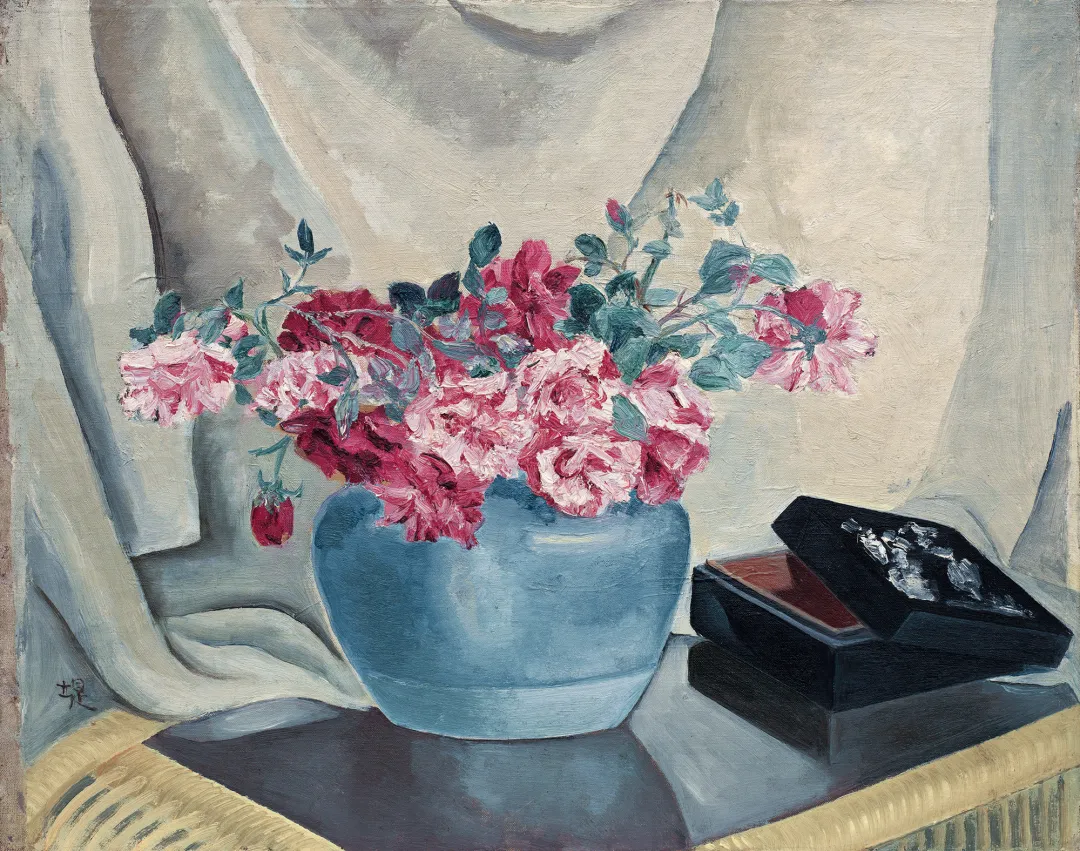
Lot 202
Qiu Di (1906-1958)
Roses and Lacquer Box
1943
Oil painting on canvas
38.5×48.5cm
Publish
Art Research, Art Research Magazine, Beijing, 1997, No. 4, p. 45
"Qiu Di", Jiangsu Education Press, Nanjing, 2006, pp. 38-39
Three Generations of Chinese Female Artists: Qiu Di, Pang Tao, Lin Yan, Fine Arts Gallery, Vancouver, 1998
"Inheriting the Past and Integrating the Present: A Retrospective Exhibition of Fine Art Auctions from China Guardian over the Past 20 Years", China Art Publishing House, Beijing, 2015, p. 358.
display
"Three Generations of Female Painters Exhibition", 1998, National Art Museum of China, Beijing
"Three Generations of Female Painters Exhibition", 1998, ART BEATUS, Vancouver
"Three Generations of Female Painters Exhibition", 1998, SOHO 20, New York
"Inheriting the Past and Embracing the Present: A Retrospective Exhibition of Fine Art Auctions from China Guardian over the Past 20 Years," National Museum of China, Beijing, November 10-30, 2013.
source
China Guardian, Chinese Oil Paintings and Sculptures, April 20, 1999, Lot 20
Important Asian Private Collections
RMB 9,000,000-15,000,000
Qiu Di's "Roses and Lacquer Box" (1943) is a museum-quality work that is enough to redefine the landscape of collectors' collections.
Qiu Di was a core member of "Storm Society," China's first modern art group.She was also the only artist within the society to receive the "Storm Society Award," an award that at the time represented the highest recognition of her exploration of modernity. Collecting her works is tantamount to collecting material evidence of the "source" of the Chinese modernist art movement.
For a long time, her artistic brilliance has been somewhat overshadowed by her identity as "Madam Pang Xunqin".As Chen Danqing stated, her still-life paintings are arguably "the best in China." With the deepening of contemporary art historical research, she should be placed at the core, alongside pioneering female artists such as Guan Zilan and Pan Yuliang.
This painting was created in 1943 in Chengdu's "Zheng Family Garden," a cultural oasis amidst the flames of war. The work transcends earlier explorations of formalism, perfectly blending modernist color and composition (such as the absorption of Impressionist light and color) with the Chinese literati's state of mind of "forgetting oneself and the external world." The roses, lacquer box, and rattan table in the painting represent not only the poetry of daily life but also a steadfast commitment to "beauty" and "dignity" during a time of war.
Qiu Di's works are extremely rare, due to war and the changing times.Only about thirty of his works (including watercolors) survive, with oil paintings being even rarer. Only six of his mature floral-themed works from the 1940s are currently known.
"Roses and Lacquer Box" is a well-preserved, clearly documented masterpiece rich in historical and cultural information. Its provenance is traceable, accompanied by valuable family memoirs and historical documents, directly linking it to specific figures and events such as Shen Fuwen (the gifter of the lacquer box) and the "Zheng Family Garden" literary circle, thus possessing profound historical and documentary value.
Compared to the prices of works by male artists of the same period and equal status in art history (such as her colleagues at the Storm Society) and her husband Pang Xunqin,The market value of Qiudi is significantly undervalued due to its long-term neglect.With the deepening of academic research and the promotion of special exhibitions featuring female artists, the return and enhancement of their value is a clear trend.
• Sun Zongwei's "Journey to the Frontier"
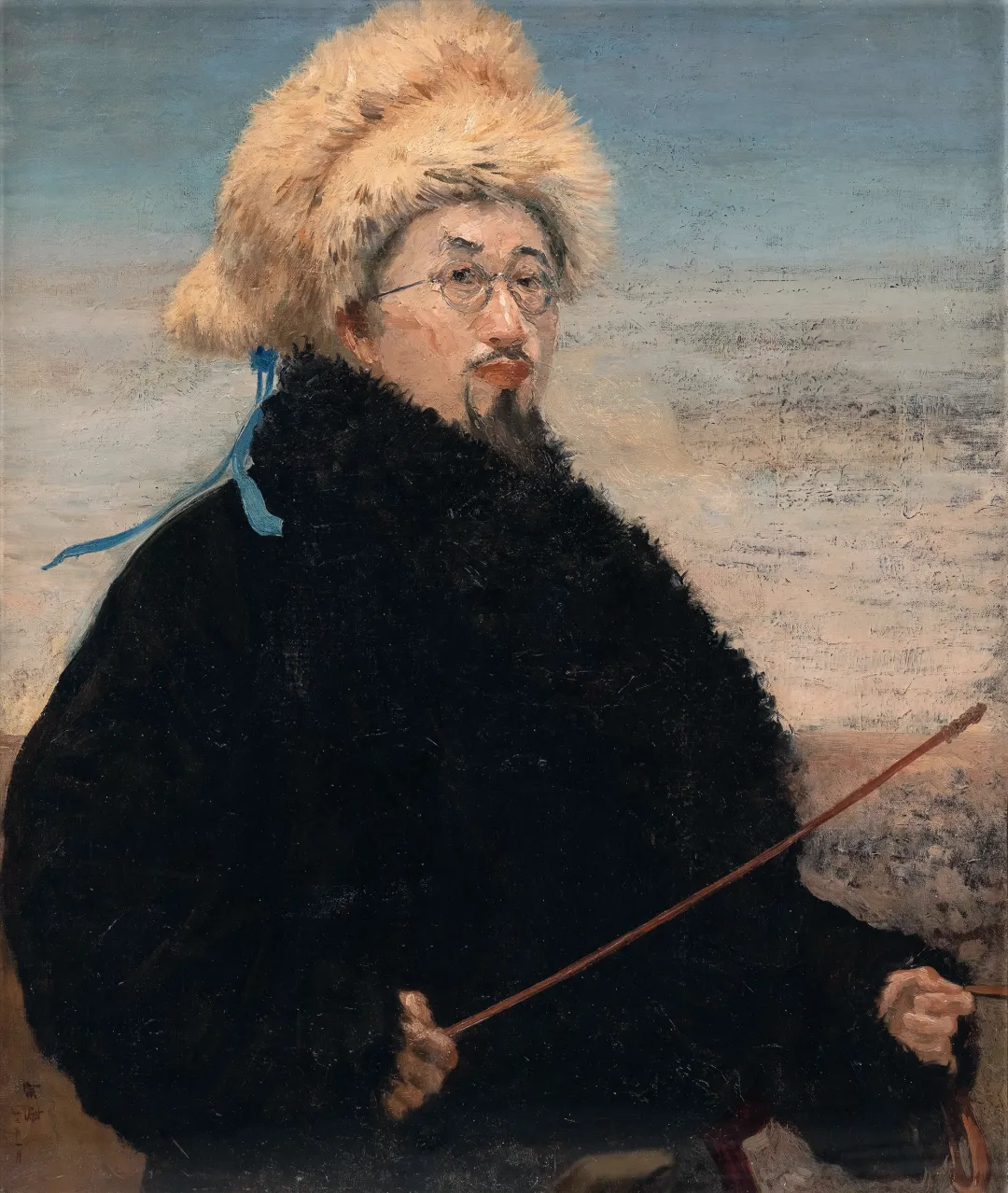
Lot 215
Sun Zongwei (1912-1979)
Sai Shang Xing
1944
Oil painting on canvas
74×62cm
Publish
Catalogue of Sun Zongwei's Painting Exhibition, Winter 1945, No. 112
Selected Paintings by Sun Zongwei, People's Fine Arts Publishing House, 1984, cover 2
Sun Zongwei's Paintings, Ya Yi Art Center, Taipei, 2000, page 11
"Traversing and Stealth: An Exhibition of Sun Zongwei's Works from the 1940s", Han Art Space, 2009, page 2.
Art for Life: A Collection of Art Documents by Xu Beihong's Students, edited by the China National Academy of Painting, Forbidden City Press, 2010, page 190.
Seeking Truth Within Myself—Sun Zongwei's Centennial Paintings, People's Fine Arts Publishing House, Beijing, 2012, p. 127
People's Artist, People's Publishing House, Issue 5, 2021, Page 8
display
"Sun Zongwei Solo Painting Exhibition", Chongqing, 1945
"Exhibition of Works by Sun Zongwei", 1983, Art Museum of the Central Academy of Fine Arts, Beijing.
"Seeking Truth Within Myself—Sun Zongwei Centennial Painting Exhibition," August 11-20, 2012, National Art Museum of China, Beijing.
"Self-Enjoying Leisure: Sun Zongwei's Sketches, Copying, and Creations in Northwest China in the 1940s," Poly Art Museum, Beijing, September 25-30, 2015.
"Heartfelt Fragrance: Sun Zongwei's Painting Exhibition," February 28 - March 25, 2023, CAFA Art Museum, Beijing.
source
Originating from the artist's family
RMB 3,500,000-5,500,000
In the 1940s, Sun Zongwei accompanied Zhang Daqian on his westward journey to Dunhuang, using his brush to record the vastness and cultural customs of the Northwest. "Journey to the Frontier" depicts the scenery of the frontier and the traveler's footprints with simple brushstrokes, expressing his deep affection for his homeland. It is not only an outstanding portrait painting, but also a precious work that encapsulates the spirit of the times, personal choices, and a turning point in art history.
"Journey to the Frontier" transcends the realm of ordinary self-portraits and is widely recognized as a masterpiece of 20th-century Chinese oil painting self-portraits.This assessment established its benchmark status in art history.
Only a dozen or so of Sun Zongwei's self-portraits survive, and "Journey to the Frontier" is widely regarded as the most representative of them.This scarcity stems from historical reasons, as well as from the exceptional level of achievement of the work itself.
In the painting, the artist depicts himself as a traveler in the Gobi Desert, his face weathered yet his gaze resolute, perfectly embodying the "arduous journey" spirit of that generation of artists who persevered in cultural exploration amidst war and hardship. This is not only a record of his personal westward journey, but also an epitome of the collective spirit of a generation of intellectuals.
At his solo exhibition in 1945, Wang Pengsheng, editor-in-chief of the Ta Kung Pao newspaper, inscribed the words "What is the purpose? Seek it within myself," which is the most accurate summary of the spirit of this work.It demonstrates an independence and self-confidence that seeks inward amidst turbulent times, upholding the essence of art and personal values. This spiritual strength transcends time and continues to resonate deeply today.
The creation of this work occurred during a crucial period after Sun Zongwei returned from Dunhuang with Zhang Daqian, when he devoted himself to the study of "nationalization of oil painting." "Journey to the Frontier" incorporates a calm and elegant oriental color palette and a narrative composition into realistic oil painting, representing an important achievement in his fusion of Chinese and Western artistic languages and the formation of a unique style.
This work is more profound and meaningful than other self-portraits in its "overlap of realism and lyricism".It transcends mere physical depiction, reaching a higher realm of "combining form and spirit" and brimming with confidence, self-sufficiency, and self-satisfaction; it embodies a high degree of unity between technique, emotion, and thought.
In the art market, top-tier representative works by artists like Sun Zongwei, whose art history status is clear, whose masterpieces are rare, and whose works possess strong spirituality and are a hallmark of their era, have always been sought after by seasoned collectors and institutions.
"Journey to the Frontier" is considered the "crown jewel" of his self-portrait series.For collectors aiming to build a Chinese modern art collection system with academic depth and historical perspective, this is a strategic collection.
• Guan Liang, *The Fiery Years*
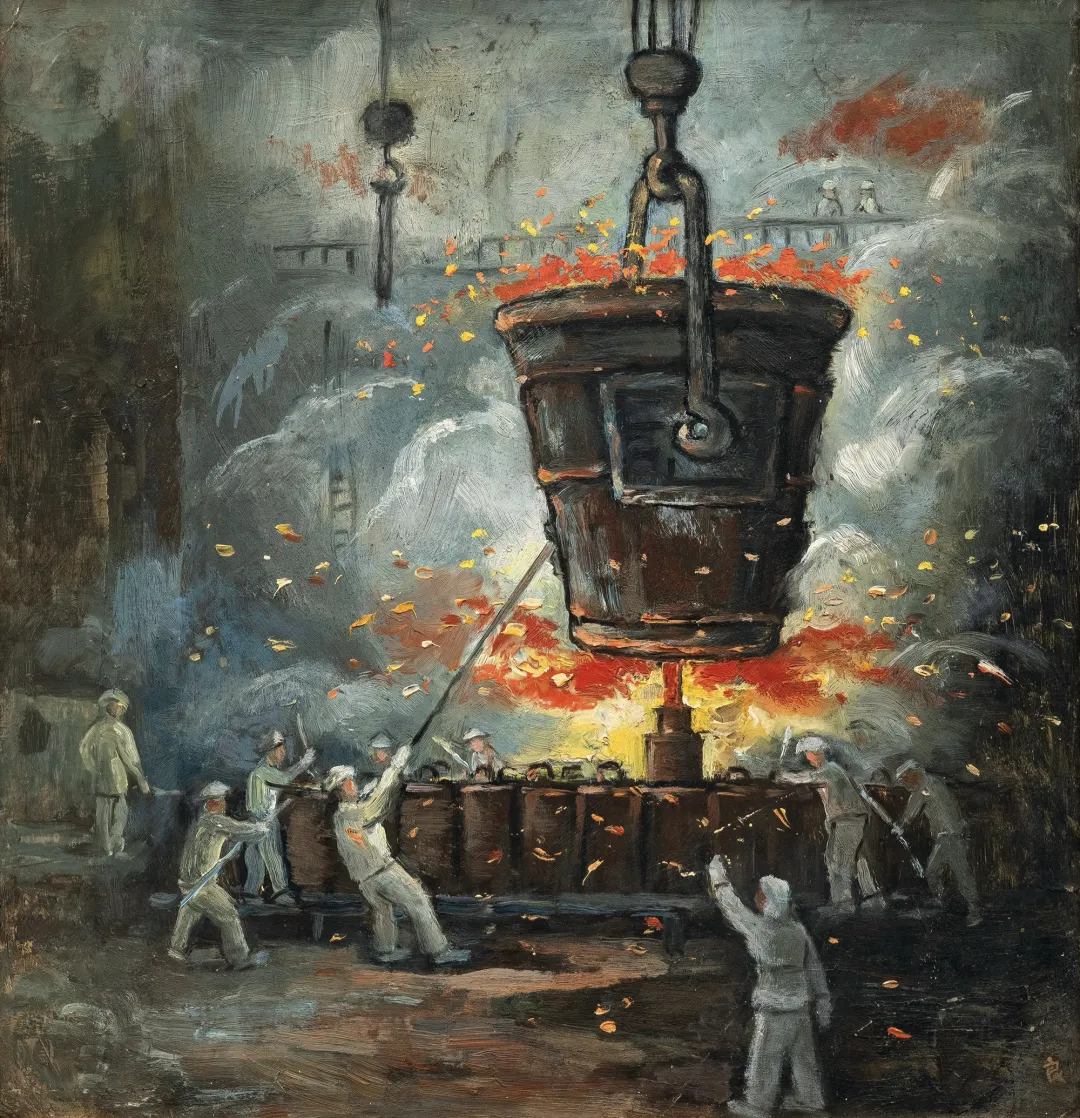
Lot 214
Guan Liang (1900-1986)
The Fiery Era
1950
Oil painting on canvas mounted on a wooden board
36×35cm
Publish
*A Comprehensive History of Modern Art in Shanghai, Volume 2: Oil Painting*, Shanghai People's Fine Arts Publishing House, Shanghai, 2013, p. 41.
"Masterpieces from the 20th Anniversary of China's Guardian Auction: Oil Paintings, Sculptures, and Installations," Palace Museum Press, Beijing, 2013, p. 71.
"Exquisite and Spiritual Expression," A Study of Guan Liang's Painting Art, Guangxi Fine Arts Publishing House, Guangxi, 2015, p. 183.
Documents on Western Painting in 20th Century China: Guan Liang, Cultural and Art Publishing House, Beijing, 2009, p. 134.
"Inheriting the Past and Integrating the Present: A Brilliant Galaxy—A Retrospective Exhibition of Fine Art Auctions from China Guardian over the Past Twenty Years," China Art Publishing House, Beijing, 2015, p. 356.
display
"Shanghai Oil Painting and Sculpture Exhibition", February 1963, Shanghai Art Museum, Shanghai.
"Inheriting the Past and Embracing the Present: A Brilliant Galaxy – A Retrospective Exhibition of Fine Art Auctions from China Guardian over the Past 20 Years," National Museum of China, Beijing, November 10-30, 2013.
source
China Guardian, Chinese Oil Paintings and Sculptures, November 4, 2005, Lot 2
RMB 3,000,000-5,000,000
In the history of 20th-century Chinese art, Guan Liang is unparalleled in his ink-wash paintings of opera figures. His Zhong Kui and Sun Wukong are vivid and lifelike, and have become classic cultural symbols. His industrial-themed oil painting "The Fiery Years," created in the 1950s, shows how a traditional literati painter, amidst the torrent of the times, used his unique Eastern wisdom to infuse a grand modern narrative with soul.
The 1963 "Shanghai Oil Painting and Sculpture Exhibition" was a historic gathering.First-generation oil painting masters such as Liu Haisu, Lin Fengmian, Guan Liang, and Yan Wenliang, under the call to "sing praises to the motherland and serve the people," went deep into factories and rural areas to create their own answers to the call of the times.Among the many masterpieces by renowned authors, Guan Liang's "The Fiery Years" stands out as particularly special.The image employs a close-up composition, thrusting the massive steel ladle directly into the viewer's view, creating a powerful sense of visual oppression and immersion. Like a central entrance on a theatrical stage, it instantly draws all attention, elevating the labor scene into a sublime heroic narrative.
As an extremely rare and mature representative work among Guan Liang's industrial-themed oil paintings, its scarcity far exceeds that of his more common opera-themed ink paintings.It is an indispensable yet unique page in Guan Liang's complete works of art.
This work is a classic example of the exploration of nationalization of Chinese oil painting in the 1950s and the response of the first generation of painters to the challenges of the times. Its value has transcended Guan Liang's personal achievements, becoming a "tangible and precious record" in the history of modern Chinese art.
Both depicting industrial construction, Lin Fengmian's "Smelting Scene" (ink and color on paper) sold for 10.81 million RMB at the China Guardian Autumn Auction in 2021. This provides a solid value reference for Guan Liang's unique and more integrated oil painting masterpiece.
• He Muqun, "Wheat Bread"
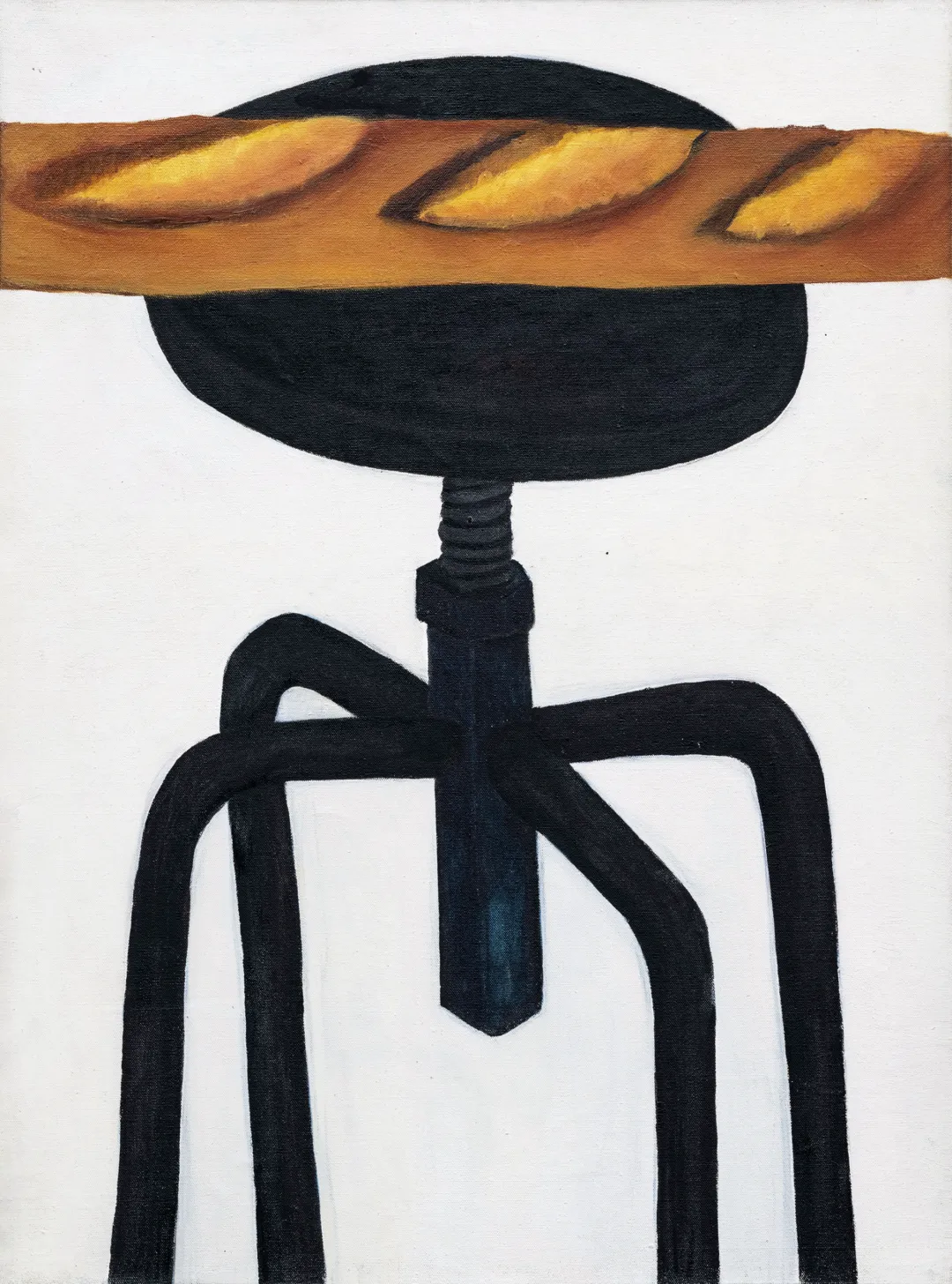
Lot 11
He Muqun (1924-2012)
Wheat bread
1975
Oil painting on canvas
73×54cm
Publish
Hoo Mojong, Shanghai People's Fine Arts Publishing House, Shanghai, 2011, page 51.
Toys: A Centennial Retrospective of He Muqun's Works, Hong Kong, 2025, page 17
display
"Discovering He Muqun", September 10 – November 10, 2024, China Art Museum, Shanghai
"Playthings: A Centennial Retrospective of He Muqun", March 26 – July 6, 2025, Asia Society Hong Kong Centre, Hong Kong
RMB 900,000-1,500,000
He Muqun, who spent his life wandering, captured everyday objects with minimalist brushstrokes."Wheat Bread" is "a model work of He Muqun's artistic pursuit in the 1970s" and "a highly representative landmark".The theme of "bread" is the most profound and personal symbol in her art. This work from 1975 is at the mature stage of her creation on this theme, with the most concise form and the most concentrated spiritual content, and is a perfect embodiment of her signature style.
In 1970, the French Ministry of Culture provided her with a studio, and her life finally stabilized. Her art was able to transcend the struggle for survival and enter into a pure contemplation of the essence of life.
The composition of "bread and stool" is not a random arrangement, but a ritualistic scene: it symbolizes the entire world upon which the artist relies for survival in a foreign land—the bread that sustains his physical existence, and the stool that supports his spiritual creation. The combination of the two represents a complete existence.
"Wheat Bread" is more than just a still life painting. This serene, simple yet powerful work quietly reminds us that the true essence of life lies in the most unpretentious and genuine "simple joy".
II. The Backbone of Our Time: A Mirror of Our Era
• Zhou Chunya, *China Landscape No. 1*
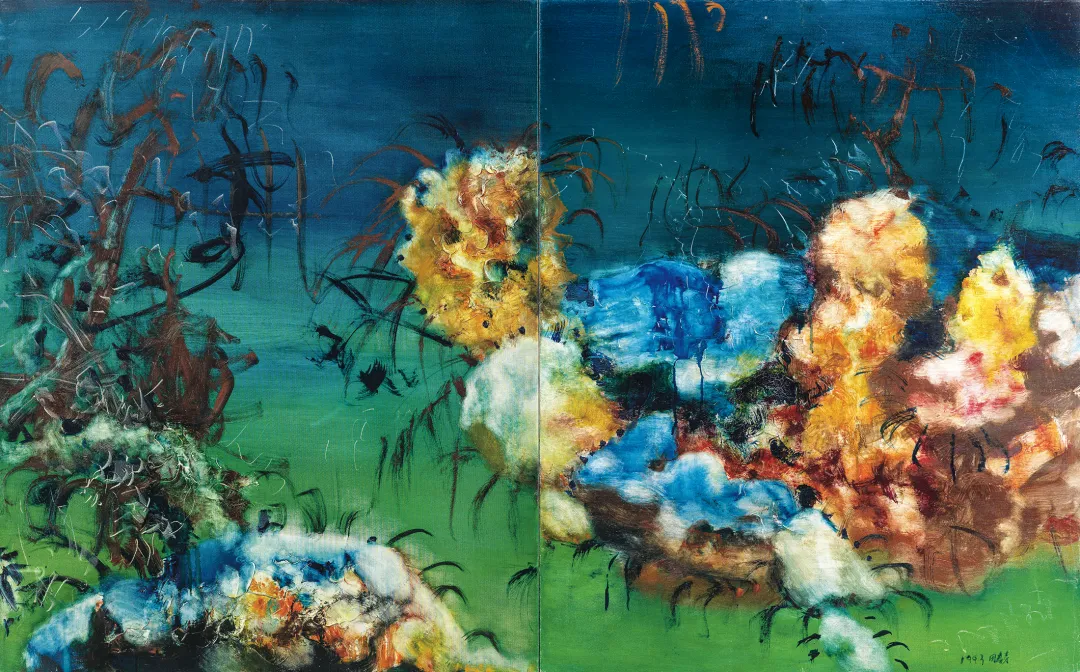
Lot 223
Zhou Chunya (b. 1955)
China Landscape No. 1
1993
Oil painting on canvas
100×80cm×2
Publish
"Zhou ChunYa", Timezone8, Hong Kong, 2010, page 197
display
"Zhou Chunya's 40th Anniversary Retrospective Exhibition of Art (1971-2010)," June 13-24, 2010, Shanghai Art Museum, Shanghai.
RMB 12,000,000-18,000,000
"Chinese Landscape No. 1," the inaugural work in Zhou Chunya's "Chinese Landscape" series, was created in 1993 and marks a milestone in the fusion of Chinese and Western art in his career. The work reconstructs traditional Chinese landscape imagery with the passionate brushstrokes of German Neo-Expressionism. The gnarled tree branches grow in reverse, and the colors are intense and unrestrained, transforming the restraint of literati painting into a powerful visual impact, fully demonstrating the contemporary vitality of the Eastern spirit.
"China Landscape No. 1" is the first work in Zhou Chunya's "Mountain and Rock Series".This not only marks a key transformation in the artist's personal creative career—from his established Tibetan themes to a profound exploration of nature, tradition, and personal character—but is also placed within the important context of 20th-century Chinese oil painting seeking its own "modern" language. It is a key practice for him to bridge Chinese and Western art through "calligraphy," and is of milestone significance.
The distinctive loess color tone in the image originates from Zhou Chunya's personal experience of crossing the Qinling Mountains on the T7 train in 1989.He himself described this color as "a color melted into the bone marrow," a product of a specific moment, specific light and shadow, and a specific state of mind. The quality of color and the intensity of emotion born from a one-time life experience are difficult to replicate, making this work a unique case in the artist's entire creative career.
As the starting point of the seriesThis work was not exhibited at the "Chinese Experience" exhibition in the same year it was created, and was once considered "the least desirable to show," which only added to its mystery and uniqueness. Works in the same series have already fetched high prices on the market.(For example, a similar work sold for over 44 million RMB in 2017). As its pioneering work, its scarcity and original value are even more prominent. The estimated price of 12 million to 18 million RMB in this instance directly confirms its top-tier market positioning.
The artwork is in excellent condition, has a clear provenance, and is well-documented (published in the 2010 album "Zhou Chunya", page 197) and has important exhibition records ("Zhou Chunya's 40th Anniversary Retrospective Exhibition" at the Shanghai Art Museum in 2010).
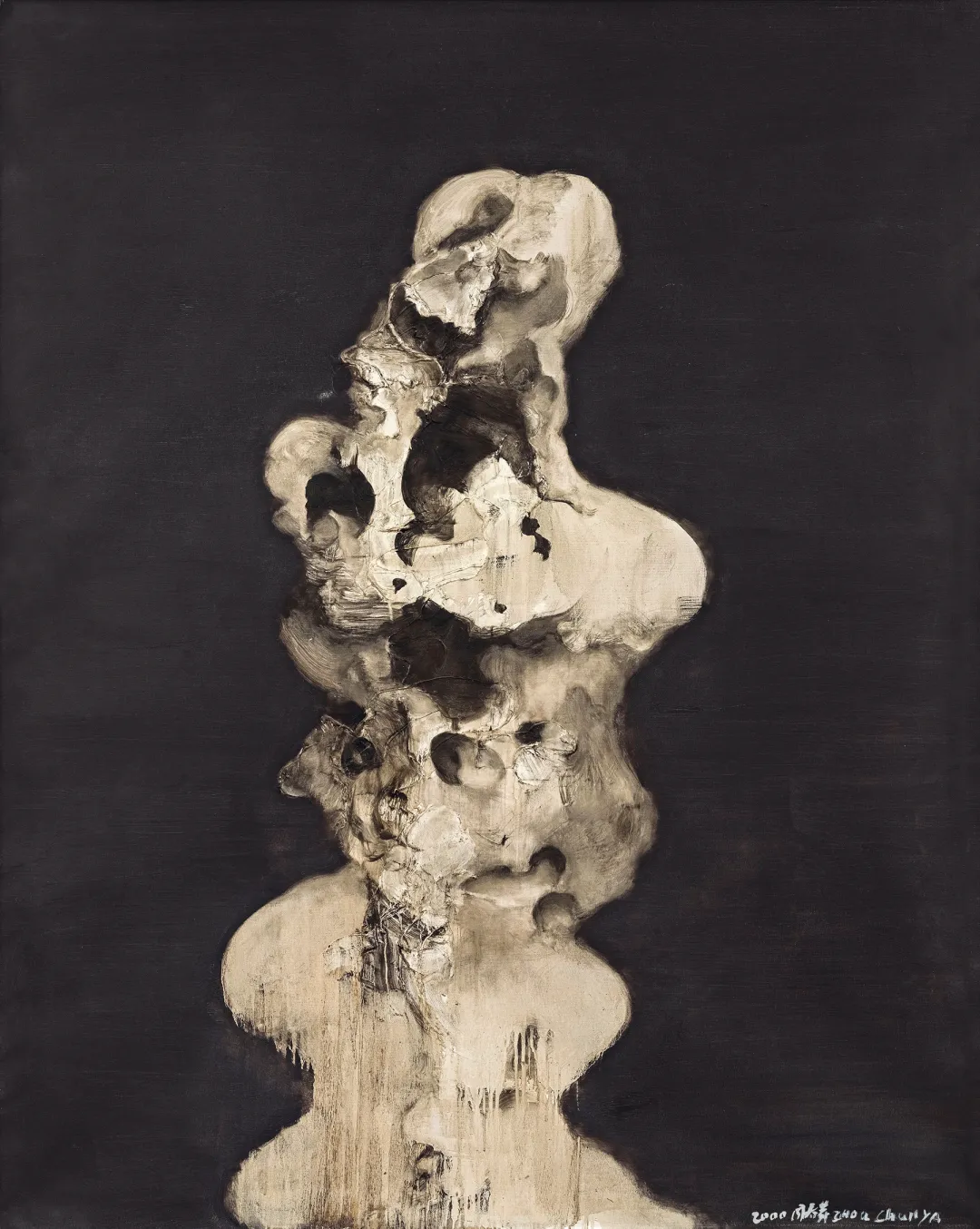
Lot 224
Zhou Chunya (b. 1955)
Taihu stones that resemble the human body
2000
Oil painting on canvas
150×120cm
Publish
Zhou Chunya, Timezone8, Hong Kong, 2010, page 449
RMB 5,800,000-7,800,000
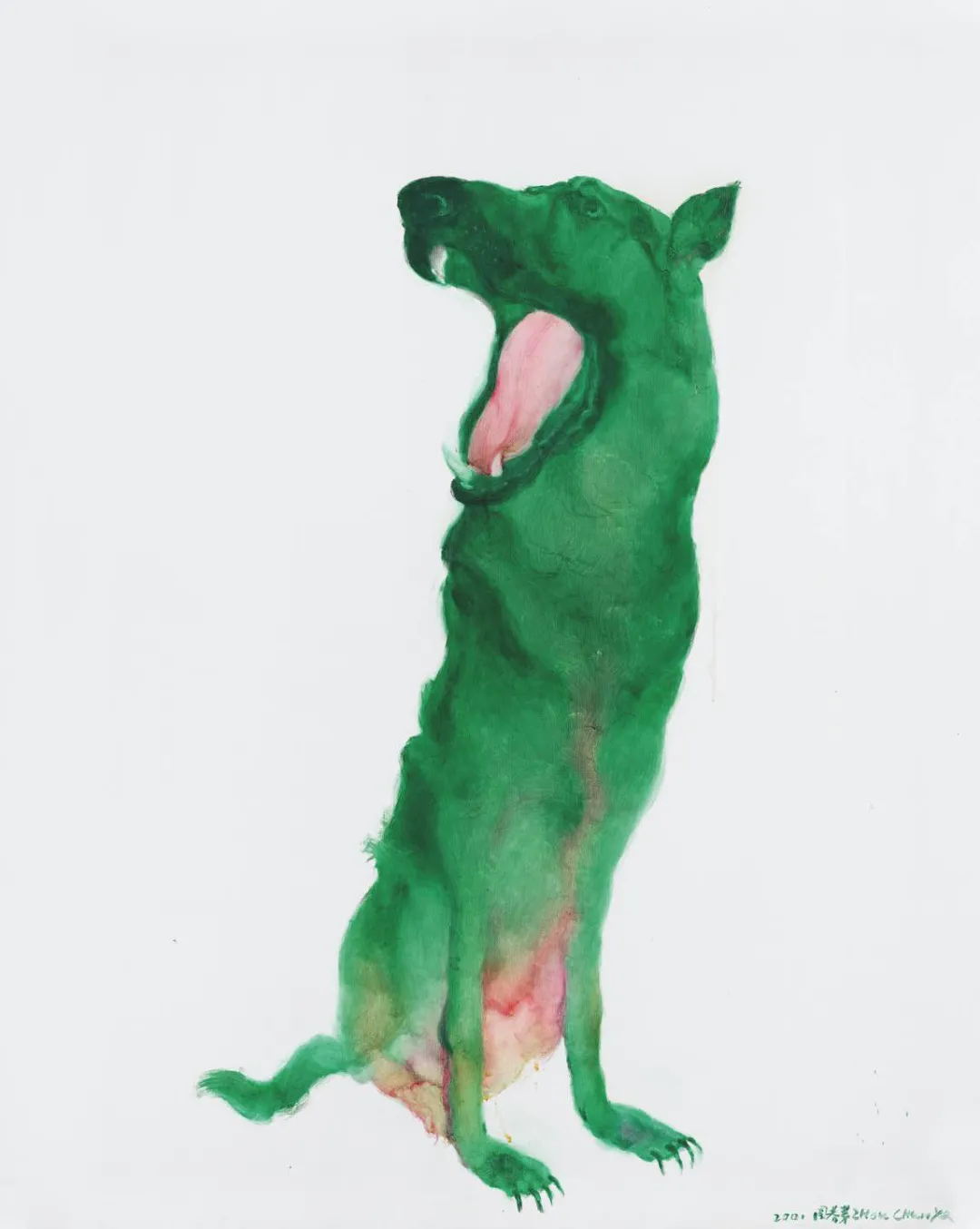
Lot 237
Zhou Chunya (b. 1955)
Green Dog
2001
Oil painting on canvas
150×120cm
RMB 3,000,000-5,000,000
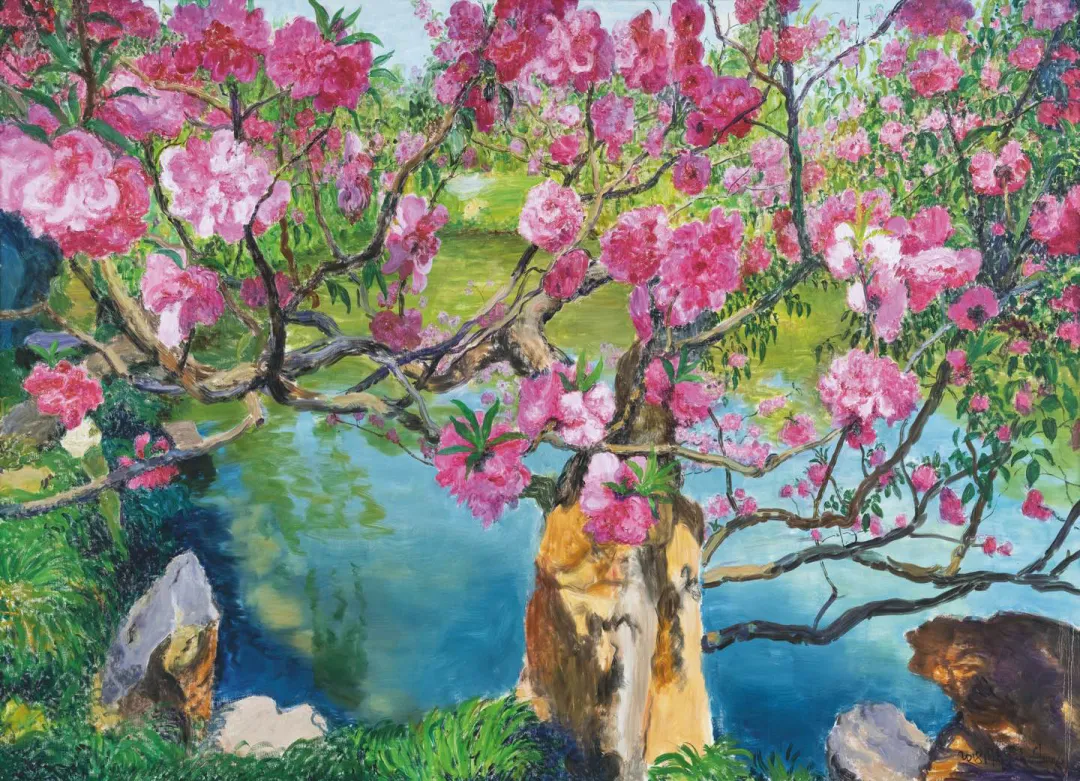
Lot 238
Zhou Chunya (b. 1955)
Springtime scenery of Slender West Lake
2018
Oil painting on canvas
180×250cm
RMB 5,800,000-7,800,000
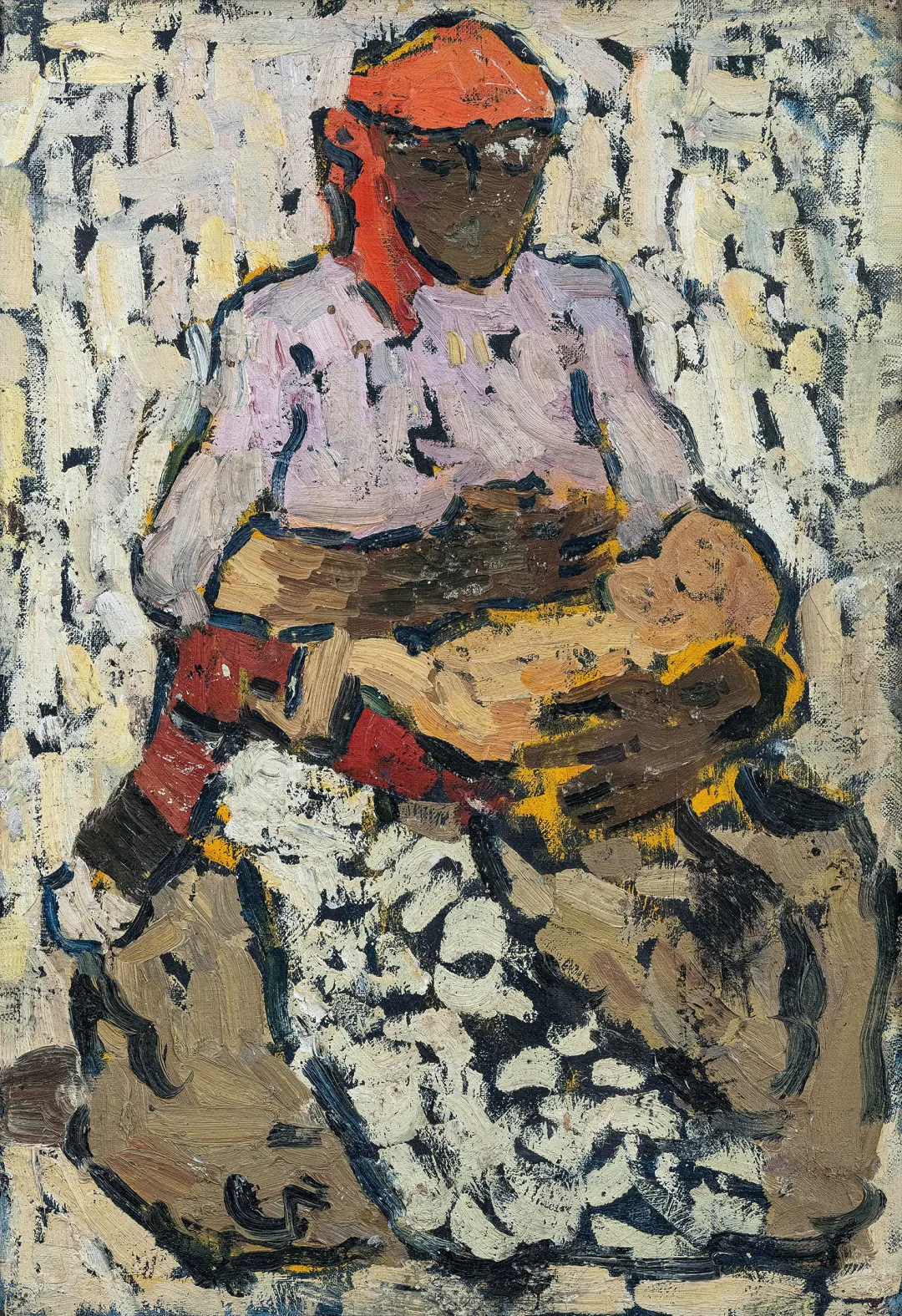
Lot 99
Zhou Chunya (b. 1955)
maternal love
1981
Oil painting on paper
53×36.5cm
RMB 40,000-60,000
• Liu Xiaodong, "Looking at the Great Wall (Part One)"
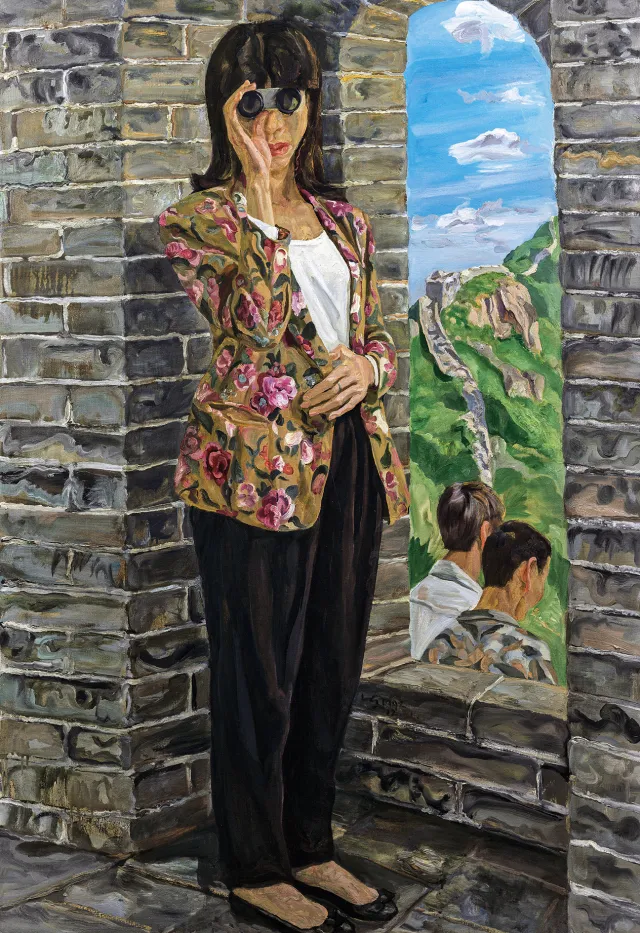
Lot 231
Liu Xiaodong (b. 1963)
Looking at the Great Wall (Part 1)
1992
Oil painting on canvas
173×118 cm
Publish
Liu Xiaodong, All-Round 1978-2018, Liaoning Fine Arts Publishing House, Shenyang, 2019, p. 204.
display
"Figurative Oil Painting Exhibition", 1993, National Art Museum of China, Beijing
RMB: 5,000,000-7,000,000
As one of the most stable and core forces in the Chinese contemporary art market, Liu Xiaodong's classic works from the 1990s have always been highly sought-after in the market.
"Looking at the Great Wall I" uses the Great Wall as a backdrop to capture the youthful portrait of a generation. The characters' expressions are indifferent yet hint at confusion. It is a true slice of the spiritual state of Chinese youth in the 1990s, and has both the memory of the times and the value of art history.
Liu Xiaodong's oil painting "Looking at the Great Wall I," completed at the end of 1992, is a landmark work in his artistic career that combines personal narrative with symbolism of the times.This oil painting, created at nearly life-size, breaks away from the artist's previous focus on everyday trivialities. With the Great Wall as a historical backdrop, it captures the moment when the lover, Yu Hong, gazes into the distance. It is not only a precious record of personal emotions but also reflects the era of social transformation in China in the 1990s and the spiritual state of young artists. It has extremely high value in both art history and collection.
"Looking at the Great Wall (Part 1)" is the last portrait of Yu Hong with long hair painted by Liu Xiaodong.It not only captures the essence of youth but also adds depth to this personal narrative.
In Liu Xiaodong's creative trajectory, the rough and precise brushstrokes (brick walls, clothing folds), the strong sense of presence brought by the towering scale of the painting, and the stark contrast between warm and cool colors (warm foreground and cold for distant mountains) in "Looking at the Great Wall I" all demonstrate his signature painting language full of "restless youthful spirit" and vitality, which is a wonderful presentation of his mature style.
The entire creative process of the work was fully documented in director Wang Xiaoshuai's debut film, "The Days".This film is the pioneering work of the Sixth Generation directors and a landmark visual record of the living conditions of artists in the early 1990s.
• Looking ahead to "The Sitting Girl"
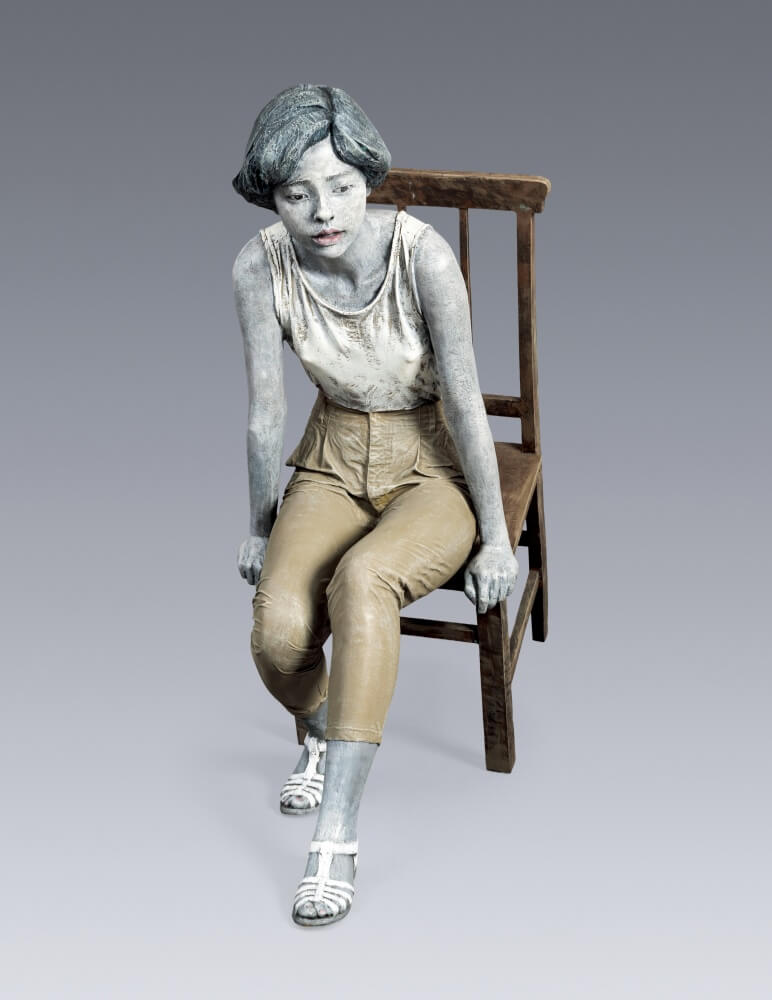
Lot 229
Outlook (b.1962)
Sitting girl
1990
Colored bronze sculpture 6/8
130×110×49cm
Publish
Cross-Strait Sculpture Art Exchange Exhibition, Mountain Art Foundation, Kaohsiung, 1993, page 197.
Oriental Plaza: A Showcase of Fine Modern Chinese Sculpture, Art Gallery, Hong Kong, 2000, p. 33
A History of Contemporary Chinese Art 1990-1999, Hunan Fine Arts Publishing House, Changsha, March 2000, p. 70.
History of Fine Arts in New China (1949-2000), Hunan Fine Arts Publishing House, Changsha, November 2002, p. 256
From Heroic Odes to the Ordinary World: Trends in Modern Chinese Art, Renmin University of China Press, Beijing, November 2004, p. 158
A History of 20th Century Chinese Art, Peking University Press, Beijing, December 2006, page 890.
"Prospect: Garden Utopia", Hunan Fine Arts Publishing House, Beijing, January 2009, page 239.
"A Collection of Artworks Commemorating the 30th Anniversary of Reform and Opening Up", People's Fine Arts Publishing House, Beijing, February 2009, Plates
Cultural Allegory of Chinese Society in the Age of Consumerism: A Report on the Investigation of Contemporary Chinese Art, Jilin Fine Arts Publishing House, Changchun, 2010, p. 416
Chinese Patterns: A Concise Art History of 25 Artists, Sichuan Fine Arts Publishing House, Chengdu, June 2011, p. 281.
Artists in Art History I, Hunan Fine Arts Publishing House, Changsha, 2008, p. 714 (same edition, multiple editions)
display
"New Generation Art Exhibition", July 9-14, 1991, National Museum of Chinese History, Beijing.
The First Invitational Exhibition of Contemporary Young Chinese Sculptors opened on September 12, 1992, at the Zhejiang Academy of Fine Arts Gallery in Hangzhou.
"Cross-Strait Sculpture Art Exchange Exhibition", 1993, Yanhuang Art Museum, Beijing
"Cross-Strait Sculpture Art Exchange Exhibition", 1993, Kaohsiung Museum of Fine Arts, Kaohsiung.
"Oriental Plaza: A Showcase of Fine Modern Chinese Sculpture," June 2-30, 2000, Art Gallery, Hong Kong.
"An Era of Openness" Invitational Exhibition, July 23 – August 22, 2003, National Art Museum of China, Beijing.
"Art Exhibition Commemorating the 30th Anniversary of Reform and Opening Up", December 17-24, 2009, National Art Museum of China, Beijing.
source
China Guardian, Contemporary Art Evening Sale, November 28, 2021, Lot 2119
illustrate
Attached is a certificate of author's personal signature issued by Qingshan Art Center.
RMB: 1,800,000-2,500,000
Looking back, his "Artificial Rocks" series later gained international acclaim, and his conceptualization and reflection on material culture had already surpassed his earlier realism. This work, "Seated Girl," is the starting point and manifesto of his artistic concepts.
The "New Generation Art Exhibition" in 1991 is regarded as a key watershed moment in Chinese art, marking a shift from the grand philosophical narratives of the '85 New Wave to a focus on the realities of individual existence. Zhan Wang's "Sitting Girl" is a prime example and core work of sculpture in this landmark exhibition.
Zhan Wang explicitly states that his hyperrealistic style "is an art that opposes expressiveness," aiming to draw the audience's attention to the work's underlying concepts rather than showcasing technical skills.
In this work, the exquisite realism serves a profound concept: to reveal the grand social psychology hidden within the neglected realities of everyday life. The work's clear art historical context, superb technique, and profound spirit of the times make it fully worthy of being a permanent collection of important museums.
• Zhang Peili, *Water Sports*
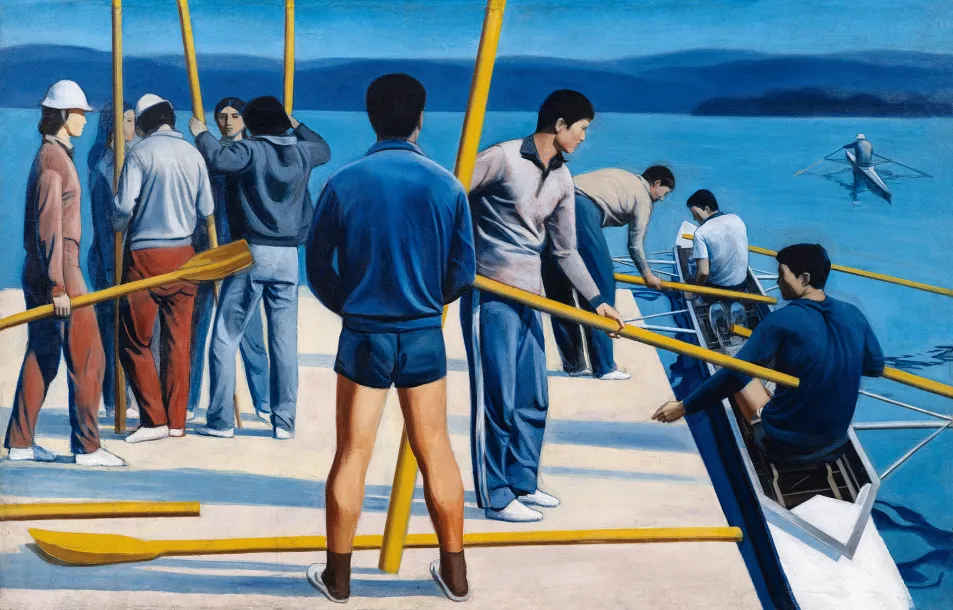
Lot 236
Zhang Peili (b. 1957)
Water sports
1984
Oil painting on canvas
83.8 × 130.7 cm
Publish
Zhang Peili's Art Handbook, Lingnan Fine Arts Publishing House, Guangzhou, 2008, page 483.
RMB: 12,000,000-18,000,000
Zhang Peili is one of the few artists in the history of contemporary Chinese art who simultaneously possess the dual identities of "pioneer" and "founder".
In November 2025, his monumental work "X?" from the "Gloves" series sold for 71.3 million RMB at China Guardian's Autumn Auction, significantly breaking his personal auction record and becoming a landmark event of the year. This signifies the market's top-level recognition of the value of his conceptual art.
According to art market analysis, during the process of "de-bubbling," the prices of works by artists who have withstood the test of scholarship and history have stabilized or even risen against the trend. Zhang Peili's works combine top academic status, strong market performance, and extreme scarcity, and their market logic has shifted from short-term focus to a firm pursuit of long-term art historical value.
The painting "Water Sports" (1984) offered in this auction is Zhang Peili's graduation work and marks a "key beginning" in his exploration of artistic language.It clearly demonstrates Zhang Peili's early experiments in shifting his focus from grand narratives to the individual and everyday structures, and is a valuable sample for studying his creative transformation.
The work is in line with "The Competitor" from the same year and directly led to the subsequent "85 Space" exhibition and the birth of the "Rational Painting" series.Collecting this work is equivalent to collecting key material evidence of the emergence of an important school of Chinese contemporary art.
This work is a "museum-quality masterpiece" and has been published in authoritative documents multiple times.For collectors aiming to build a collection system with an art historical context, such works that lay the foundation for an artist's early career are an indispensable part of the core puzzle.
• Wang Xingwei, Untitled (Selling Eggs)
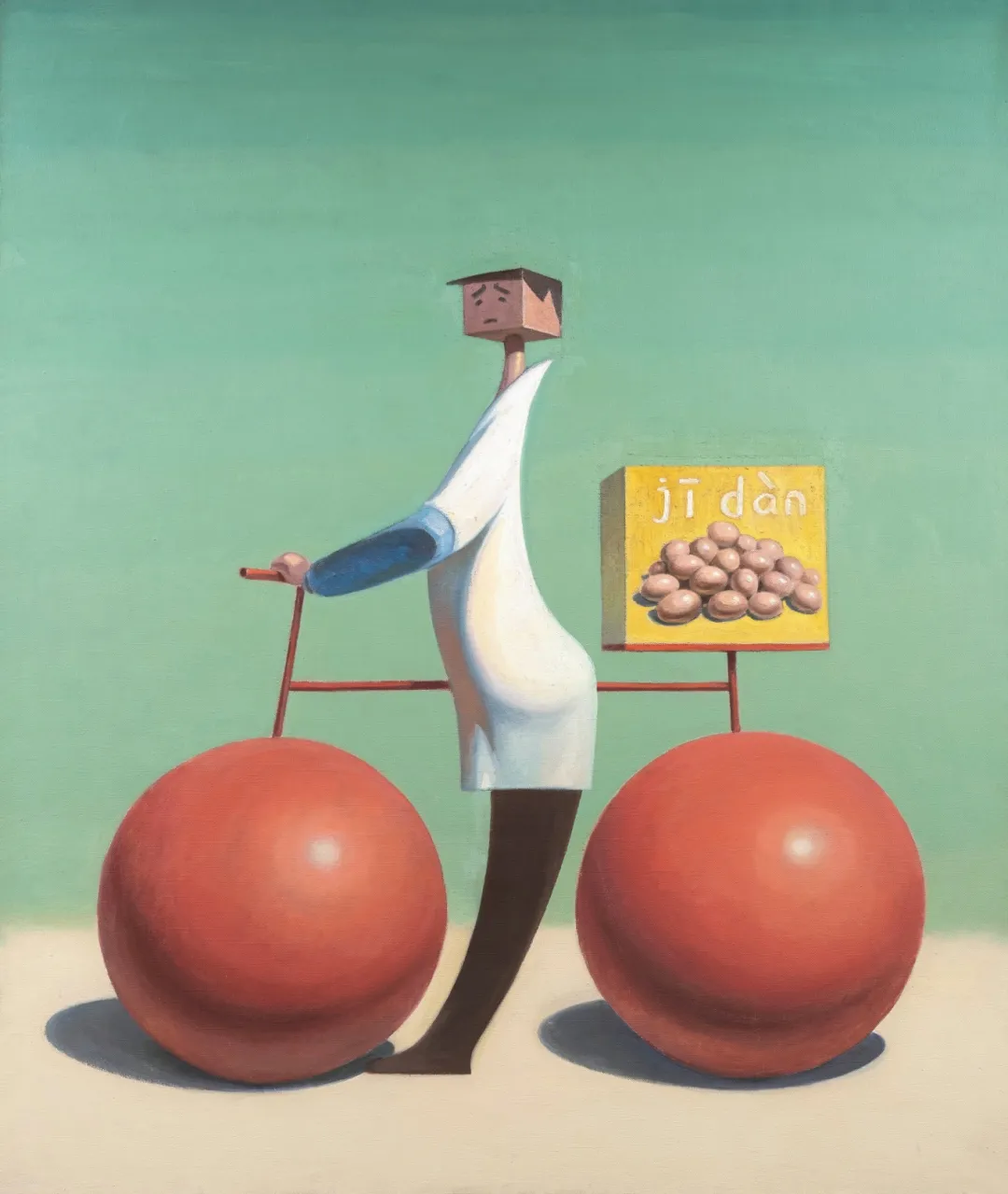
Lot 241
Wang Xingwei (b. 1969)
Untitled (Selling Eggs)
2007
Oil painting on canvas
240×200 cm
display
“Wang Xingwei”, May 19 – August 18, 2013, Ullens Center for Contemporary Art, Beijing
"Wang Xingwei in Shanghai 2002-2008", July 9 - October 9, 2022, Shanghai Museum of Contemporary Art, Shanghai.
Publish
Wang Xingwei, Ullens Center for Contemporary Art, World Book Publishing Company, Beijing, 2013, page 128.
"Wang Xingwei in Shanghai 2002-2008", Shanghai Museum of Contemporary Art, Shanghai, 2022, cover.
Wang Xingwei, Shanghai Museum of Contemporary Art, Shanghai People's Fine Arts Publishing House, Shanghai, 2023, cover and page 165.
RMB: 8,000,000-15,000,000
In Wang Xingwei's intricate and complex art world, full of intellectual gamesUntitled (Selling Eggs), created in 2007, is a crucial key. It was created at the end of the artist's Shanghai period, on the eve of his move north.Therefore, it embodies a summarizing energy and the expectations before setting off.
This work is far more than a distinctive painting; it is a highly self-consistent visual system that, with a lighthearted and humorous touch, fuses personal memories, contemporary sentiments, and experiments with the essence of painting itself.
The work inherits the comic style pioneered by the "Big Rowing Boat" series, and refines the series' focus on the awkward living conditions of urban youth into a more symbolic and personalized classic image.That image of a young man with a furrowed brow, a thin neck, and one leg has since become one of the most recognizable faces of the era in Wang Xingwei's works.
The man in the painting, with his sorrowful, embarrassed, and furrowed brows, perfectly captures the popular internet slang term "囧" (jiong). This face is a collective portrait of the spirit of countless "outsiders" flocking to first-tier cities like Shanghai, possessing a powerful resonance with our times.
The act of "selling eggs" transcends a simple depiction of livelihood, becoming a microcosm of social change. It connects the artist's personal memories of growth with the macro-transformation of the era, giving a contemporary painting a sense of historical weight.
As an important representative of Chinese conceptual painting, Wang Xingwei's market value system is stable. Works like "Untitled (Selling Eggs)," which have detailed exhibition records, wide image dissemination, high academic status, and are at a critical stage of creation, are "hard currency" that are hard to come by in the market.
• Chao Ge, *Knight Suho*
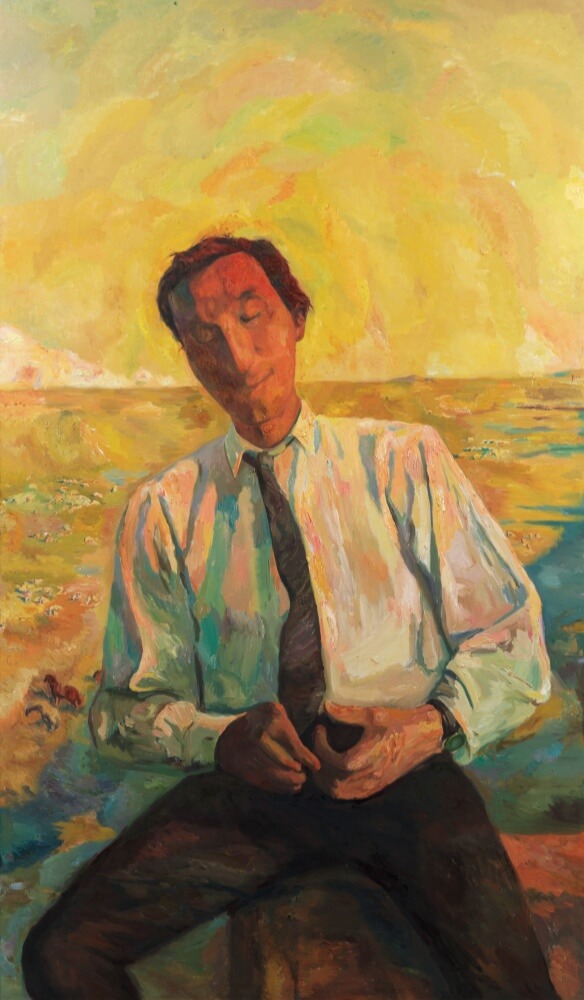
Lot 228
Chao Ge (b. 1957)
Knight Su and
1998
Oil painting on canvas
191×112 cm.
Signature: Chao Ge, June 1998.
display
"Twenty Years of Revelation—An Exhibition of Contemporary Chinese Art," October 15-25, 1998, Beijing Working People's Cultural Palace, Beijing.
The 3rd Paris-Issy International Biennale, March 12 – April 11, 1999, Paris, France
illustrate
Received the Jury Prize at the Paris-Issy International Biennale
RMB: 800,000-1,500,000
Chao Ge’s “Knight Suho” (1998) is one of the few masterpieces that can accurately capture and profoundly reflect the complex emotions of an ancient civilization in the process of modernization with the quiet power of painting.
Chao Ge's art is often examined within the context of China's "new generation" or "new wounds." Unlike direct depictions of historical trauma, he portrays a pervasive, slow-moving "internal injury"—a profound sense of desolation and identity anxiety stemming from the quiet disappearance of his spiritual homeland behind economic development and material abundance. This work is one of his most complete and compelling visual expressions on this theme.
Created in 1998, a time of profound transformation in Chinese society, Chao Ge astutely captured a pervasive spiritual symptom.The painting depicts a dramatic conflict between tradition and modernity, rural and urban life, and inner identity and the external world. The Mongolian knight in a suit sitting alone on the grassland is not a specific person, but a highly condensed cultural symbol, a spiritual microcosm of countless individuals who feel alienated and confused in the wave of modernization.
In Chao Ge's personal creative sequence, the period around 1998 was his "golden period," in which both his style and thought reached maturity.
"Knight Sue" combines symbolic composition, spiritual portrayal, and conflicting colors, making it a complete embodiment and summary of his artistic pursuits in the 1990s. The work was exhibited at the Paris "Issy Biennale" the following year (1999) and won the Jury Prize.
As a precise slice of the Chinese social and cultural mentality in the late 1990s, this work is a key piece for studying the "rural reflection" and "spiritual painting" trends in contemporary Chinese art at the turn of the century.
Other recommended auction items
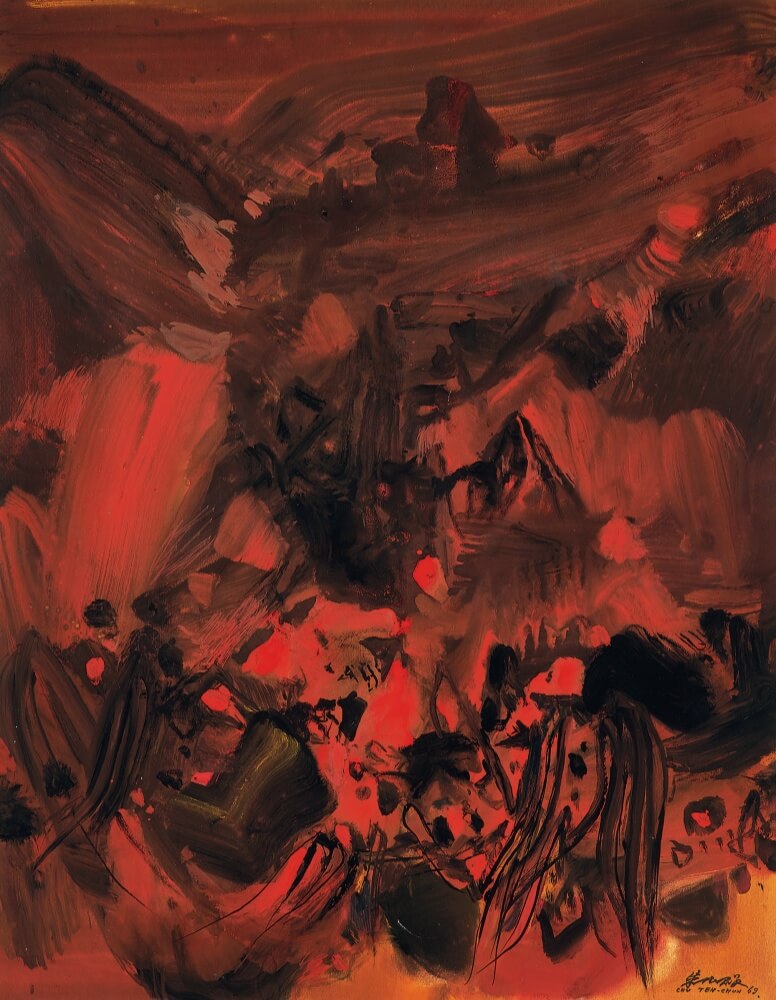
Lot 167
Zhu Dequn (1920-2014)
Song of Fire
1969
Paper acrylic
62.5 × 47.5 cm.
source
China Guardian, 20th Century Art, May 20, 2021, Lot 1748
illustrate
The work will be included in the "Chronological Collection of Chu Teh-Chun's Works" compiled by the Chu Teh-Chun Foundation and Ms. Chu Ching-Chao.
RMB: 1,200,000-1,800,000
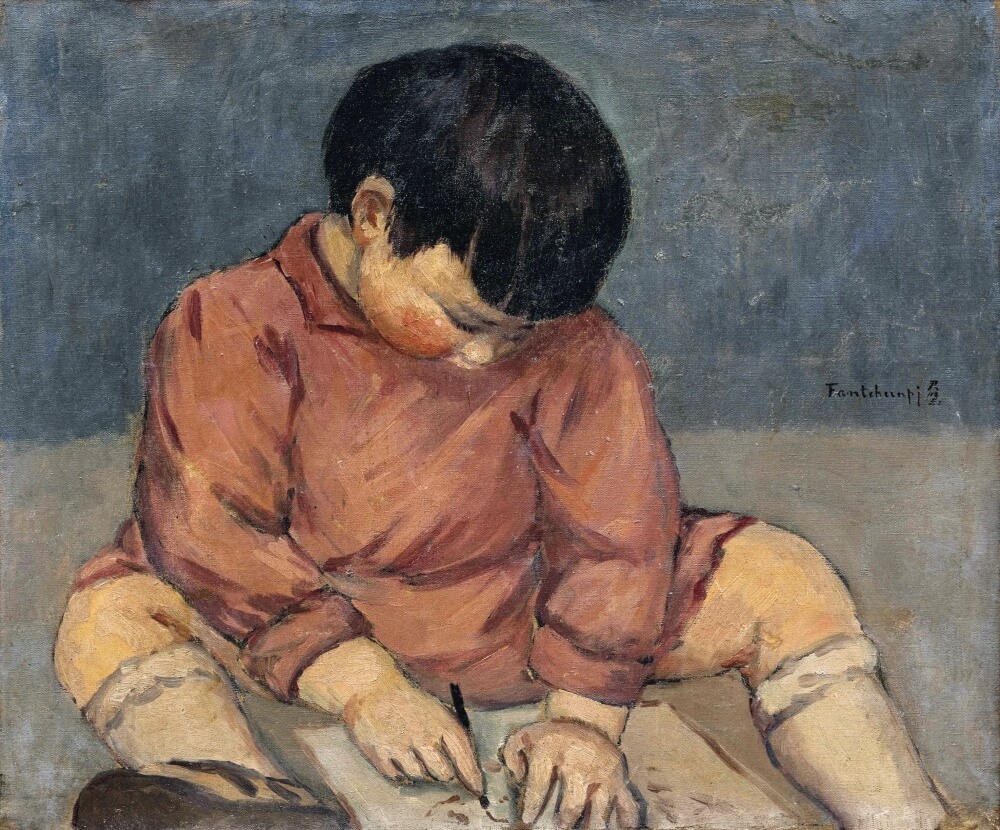
Lot 12
Fang Junbi (1898-1986)
little painter
1929
Oil painting on canvas
46×55.5 cm.
Signature: FanTchunpi Junbi; 1929 (on the back of the painting)
Publish
The inaugural issue of *Women's Monthly*, Volume 1, Issue 1, published by Women's Bookstore in Shanghai on March 8, 1933, featuring illustrations.
RMB: 300,000-500,000
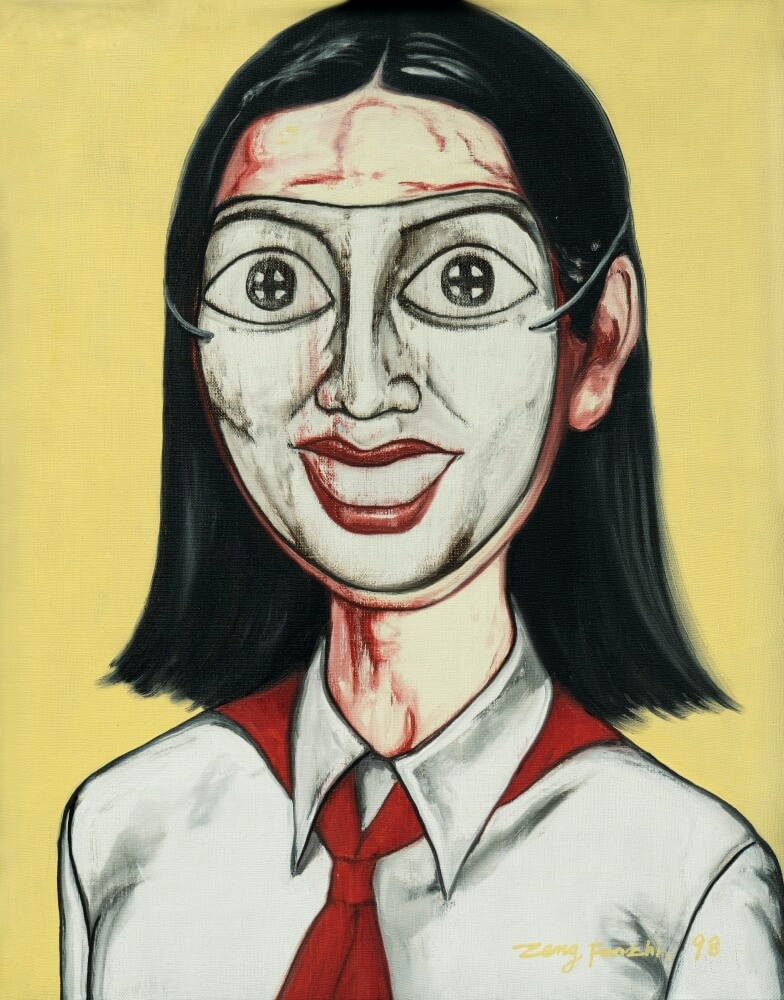
Lot 175
Zeng Fanzhi (b. 1964)
Mask Series
1998
Oil painting on canvas
48×38 cm.
illustrate
Attached is a certificate of artwork signed by the artist and issued by Fanzhi Studio.
RMB: 1,800,000-2,500,000
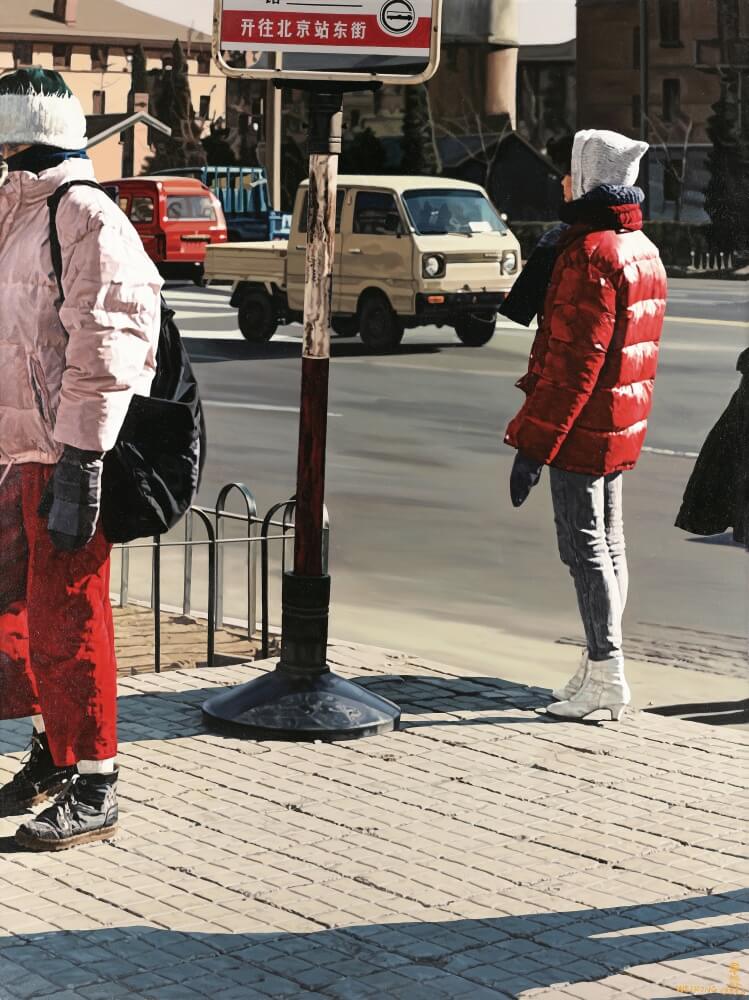
Lot 176
Wei Rong (1963-2025)
Winter
1989
Oil painting on canvas
130×97 cm.
Publish
The Artist, 1990, page 213
Jiangsu Pictorial, Jiangsu Provincial Publishing House, Nanjing, 1991, page 24
Selected Oil Paintings by Young Faculty Members of the Central Academy of Fine Arts, Shandong Fine Arts Publishing House, Jinan, 1991, p. 19
"Forty Years of the Central Academy of Fine Arts: Selected Outstanding Works by Faculty Members", People's Fine Arts Publishing House, Beijing, Plates
A Collection of 20th Century Chinese Oil Paintings, Guangxi Fine Arts Publishing House, Nanning, 2001, p. 226.
A History of Chinese Oil Painting, China Youth Press, Beijing, 2010, p. 361
A Century of Localization of Chinese Oil Painting, People's Publishing House, Beijing, 2017, p. 433.
RMB: 200,000-300,000
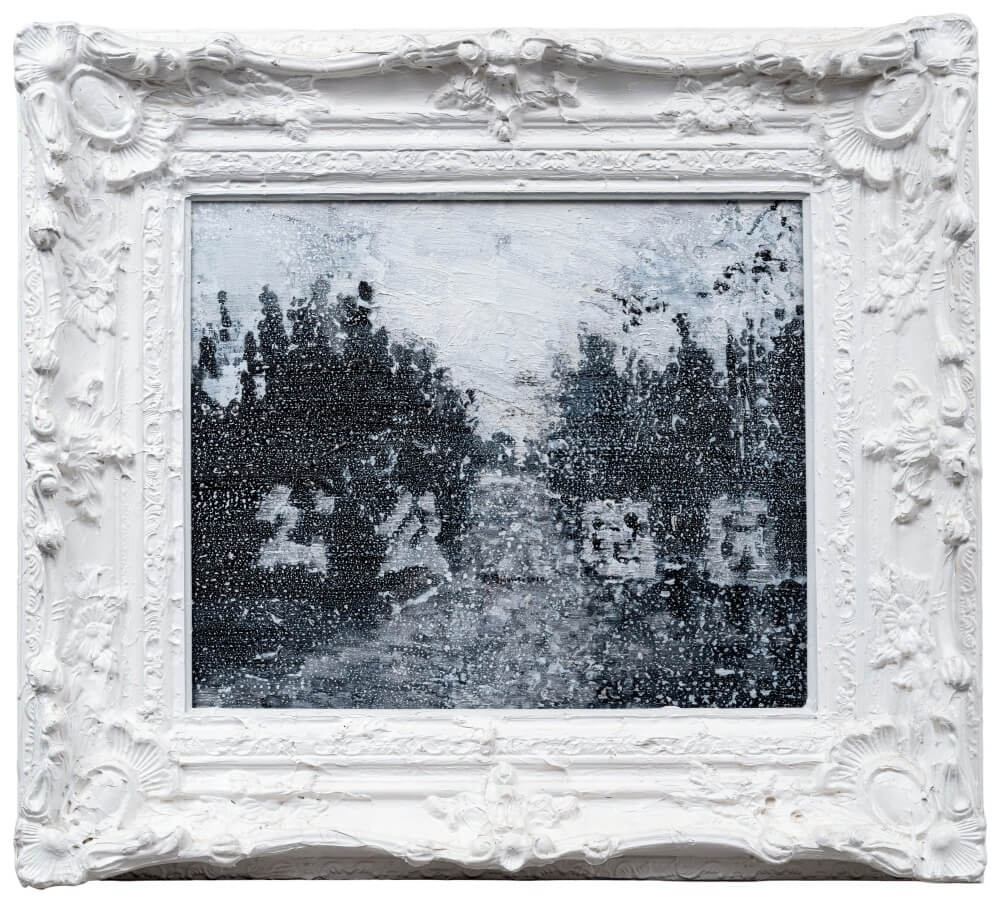
Lot 164
Liu Wei (b. 1965)
Public Park
2010
Oil painting on canvas
82×92 cm
Publish
Art Review, December 2010, page 49
Gallery Guide Hong Kong, Issue 29, May 2011, Page 23
Surrealist Reality: Liu Wei, KERBER VERLAG, Berlin, 2015, pp. 46-47
Exhibition
"Liu Wei's Works Exhibition", December 12, 2010 to February 28, 2011, Aye Gallery, Beijing
"Surrealist Reality—Ji Dachun, Liu Wei, and Mou Baiyan," June 14–August 16, 2015, Ludwig Museum, Germany.
"A Shared Scene: UCCA 15th Anniversary Board Collection Exhibition," April 16 – August 7, 2022, Ullens Center for Contemporary Art, Beijing.
RMB: 800,000-1,500,000
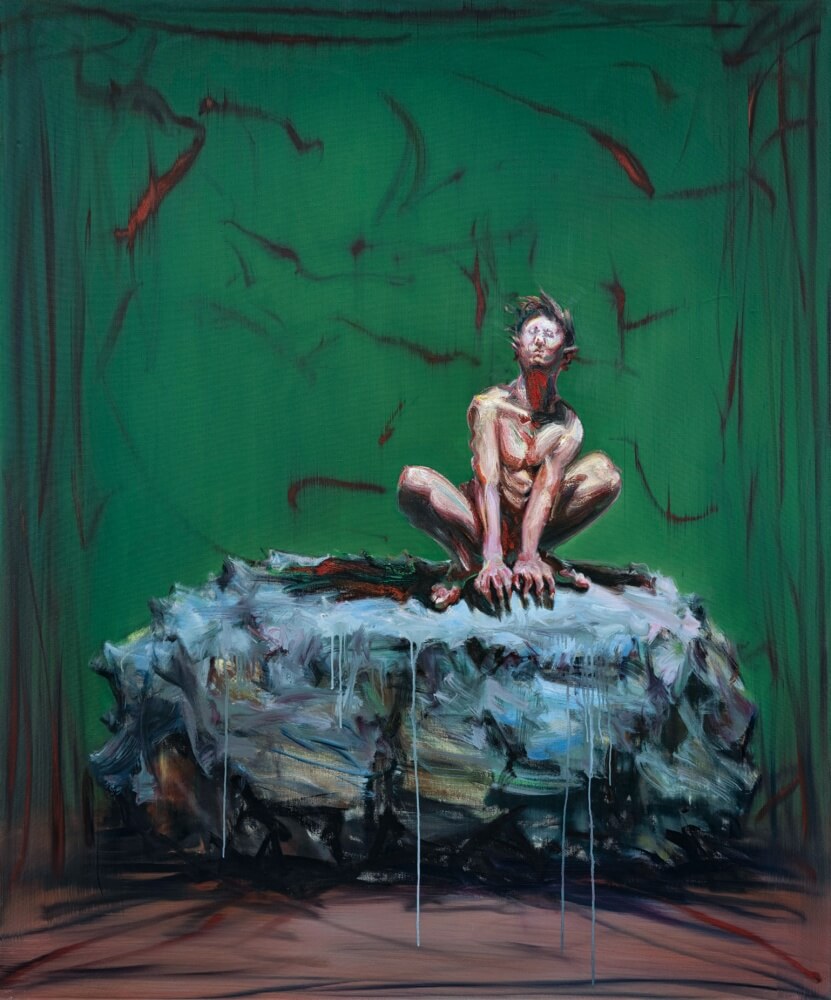
Lot 104
Yin Zhaoyang (b. 1970)
king
2006
Oil painting on canvas
180×150 cm.
Signed: Chaoyang, 2006 (on the back of the painting)
RMB: 300,000-500,000
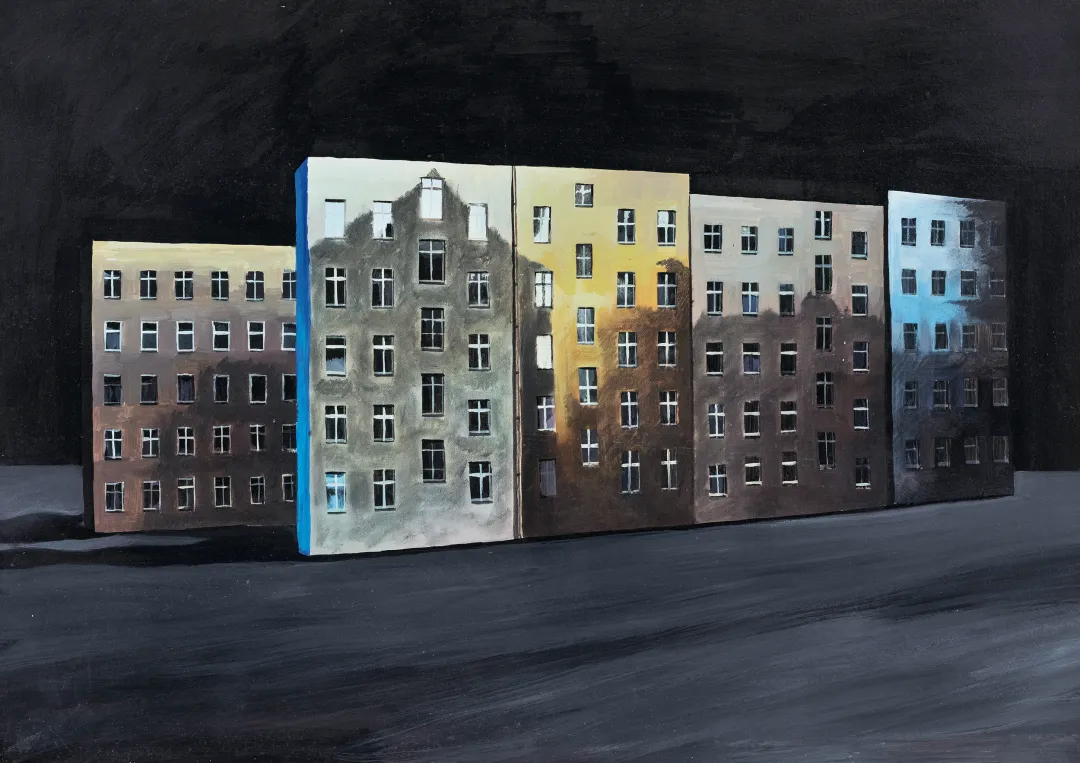
Lot 184
Kang Haitao (b. 1976)
dusk
2004
Cardboard Acrylic
78×107 cm
RMB: 280,000-380,000
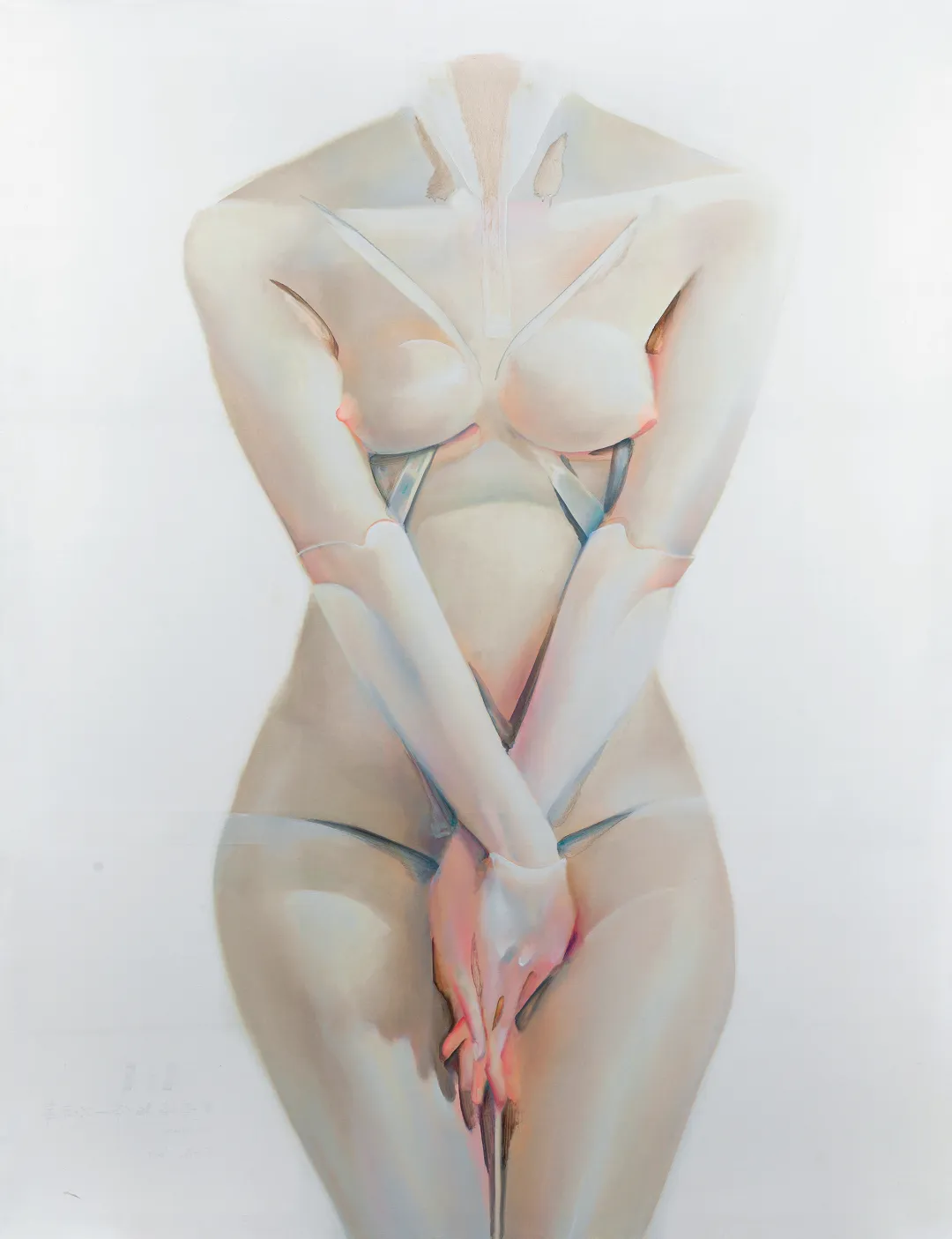
Lot 186
Song Kun (b. 1977)
Cyborg body
2019
Oil painting on canvas
180×140 cm
RMB: 400,000-600,000
Preview time
May 7-10
Auction Date: May 11
20th Century and Contemporary Art 14:00
Special Contemporary Art Session 17:00
20th Century Art Evening Session 19:30
Contemporary Art Evening Session 20:00
Auction Location
Guardian Art Center, B1 Floor, Hall A
Stay tuned to ArtPro for the latest updates on the global art market.