
[2026 Spring Auction] Zao Wou-Ki and Wu Dayu Lead the Way: Guardian Hong Kong Fine Art Exhibition Debuts at March Art Events
From March 25 to 27 this spring, Guardian Hong Kong's "Asian 20th Century and Contemporary Art" department will hold a fine art exhibition at the Grand Hyatt Hong Kong's Loft Gallery, concurrently with Art Basel, presenting nearly 50 highlight works.
This launch"The Sound of Power" Special FeatureThis exhibition focuses on 16 contemporary Asian masters, showcasing their exceptional use of line, color, and movement, and their artistic achievements. Among them are renowned Chinese modern art masters.Zao Wou-Ki,Wu DayuAvant-garde female artistsYayoi Kusama,Xie JinglanJapanese Hall of Fame RepresentativeShiroka Kazuo,Yoshitomo NaraLiu Guosong, the father of modern Chinese ink painting; Ding Yanyong and Lin Fengmian, renowned 20th-century artists; Chen Ke, a contemporary Chinese avant-garde.Ding Yi,Huang Yuxingand Spanish artistsJavier CallejaHis important representative works, such as these, reveal the tension and rhythm in the paintings, between intensity and elegance, strength and gentleness, and allow one to hear the rhythmic echoes created by the interplay of lines, colors, and movement!
In addition, the exhibition will also feature Chinese sculptor Li Zhen and Japanese artist who created a world where all things have a spirit.Nakamura MoeAnd "Japanese oil painting creators"Zenzaburo KojimaThis collection of classic works by artists such as [names of artists] showcases the diverse facets of contemporary art.
01
The mountains stand tall and majestic, while the Yellow River flows down from the heavens.
Zhao Wuji's Penglai Realm, where he coexists with heaven and earth
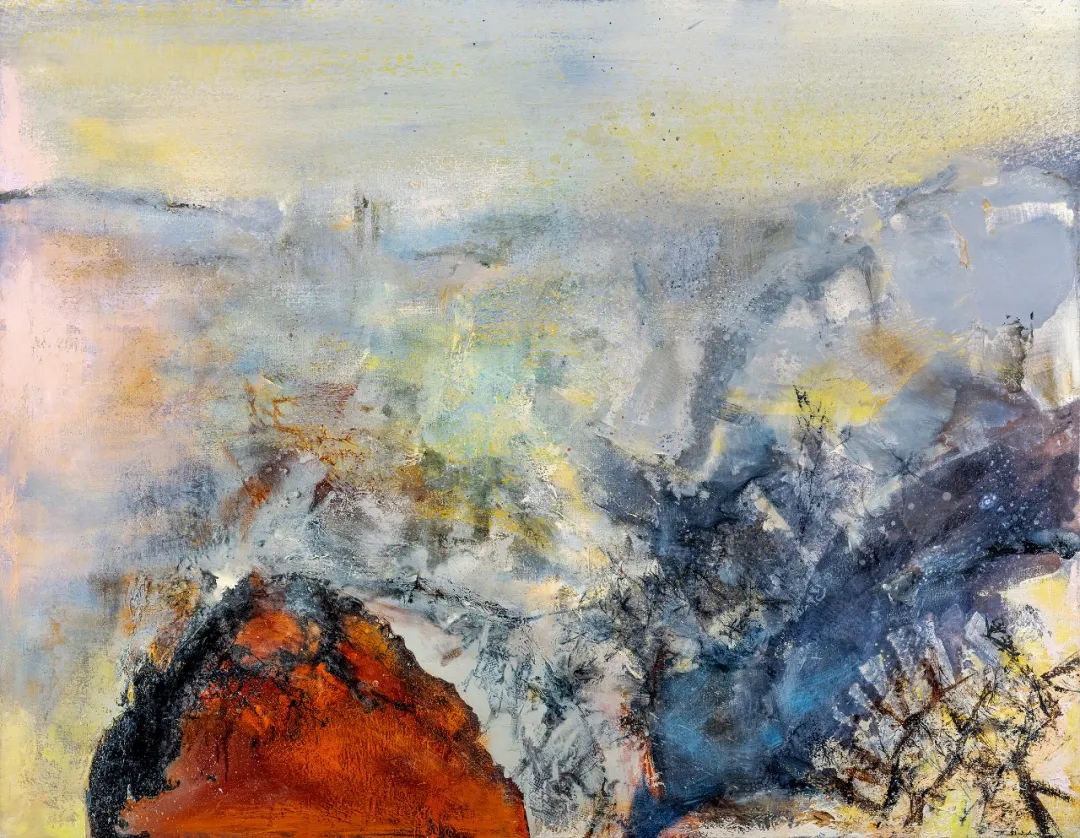
Zao Wou-Ki, April 9, 2009 - June 7, 2007, 2008
Oil paint on canvas
Written in 1992-1993
114 × 146 cm
Estimate: HK$9,000,000 - 15,000,000
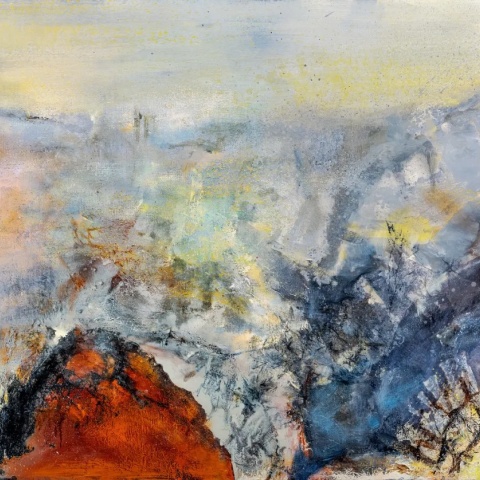
Leading the spring auction is Zao Wou-Ki's important representative work from the 1990s, "09.04.92-07.06.93".When Zao Wou-Ki created this work, he was already famous throughout the East and West and was frequently invited to hold major exhibitions in Europe and Asia. In addition to reflecting his broad mind at that time when he was successful and content, the work was also exhibited in ten major retrospective exhibitions of Zao Wou-Ki, including the Château de Chenonceau in France, the National Art Museum of China in Beijing, the Shanghai Museum, and the Hong Kong Museum of Art, which shows that it is a landmark and representative work.
Since 1954, Zao Wou-Ki has abandoned concrete imagery in favor of abstract representation; however, here he places it in the lower left corner.However, it is rare to see his detailed depiction of natural mountain shapes. The solid triangular peaks stand tall and proud, and the orange-red color is like autumn maple leaves dyeing the forest and the mountains turning red, which infuses the canvas with a vigorous vitality!Meanwhile, the large brush on its right, stained with a light blue color, extends downwards in a parabolic motion.If the Yellow River's waters came from the sky...In an instant, waves surged forth and gathered beneath them to form a deep blue lake.On the left and right sides, one is fiery red like flames, the other is as blue as the sea; one is as still as a mountain, the other is surging endlessly, revealing the Lao-Zhuang philosophy of the mutual generation of Yin and Yang.
Zao Wou-Ki once said:"Every building in my childhood home had a yard, and even if it was small, it always had a fish pond and a clear spring, just like the house I lived in in Paris. I loved having the sound of flowing water to my ears."The azure blue in this painting, like a clear spring, is an element he cherished throughout his life. The majestic orange-red mountains are like the mountain peaks he saw peeking out from the clouds when he climbed to a high place countless times, or the mountains in paintings he saw when he and his father appreciated the treasured works of Mi Fu and Zhao Mengfu in his childhood.In addition, the painting is filled with a divine golden radiance that seems to travel through more than thirty years from the background, rushing towards us and leading us into this fairyland that is like Penglai.The work vividly demonstrates the painter's transcendent state of mind at that time, where he felt at one with heaven and earth and all things. It is truly a masterpiece!
02
One man can hold the pass against ten thousand; with his strength and speed, he can sink and soar across the sea and sky.
Echoes of Heaven, a masterpiece of Wu Dayu's musical composition
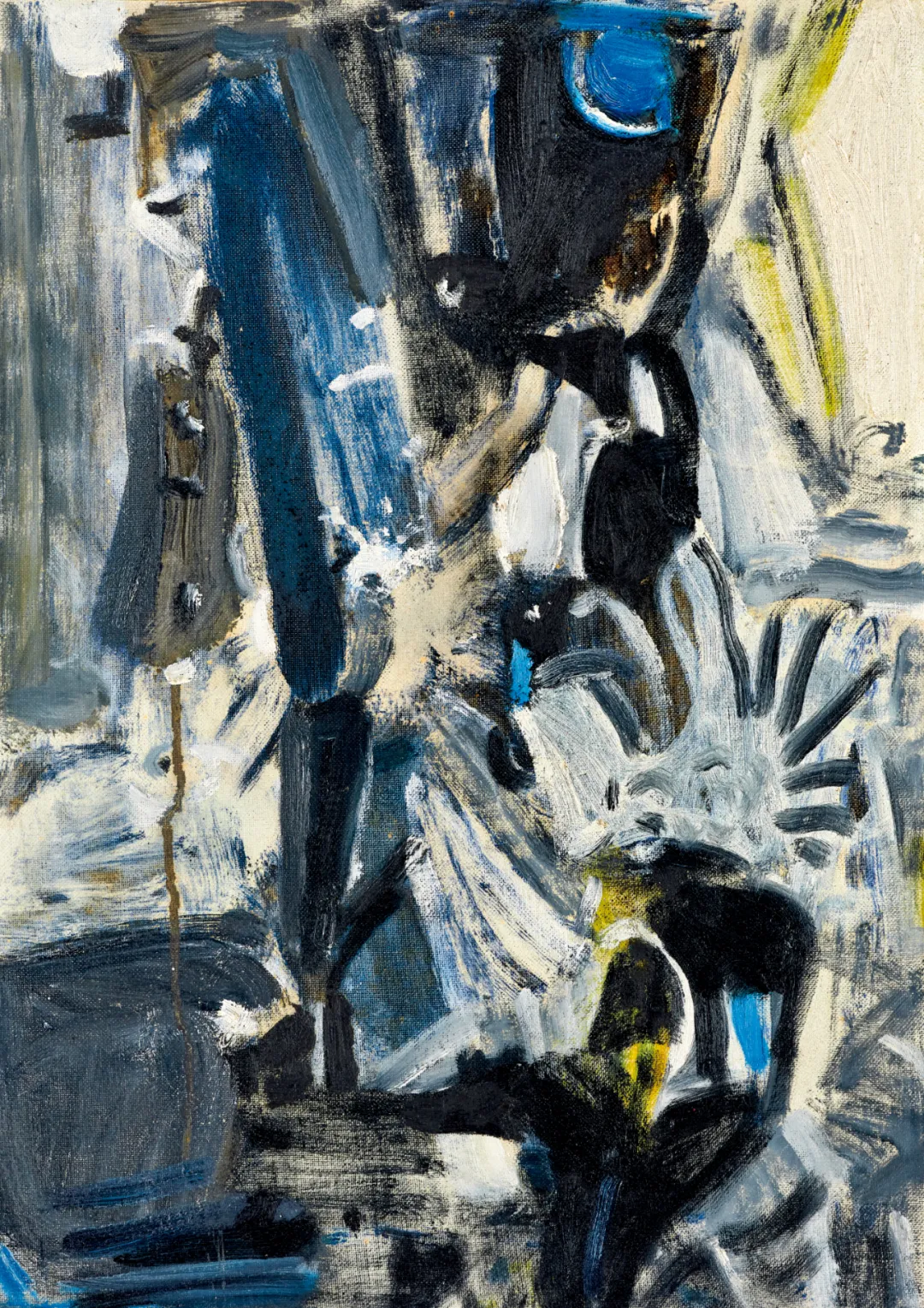
Wu Dayu's "Rhyme Score (Untitled 62)"
Oil paint on canvas
Worked around 1980
53 × 38 cm
Estimate: HK$8,000,000 - 13,000,000
"Pu Yun (Untitled 62)" is considered a masterpiece among masters of the 20th century.——A rare oil painting by Wu Dayu. This work has been exhibited in major solo exhibitions of the artist at the Taipei History Museum and the Shanghai Art Museum. On the 95th anniversary of Wu Dayu's birth, the work was selected by the Shanghai Art Museum as a "commemorative first-day cover" representing his lifelong aesthetic achievements, which speaks volumes about its significance.
In this work, Wu Dayu abandoned the complex color spectrum and boldly constructed the entire world with condensed Prussian blue, ochre yellow and black.The robust human body in the lower right corner of the image is presented with a steady yet explosive power.This demonstrates the solid foundation he built from his studies in classical sculpture in France, as well as his exquisite understanding of human proportions. The figures' postures possess the poised tension of the ancient Greek sculpture "Discobolus," and also resemble Pangu creating the world.With the will of a lone warrior guarding the pass, he guided the flow of light and color in the picture, demonstrating a strong "movement of momentum".In the upper left,An instrument that "fuses East and West" emerges, possessing both the cross-shaped headstock of the Eastern pipa and the curves of the Western cello, forming a "sound entity".
In this work, we seem to "see" sound: the steady, lingering blocks of color are the resonance of bass notes, the unrestrained brushstrokes are the soaring strumming of strings, and the intense collision of forms is a magnificent symphony! It vividly showcases what he pursued throughout his life."The musicality of painting"Between the two, the bright yellow color, like lightning streaking across the night sky, leaps out with lively dots and lines. And the bird swooping down in the center further expresses the artist's sincere yearning for freedom.Among all his oil paintings, this work is the only one that clearly and concretely depicts musical instruments and human figures, making it exceptionally rare!
03
The rolling mountains and rivers blend seamlessly with the vast sky.
Xie Jinglan's "Warm Sun" - A shimmering, ethereal realm
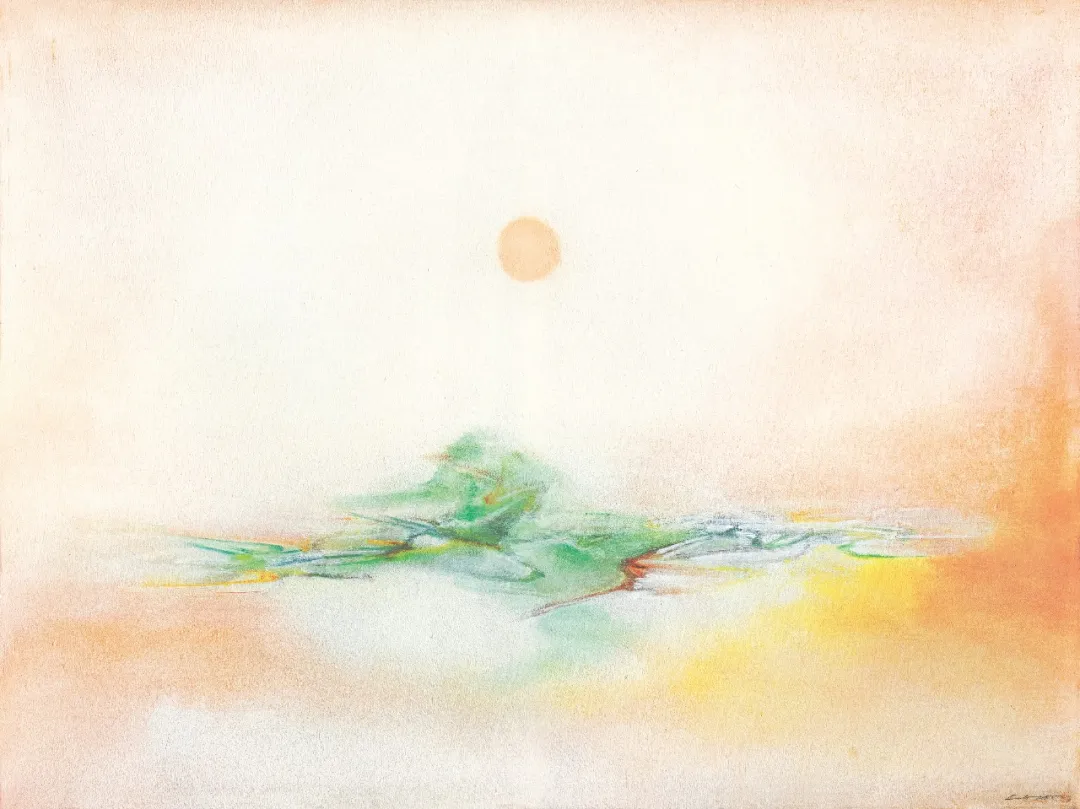
Xie Jinglan, "A Warm Sun"
Oil paint on canvas
Written in 1973
46 × 61.5 cm
Estimate: HK$180,000 - 280,000
Hsieh Ching-lan, who rose to international prominence in the 1970s for her "comprehensive art" that combined painting, dance, and music, transcending East and West, is a unique figure in the international art scene."The Warmest Day" was completed in 1973, when she received a grant from the French Ministry of Culture and was highly recognized.
The artwork uses a beige base, resembling an unfolded sheet of rice paper, creating a warm and hazy atmosphere. A touch of light orange at the top, like gentle sunlight, sets the tone for the painting both softly and firmly. The mountains below are outlined in emerald green, cyan, and ochre, the lines combining the rhythm of dance with the brushstrokes of calligraphy.It showcases the vastness and continuity of the landscapes of the Southern Song Dynasty, transforming classical painting scenes into the rhythm of modern oil paint. What is most admirable is its handling of light: milky white and pale yellow are layered and interwoven, using thin-painting techniques to render transparent river water and misty vapor, blurring the boundary between heaven and earth, conveying the realm of "autumn water and sky merging into one color" with the poetic beauty of Monet's "Impression, Sunrise".The touch of pink on the right adds a touch of soft, rosy light to the tranquil river surface, further embodying the philosophical concepts of "illusion and reality" and "ethereal beauty" in Chinese painting theory.
Xie Jinglan found a balance between Eastern contemplation and Western expression, conveying a profound understanding of heaven and earth and nature through simple and quiet imagery.
04
Autumn colors stretch across the water, creating a poetic scene of waterfalls where the water's hues complement each other.
Xie Jinglan's "Untitled" - The beauty of relief sculpture through the tension and relaxation of ink lines
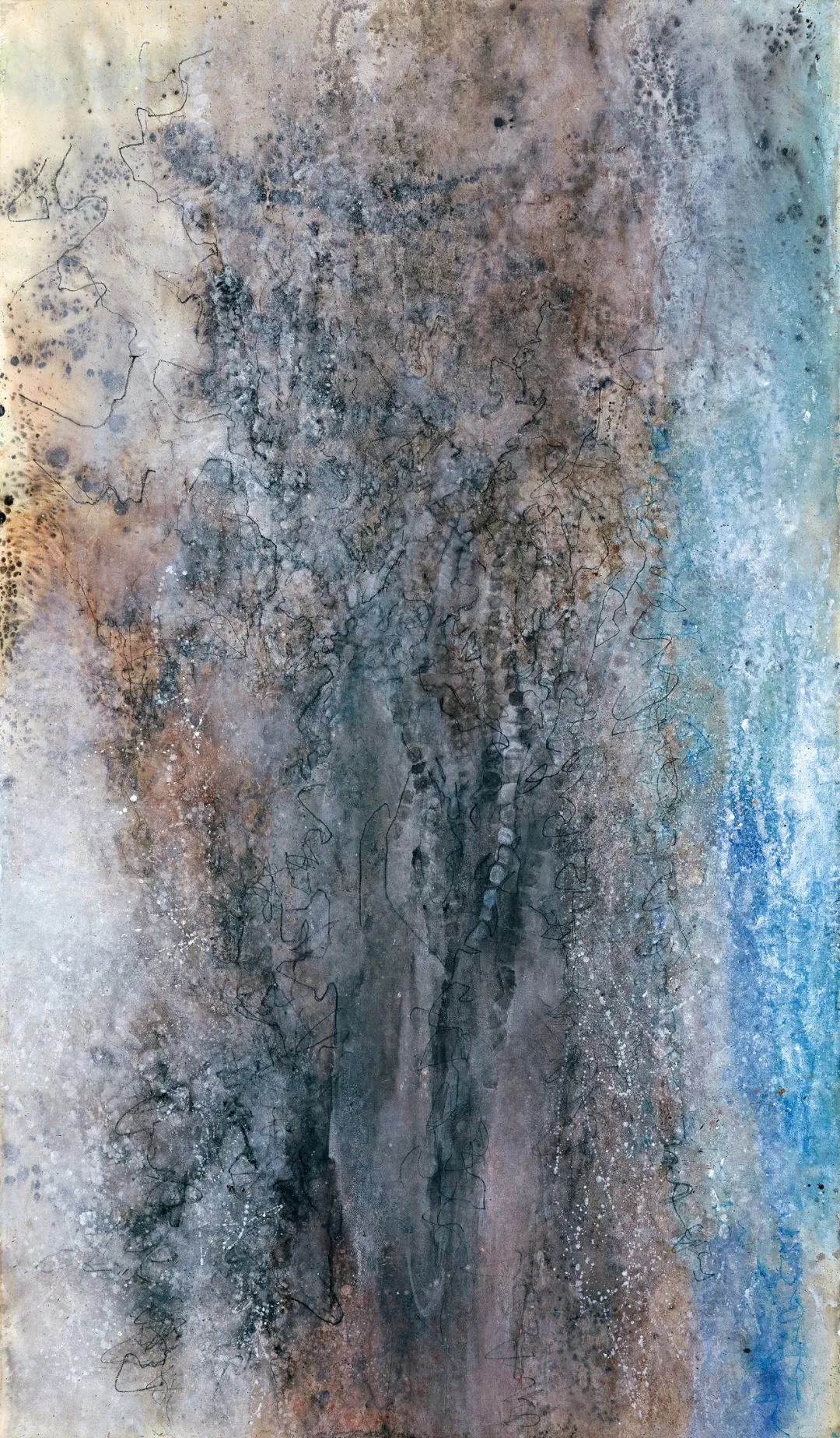
Xie Jinglan, Untitled
Composite Media Paper
Written in 1993
200 × 113 cm
Estimate: HK$1,000,000 - 1,800,000
Another work, "Untitled," completed in 1993, is a masterpiece created by Xie Jinglan in her later years after settling in Acacia Town, France, where she integrated and mastered various techniques.
The painting unfolds with the structure of a vertical landscape scroll, yet it perfectly embodies abstract beauty. Dense and vigorous charcoal lines run through the center, spiraling and stretching like a coiled dragon, while ink lines ripple outward like sound waves, and soft watercolors blend and diffuse in layers of rhythm.These lines, with their varying tension and release, represent both the fluctuations of electronic music and the twists and turns of a dancer's body, creating a three-dimensional relief effect with natural marble-like textures.Music, dance, and calligraphy are powerfully integrated here, perfectly interpreting the artistic conception of traditional Chinese painting and calligraphy with Western abstraction. The color scheme is based on Lanlan's signature clear gray-blue hue, with splashed white dots and blended cyan intertwined, and subtle warm yellow accents on the left side, presenting..."Autumn colors stretch across the waves, and cold mist hangs over the water like emerald."The scenery is captivating. The strong combination of blue and white evokes images of splashing waves and misty clouds as waterfalls cascade down.
Through the power of brushstrokes in Eastern calligraphy, the graceful and flowing lines of the body, and the undulating sound waves of music, the artist endows the water vapor with a dancing soul, showcasing the boundless and ever-changing nature of water, which is "formless yet infinitely varied"!
05
Nurturing your true self, writing a legendary life.
Yayoi Kusama's rare "group portrait" masterpiece makes its debut.
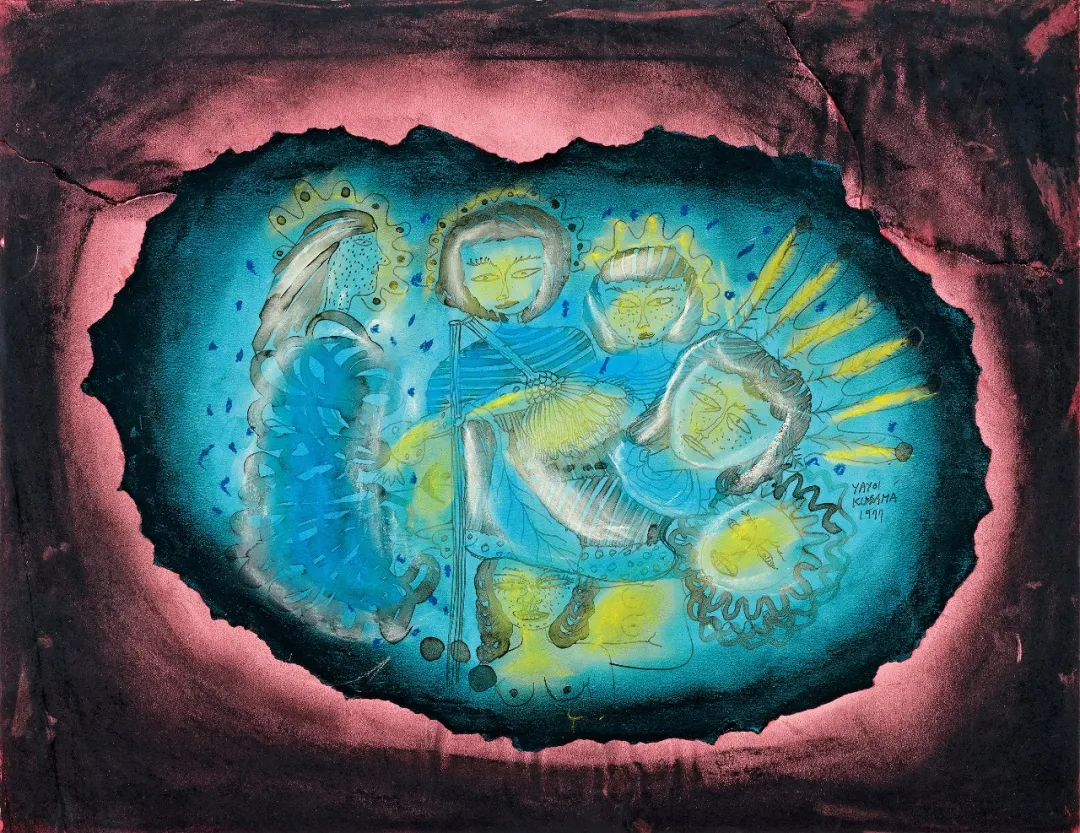
Yayoi Kusama's "Six Girls"
Watercolor, Ink, Collage, Paper
Written in 1977
42.2 × 54.4 cm
Estimate: HK$800,000 - 1,200,000
"Six Girls," making its auction debut and completed in 1977, is a rare "group portrait" work by Kusama that showcases his highly independent spirit after returning to Japan from New York. In the past thirty years, only five of his paper works depicting "group portraits of women" have appeared in the auction market, demonstrating the rarity of this subject matter.
The work showcases six protagonists with distinct hairstyles and attire, reflecting the diverse ethnicities of women from Asia, Africa, Europe, Judaism, and South America, or revealing their multifaceted and multifaceted selves. Some gaze directly at the viewer, while others boldly expose their breasts, expressing avant-garde ideas of "sexual liberation." The sparks, plants, feathers, and polka dots emanating from their heads not only reveal their personalities and aesthetics but also symbolize the divergence, collision, and fusion of ideas. Kusama depicts the girls with delicate black lines, tinting their hibiscus-like cheeks with warm yellow hues, making them shimmer in a clear sky.At the center of the image is a woman adorned with feathers, striking a "queen-like" pose, seemingly an embodiment of Kusama's own personality.The layers of poppies, like dancing skirts, bend towards her diagonally in front, while the entwined stamens to her left represent a spiritual link of "self-dissolution," giving birth to the artistic theme of her life. She seems to have been born from the heart of the red flowers, then broke through the "night" and burst forth with the power of fervent growth.
The works not only record Kusama's spiritual rebirth after returning to Japan, but also use female portraits to proclaim the diversity and resilience of life, reflecting the eternal poetry of the artist's spiritual rebirth and self-healing.
06
Beyond the tempest and stillness of life
A rare and unique Japanese painting: "Bamboo" - its emergence and rebirth.
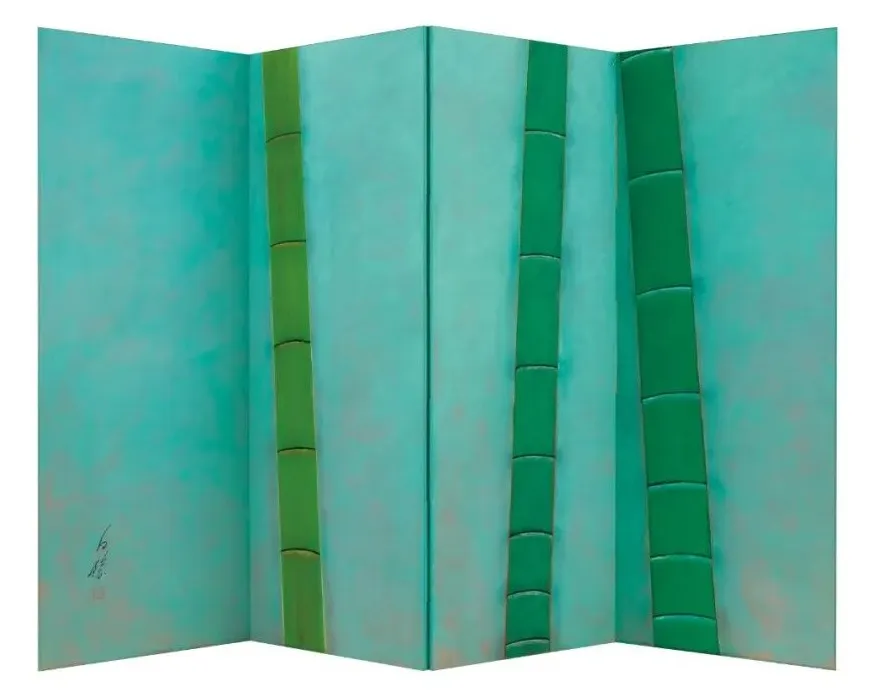
Kazuo Shiro's "Bamboo"
Rock painting on paper, screen
Written in 1981
176.3 × 268 cm
Estimate: HK$400,000 - 600,000
By the 1980s, Kazuo Shiraga had already gained renown in the art world for his "foot paintings," but he never forgot his artistic origins: when he enrolled in the Kyoto Municipal School of Fine Arts in 1942, he received systematic training in Japanese painting.In 1981, he was commissioned by the Niigata Shōtoku Inari Shrine to create one of only two Japanese paintings in his lifetime—the four-panel screen "Bamboo," a rare and exceptional piece. The work uses an ethereal and tranquil green as its base, with each of the first three panels depicting a section of bamboo. The colors flow delicately from dark green and emerald green to yellowish green, resembling the vitality of spring, the accumulation of summer, and the warmth of autumn.
This approach transcends the mere reproduction of plant forms, directly addressing the Japanese tradition's perception of the changing seasons and the cycle of life and death. The fourth screen, entirely blank, symbolizes the winter's dormancy and the quiet anticipation of the cycle of life. This rhythm of "existence-existence-existence-non-existence" is imbued with Eastern Zen philosophy, revealing the power of life through the blank spaces.
In addition, the white-haired artist deliberately selected a section of the bamboo stalk, creating a simple yet bold composition.It gives the bamboo joints a "sculptural sense of volume".He used the full force of oil paint to express the resilience of bamboo, while the varying shades and textures of mineral pigments also revealed the humble and open-minded nature of life.The truncated composition further suggests the existence of a wider bamboo forest beyond the picture, embodying the essence of Japanese "yūgen" aesthetics with the concept of "the infinite within the finite".
07
The Meditation Trajectory of Arcs and Linearity
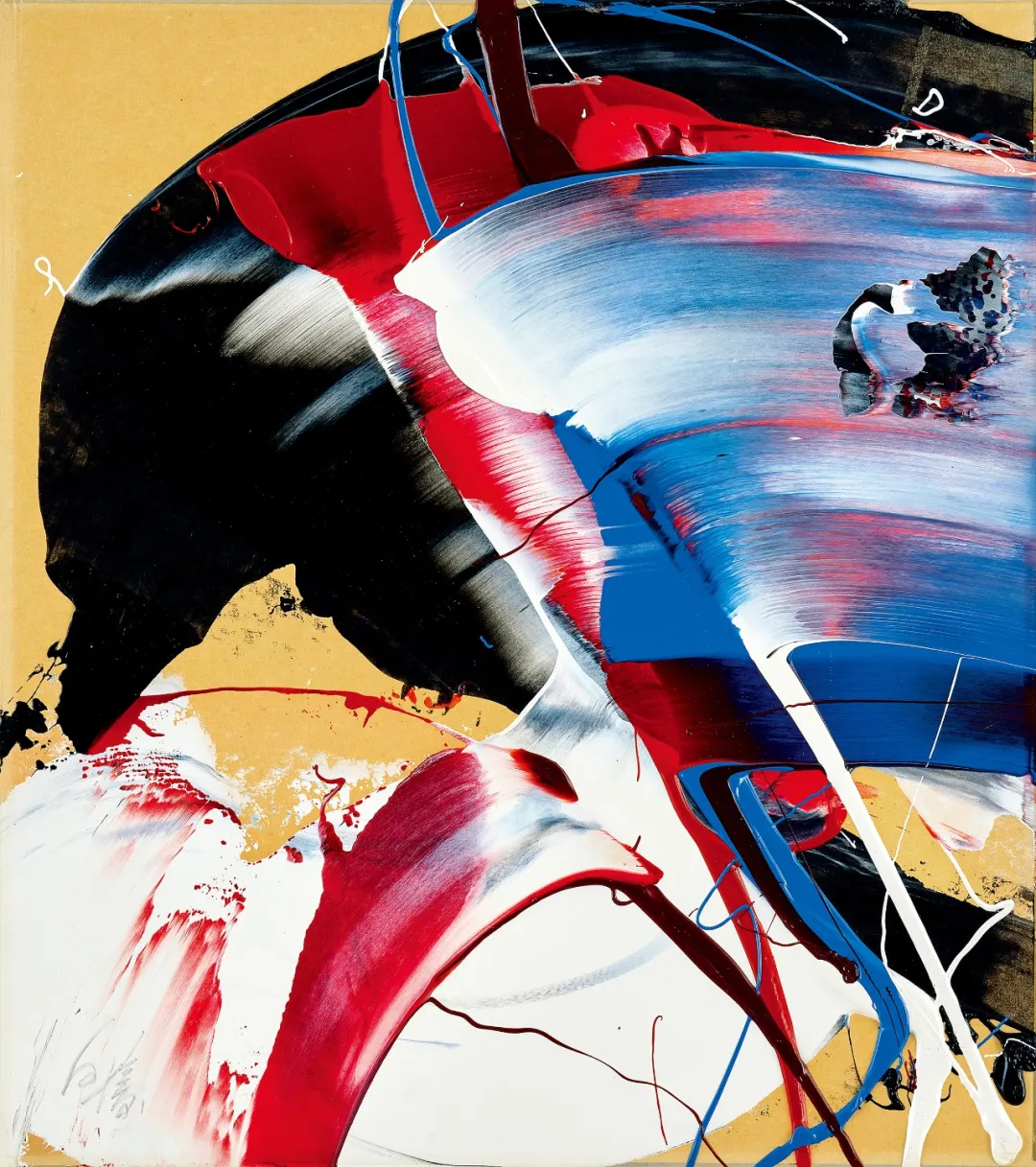
Kazuo Shirogane, Untitled
Oil paint on paper
Written in 1974
27.2 × 24.2 cm
Estimate: HK$60,000 - 100,000
08
A frenzied storm of color and ink
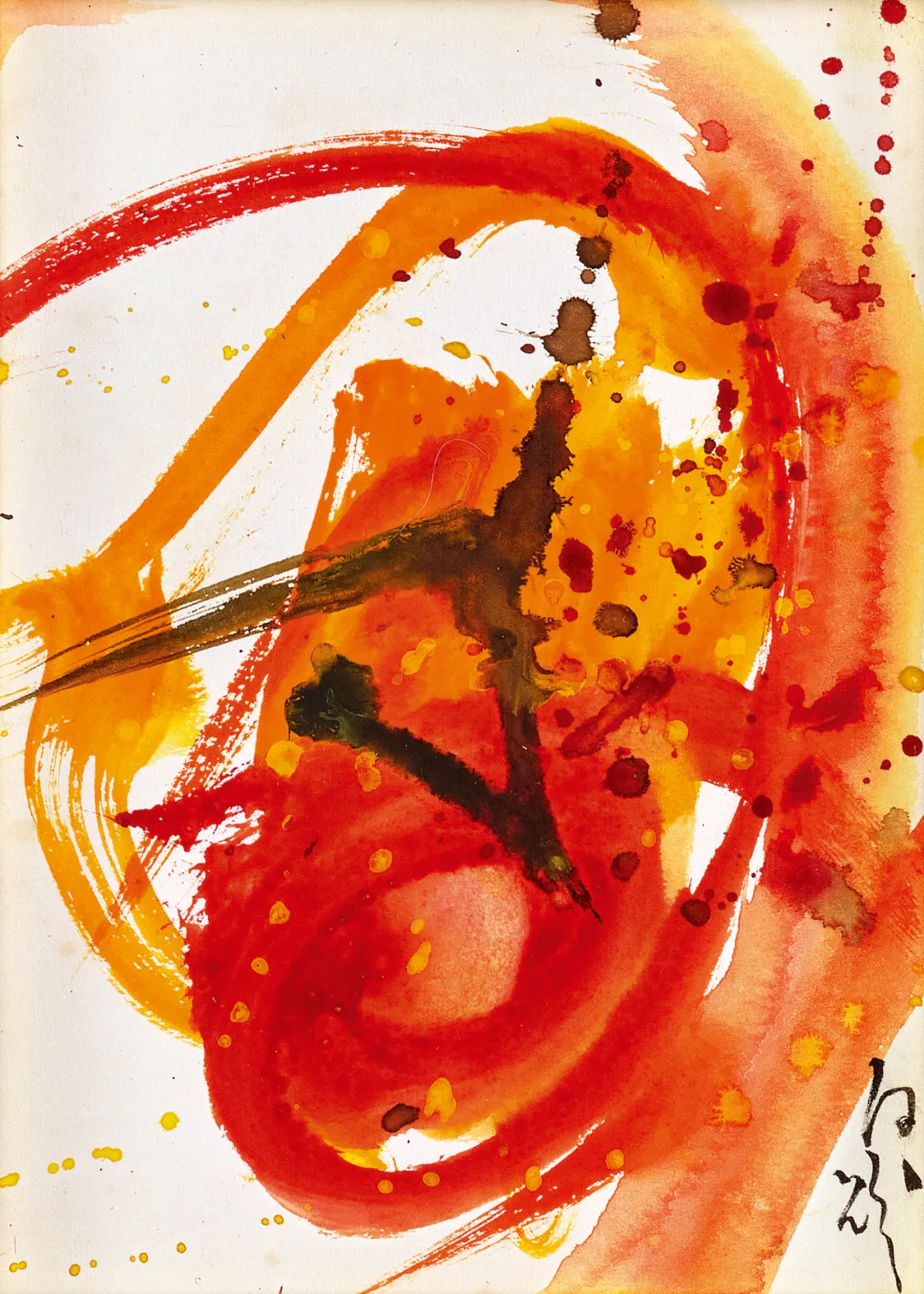
Kazuo Shirogane, Untitled
Watercolor on paper
Written in 1961
14.2 × 10.2 cm
Estimate: HK$20,000 - 40,000
09
Shining brightly on the earth, surging through the four seasons
Liu Guosong's rare 1990s hand-painted porcelain plaque series makes its first appearance.
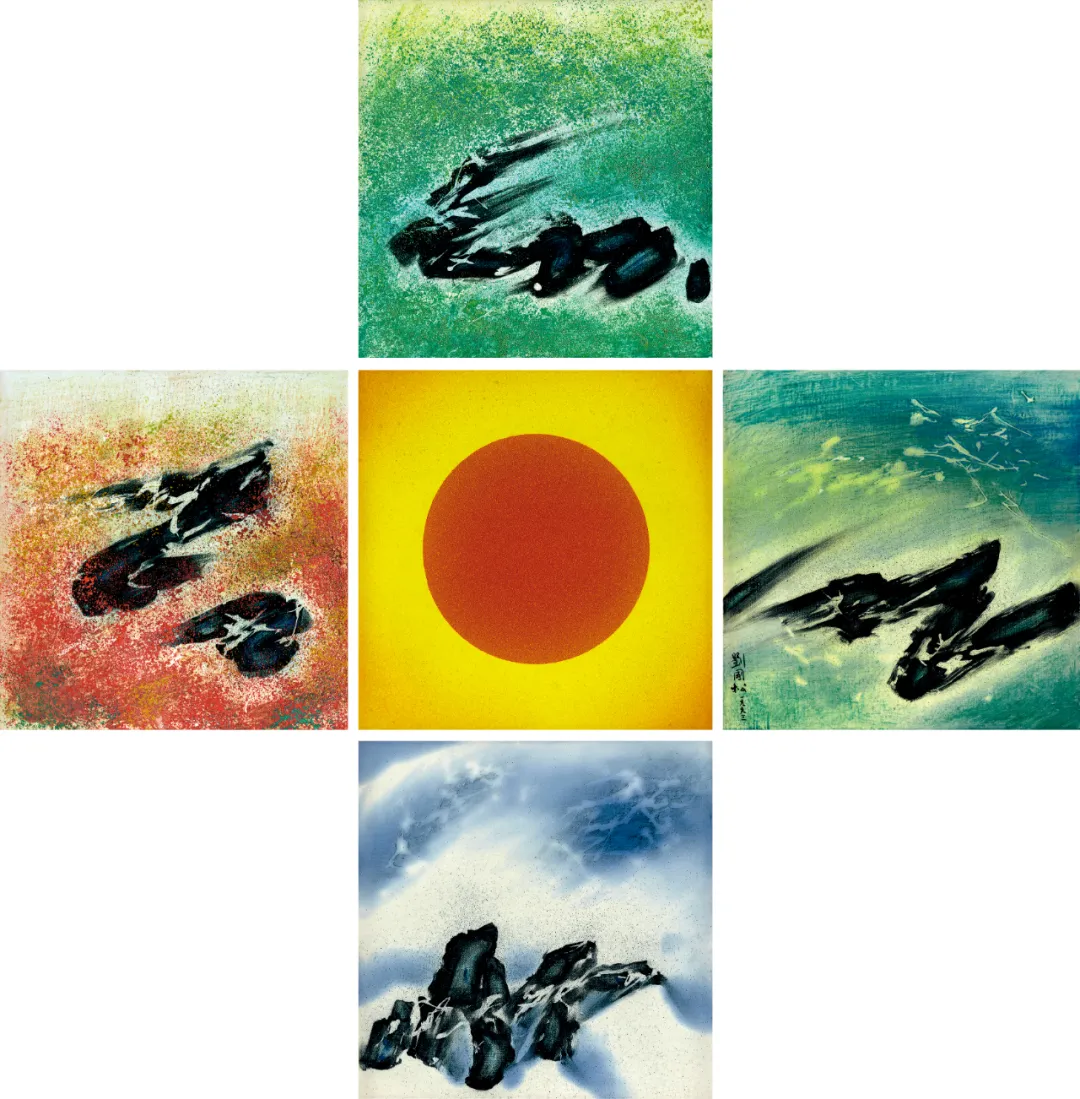
Liu Guosong, *The Cycle of the Four Seasons (A Set of Five)*
Hand-painted ceramics
Written in 1993
33 × 33 cm. × 5
Estimate: HK$250,000 - 350,000
Liu Guosong, known as the "Father of Modern Ink Painting," is a key figure in the reform movement of modern Chinese ink painting. By introducing new techniques such as collage and rubbing, he broke through the limitations of traditional brush and ink, and founded the "May Painting Society," which enjoys international renown. His works are collected by more than 80 important institutions worldwide, making him the living Chinese artist with the most museum collections, a truly significant position.
In 1968, inspired by the space photography of Apollo 8 and the Eastern philosophy of "a round heaven and a square earth", Liu Guosong launched his most popular "space series"."The Cycle of the Four Seasons" is an extremely rare porcelain plaque painting with a cross composition in this series. No more than five of his works with a cross composition can be seen in his lifetime, and fewer than four of his porcelain plaque creations can be seen at auction, which further highlights the rarity of this work.
At the center of the painting is the iconic circular cosmic image, symbolizing the sun, the source of life. The surrounding area is painted in shades of green, emerald, orange-red, and bluish-white, depicting the four seasons of spring, summer, autumn, and winter. He employs semi-automatic techniques such as splashing and splattering to create a naturally harmonious atmosphere; calligraphic brushstrokes transform with the seasons into cloud shadows, vitality, harvest, and snow-capped peaks, connecting the cosmic principles of the universe. The porcelain plaque, after firing in the kiln, possesses a lustrous sheen, giving the work a timeless quality.This work not only showcases the changing seasons, but also composes a cosmic poem that blends East and West and connects the past and present, embodying the highest realm of "harmony between man and nature".
010
The croaking of frogs in the breeze stirs the heart.
Ding Yanyong's exquisite oil painting "Summer Song" featuring a husband and wife.
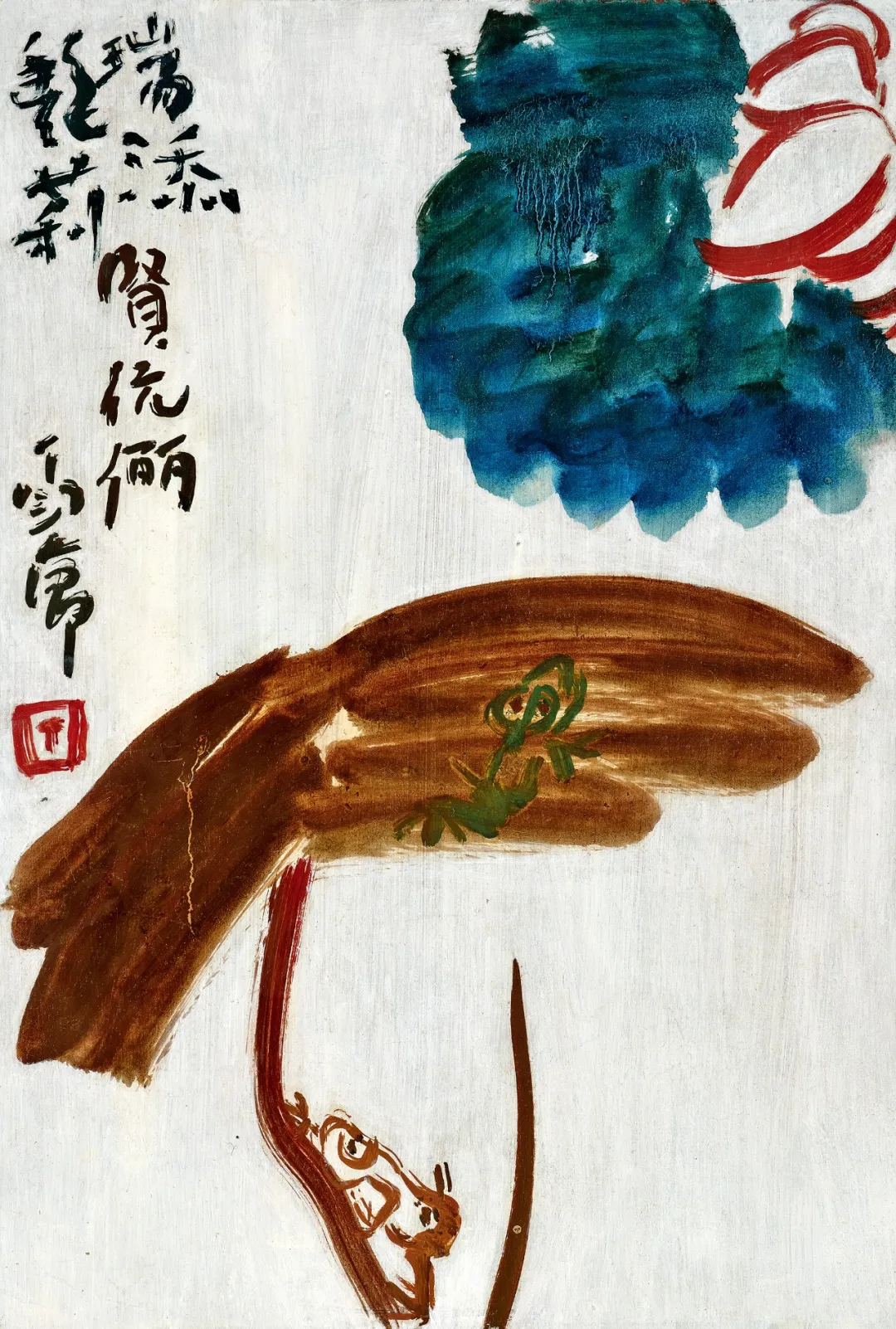
Ding Yanyong's "Summer Song"
Oil paint on wood panel
Made in the 1970s
45.2 × 30.5 cm
Estimate: HK$700,000 - 1,000,000
Ding Yanyong produced only 203 oil paintings in his lifetime, of which only 8 were on the theme of "flowers and birds". "Summer Song" is among these rare works. The work uses oil paint to showcase the characteristics and form of ink painting. Looking at his creations, it is unique and shows his outstanding talent.The inscription in the upper left corner of the painting is addressed to "Ruitian and Yanli, a virtuous couple." The name "Yanli" has appeared many times in Ding Gong's ink paintings given to his students, witnessing the deep teacher-student relationship between the two. What is particularly rare is that there is another portrait sketch on the back of the painting, and the person in the painting may be another recipient, "Ruitian."A painting with two sides, conveying both affection and blessings. The work was later collected by the renowned Hong Kong collector, Mo Yidian, and then kept by a prominent Asian collector for 27 years from 1999 onwards. Its reappearance at auction today is extremely rare!
The painting depicts two frogs perched between lotus leaves, one raising its head and croaking, the other climbing the stem in response, their stillness and movement complementing each other, like a couple whispering sweet nothings.In traditional culture, the croaking of frogs symbolizes a bountiful harvest and peace, and the sight of two frogs cuddling together implies a wish for "peaceful and tranquil times."Ding Gong captures the endearing clumsiness of frogs with his naive brushstrokes, condensing the refined taste of literati and folk wishes into a small space. Ding Yanyong, on the other hand, is dedicated to integrating the lines and ink techniques of Chinese painting into Western painting, and this work demonstrates his fusion: the lotus stems twist and turn like calligraphic brushstrokes, the frogs' outlines are concise and powerful, and the lotus leaves retain traces of "flying white" in their vigorous sweeping strokes. In terms of composition, the lotus flower is located in the upper right, and the lotus leaves and the two frogs form a diagonal line, guiding the flow of the eye. The background is painted with a thin layer of milky white to imitate the texture of Xuan paper, creating a sense of blank space and a balance between reality and illusion.
The work demonstrates the skill of "capturing the spirit through form" through bold and freehand brushstrokes. Amidst the gentle breeze rustling the lotus leaves and the clear croaking of frogs, worries dissipate, and love endures as one entrusts one's feelings to the world.
011
The swaying willows paint a picture of my heart.
Lin Fengmian's spiritual landscape that integrates East and West
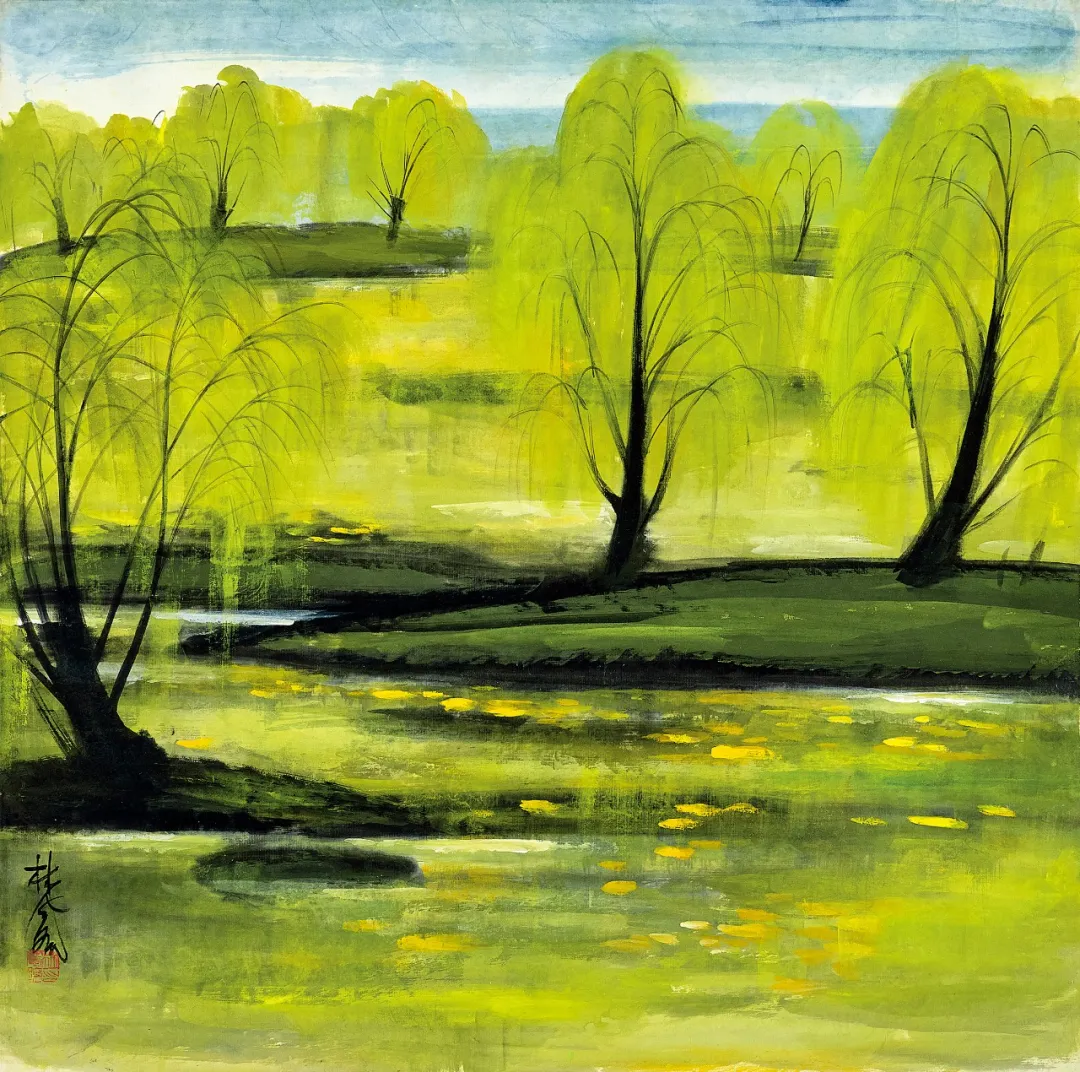
Lin Fengmian's "Tender Green Willows on the Embankment"
Color ink on paper
Written in 1958
68 × 68.5 cm
Estimate: HK$800,000 - 1,500,000
Growing up in a mountain village, Lin Fengmian was nurtured by the natural world from a young age, shaping his creative philosophy of "learning from nature," which became the core of his painting after the 1950s. This exhibition presents "Tender Green Willows on the Embankment," completed in 1954, from an important private collection in Asia. At that time, Lin Fengmian had resigned from his teaching position and settled in Shanghai, devoting himself entirely to creation and finding solace in nature.
The artwork, themed around the willows of West Lake that he loved during his time teaching in Hangzhou, employs his signature "square layout" to unfold a vast spring scene of shimmering water, tender willows swaying in the breeze, and a long embankment lying across the lake, showcasing a relaxed state of mind.With flowing curves that he hailed as the "line of beauty and life," he outlined the willow branches in his paintings with the graceful movements of dancers, echoing the postures of theatrical figures he explored after moving to Shanghai. Furthermore, the treatment of the willow leaves departs from traditional meticulous brushwork, employing large areas of thin washes of color to create a sense of volume using Western painting principles, showcasing a profound reflection on the fusion of the essence of Chinese and Western art, and revealing the poetic beauty of "willow leaves as ethereal as smoke" in the East.
The willow has been a symbol of resilience and integrity since ancient times. This work recalls the free spirit he had when he was in charge of the Hangzhou Academy of Fine Arts, which made Lin Fengmian stand out from the realist art scene that prevailed in the 1950s, showing his literary spirit and artistic passion that did not follow the trend.
012
Save every glimmer of light in life
Chen Ke and her dream chaser
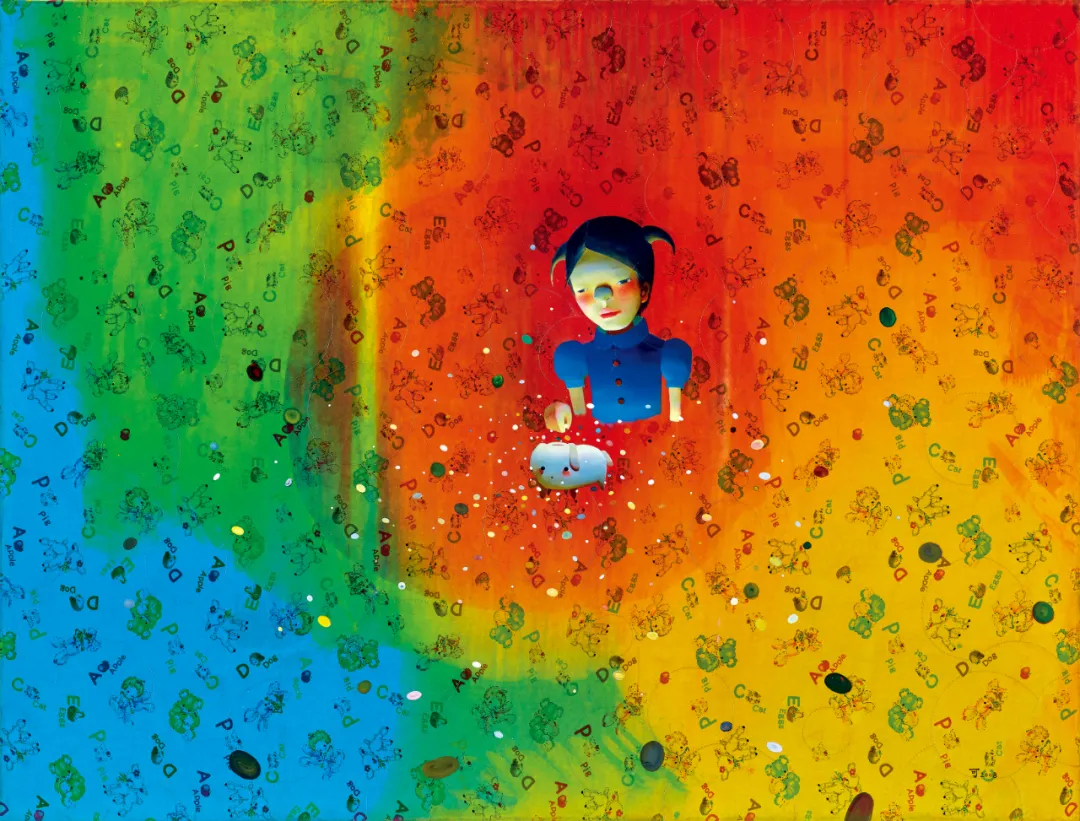
Chen Ke's "Two Sides of a Coin"
Multimedia Canvas
Written in 2008
145 × 190 cm
Estimate: HK$1,200,000 - 1,800,000
Completed in 2008, "Two Sides of a Coin" is a large-scale representative work by contemporary Chinese female artist Chen Ke, which interweaves the realistic weight of growth with the light radiance of dreams, exploring the dialectical philosophy of "two sides of one body" in life.
In the center of the image, a little girl with neatly combed hair and goat-like horns on her head is intently dropping a coin into a dog-shaped piggy bank. She is surrounded by surreal elements...Surrounded by a vortex of red, yellow, blue, and green colors, the artist hand-stitched together bubble-like circles with fine threads.Among them are teddy bear and rabbit dolls, as well as English words commonly used in early childhood education such as piglets and apples.Like a crib mobile in a nursery, it dances with colors into a joyful ocean, leading viewers back to their childhood memories.At the very instant the coin was tossed, concentric rings of brilliant light radiated outwards from it, like the explosion of a nebula at the dawn of the universe. These points of light were a perfect reflection of the girl's heartfelt wish:A fondness for dolls, the joy of acquiring new knowledge, and the yearning for love and understanding.All of them appeared in an instant.
"There are two sides to every coin"—this proverb encapsulates the core philosophy of the work. One side of the coin shines with the light of dreams, while the other bears the weight of reality; one side faces the future, the other clings to the past. The piggy bank stores not only money, but also fragments of life's memories; the act of tossing in a coin is an investment and a promise to the future. Chen Ke does not shy away from the sorrows of growing up, nor does she exaggerate the joys of childhood. Instead, with a gentle touch, she weaves together sweet childhood fun with a profound and complex inner world.It explores the dialectical philosophy of life in a lighthearted way—reality and fantasy, collecting and giving, solitude and abundance.This is thought-provoking.
013
Secret Letters Writing Your True Self
Yoshitomo Nara's Whispering Moments
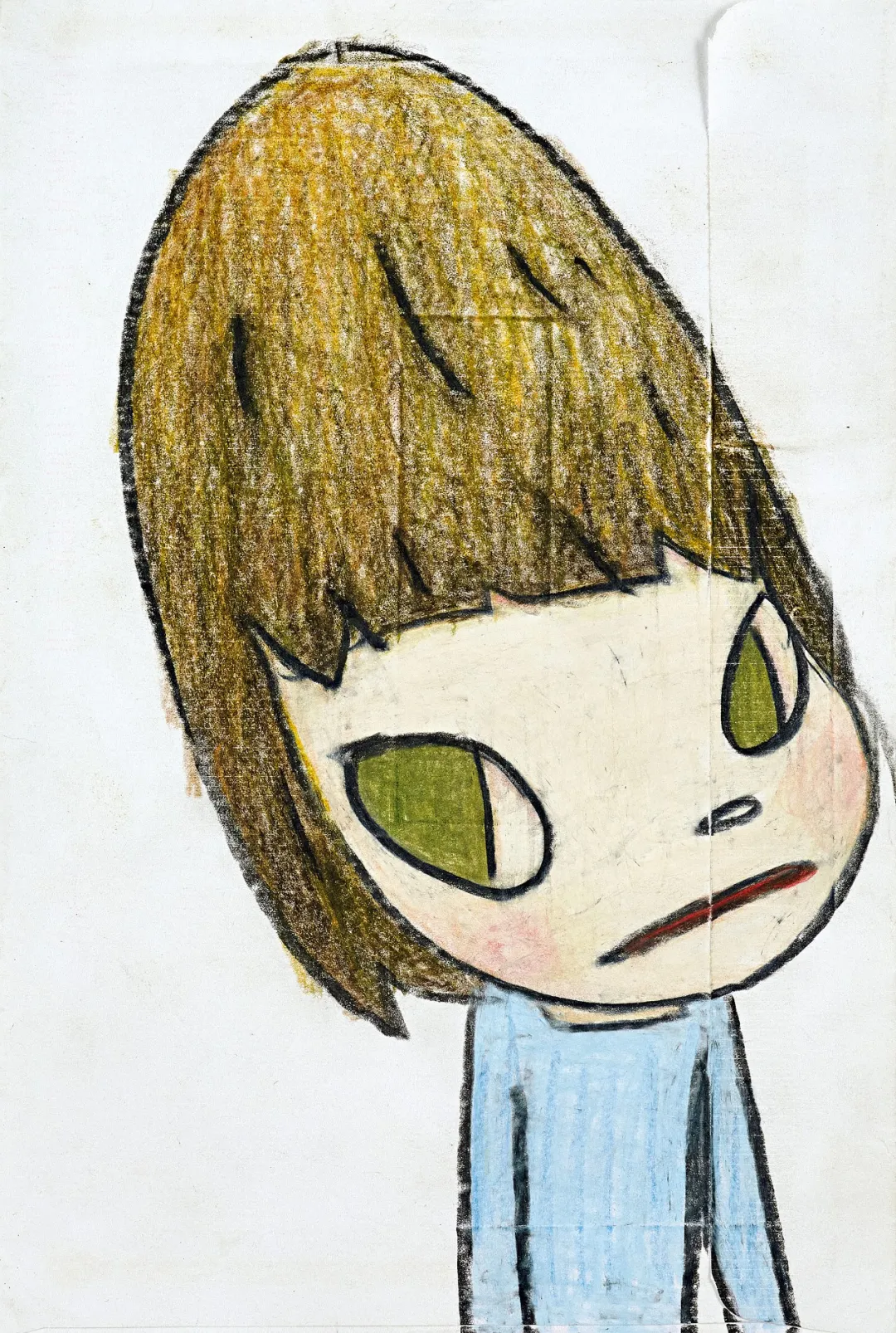
Yoshitomo Nara, Untitled
Colored pencils on paper
Written in 2008
22.4 × 15.2 cm
Estimate: HK$1,100,000 - 1,600,000
Yoshitomo Nara's "Untitled," completed in 2006, is a portrait of a young boy that embodies his rebellious and bold personality and his rock spirit of not easily compromising with the world.It is a unique creation that, like a self-portrait, is full of authenticity and the breath of life.
The main character is presented in his classic "big-headed child" form, glancing sideways with lips pressed into a straight line, then slightly parted, as if unspoken. The serene tone of his light blue clothing creates a subtle tension with his intriguing expression. His hands are completely hidden from view, this deliberate "concealment" creating ample room for imagination: perhaps he is clutching a secret, or protectively guarding the boundaries of his heart. This "unspoken" suspension allows the simple image to encompass a wide range of interpretations, from everyday trifles to philosophical reflections on life.
The Untitled work was born on an envelope, like a secret letter sealed with a paintbrush, carrying the core essence of Nara's work: authenticity rooted in life and memory.For Nara, drawing on envelopes and flyers is an almost instinctive habit. The inherent size, creases, and postmarks of the paper create a unique creative environment, making the lines more primal and the emotions more direct, preserving a cherished corner of life forever. Nara doesn't write a single word, yet he conveys his most authentic self through his brushstrokes, allowing one to hear the untamed stubbornness within, the untamed child within, wrapped in a yearning for and love of the world.
014
Face the world with innocent eyes
Caleca's most important masterpiece appears
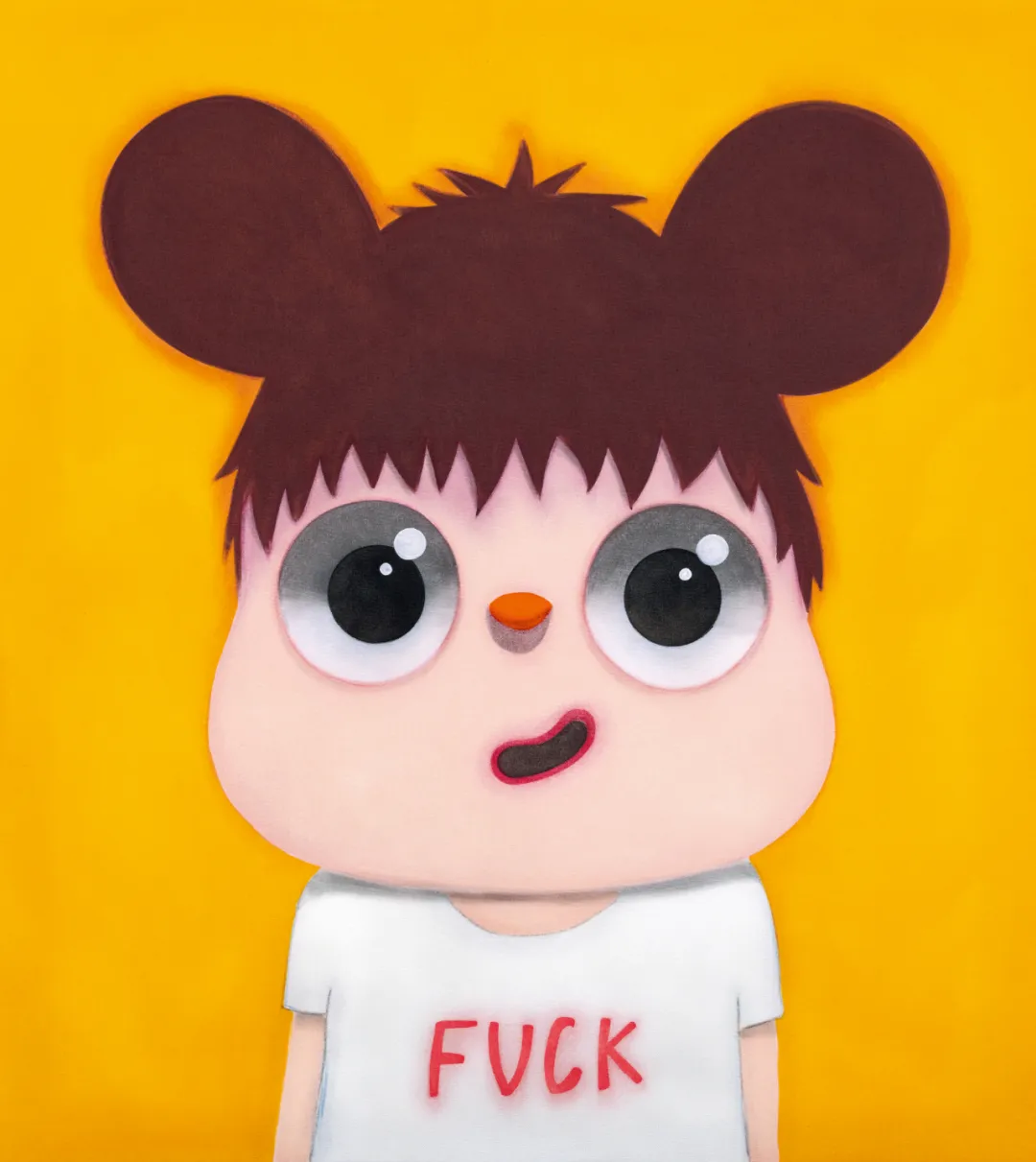
Javier Calega's "Fuck"
Acrylic canvas
Written in 2018
130 × 116 cm
Estimate: HK$1,000,000 - 1,500,000
Spanish artist Javier Calleja's optimistic "Big-Eyed Boy" paintings have become increasingly popular in the art world in recent years. Since 2019, his works have repeatedly fetched high prices at auctions and are highly sought after.The painting "Fuck" presented here was completed in 2018. It originated from the artist's collaboration with the well-known brand BE@RBRICK that year and was one of only three oil paintings specially created for him at that time.
The artwork combines the iconic "big-eyed boy" image from Caleca's paintings with the round ears of a teddy bear. The artist uses precise brushstrokes to create a deep, inward-looking space in the boy's eyes, like a clear lake of emotion, inviting viewers to immerse themselves and perhaps see a reflection of their own endearing, cheerful, and fearless selves within. The boy's large, watery eyes contrast sharply with the bright red "FUCK" lettering on his shirt.These unadorned words carry the sharp edge of the adult world, conveying a cynical attitude and the underlying resilience that makes it seem effortless, proclaiming that innocence is not ignorance, and that innocent eyes can also mock reality.
As the artist himself stated, the person in the painting is..."A little hero who has just overcome adversity and is preparing to smile again after crying."It awakens in us the courage to smile again after tears and to find humor in adversity.
015
Traversing latitude and longitude, spreading wings and taking flight
Ding Yi's Vibrant Era Variation
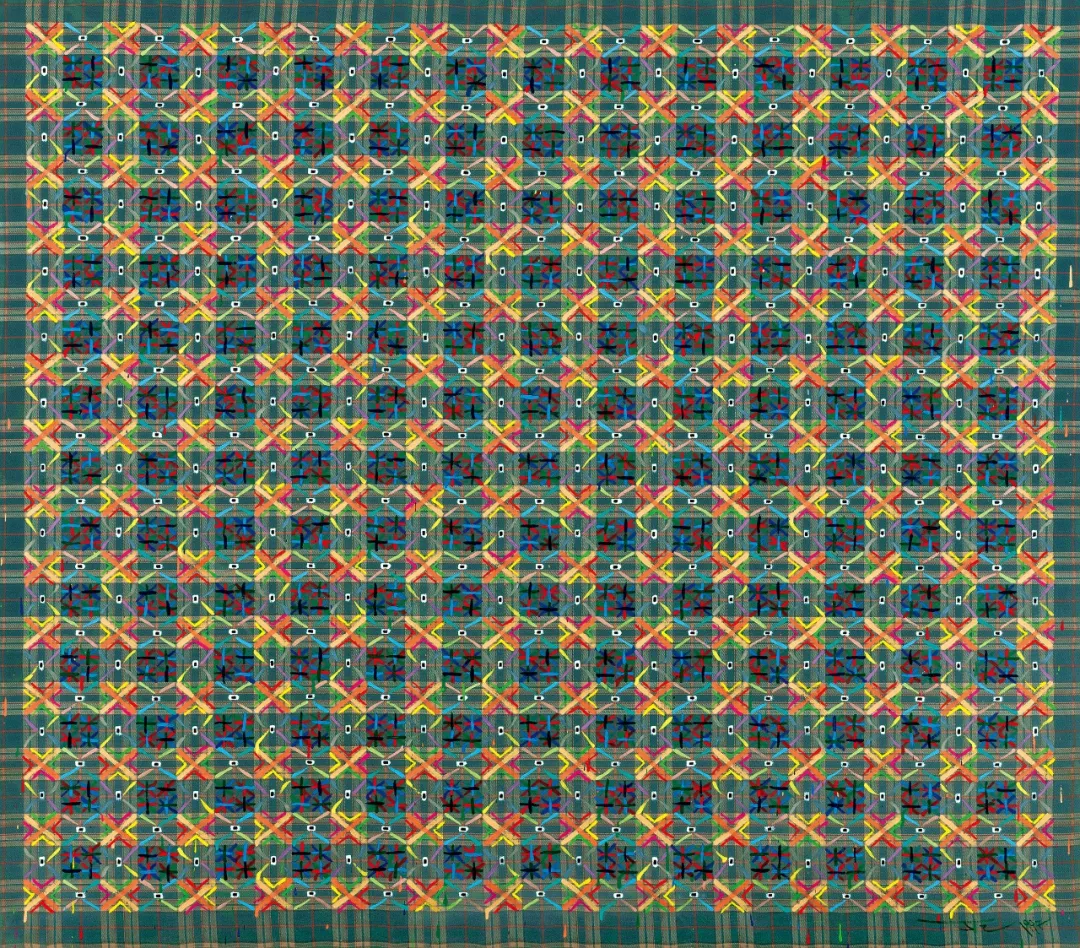
Ding Yi, Ten Instructions, 97-45
Acrylic Color Cobbles
Written in 1997
140 × 160 cm
Estimate: HK$1,200,000 - 1,800,000
In 1997, on the first decade of the "Ten Manifesto" series, Ding Yi unveiled a groundbreaking work in his solo exhibition at the Shanghai Art Museum—a work created using Scottish tartan fabric instead of traditional linen canvas. "Ten Manifesto 97-45," completed that year, is a significant representative work showcasing this breakthrough honed over a decade.
On a military green checkered canvas, he used a rich array of "X" patterns as the main element, dividing and recombining the canvas, as he stated..."Non-cultural connotations obscure the meaning of culture."The works use the appropriation of ready-made objects to dismantle established perceptions of Eastern and Western cultures. Furthermore, they restore the natural spontaneity of freehand painting, using vivid lines to create the composition and preserving harmony and order within free brushstrokes.
This work uses as many as 22 colors, dividing the canvas into four groups of spaces according to the shades of the fabric texture, weaving a colorful scene like thousands of butterflies landing.The diamond pattern, connected by anchor points, is then assembled into a larger ten-symbol design, resembling a city network built of reinforced concrete. Within the black and white hubs, vibrant neon colors illuminate the space, bursting forth with lively vitality amidst the interplay of commonality and individuality, rationality and sensibility, freedom and order. The windows in the painting are like countless lights, twinkling stars, or like the ten-symbol symbol, outstretched arms to embrace the future and endless possibilities!
016
A passionate duet of roundness and sharpness
Huang Yuxing's sparkling "Gemstone"
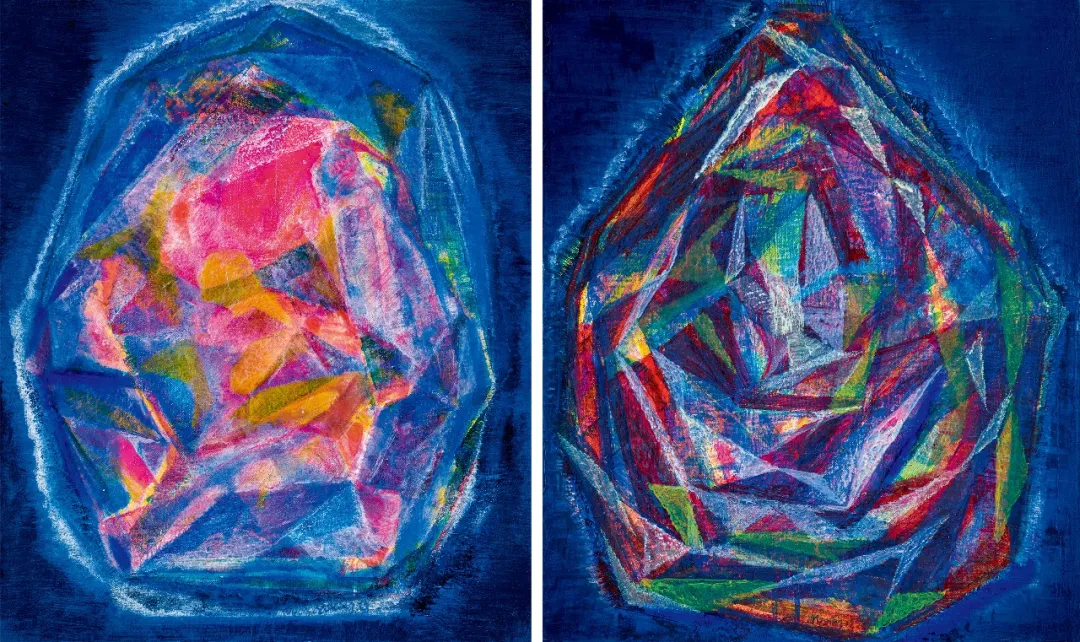
Huang Yuxing, "Gemstones" (a set of two pieces)
Oil paint on canvas
Written in 2013
60 × 50 cm × 2
Estimate: HK$360,000 - 600,000
Completed in 2013 and presented as a set of two works, "Gemstones" showcases the work of one of China's most prominent contemporary artists born in the 1970s.Huang Yu-hsing's "Treasure" series showcases a dazzling work that embodies the "crystallization of human wisdom."
In the image, highly saturated colors such as fluorescent pink, purple, blue, and green intertwine against a deep Prussian blue background, as if..."The sun warms the jade fields of Lantian, and smoke rises from them."Huang Yuxing solidified the flowing colors into a geometric crystal structure, outlining the contours with white lines and simulating light refraction with multiple layers of glaze on the inside.It creates a surreal atmosphere that is both subtly luminous and wildly vibrant.For him, the element of "gemstone" is the cornerstone of his visual language and a symbol of the crystallization of human wisdom.The energy produced by being tempered under high pressure for hundreds of millions of years is essentially the "ultimate concentration of matter" and a kind of "fossil of time".
Furthermore, the two works complement each other: the one on the left has warm and soft tones, like an uncarved "stone," symbolizing the infinite possibilities of newborn life; the one on the right has cool and sharp tones, like a carefully polished "finished product," representing the unwavering will after trials and tribulations. The juxtaposition of the two reflects the trajectory of life's growth from harmony to sharp edges.Huang Yuxing uses this to explore how humanity can find the core of wisdom within itself, as hard and pure as a gemstone, in today's rapidly developing world.—The physical body may perish, but the crystallization of spirit and wisdom will shine eternally in the long river of time, like a jewel in a painting!
017
Alone I climb the snow-capped peak into a fairyland, lightly sweeping away the dust, I feel carefree and at ease.
Li Zhen's spiritual space, "Snowy Peak Fairy Tale"
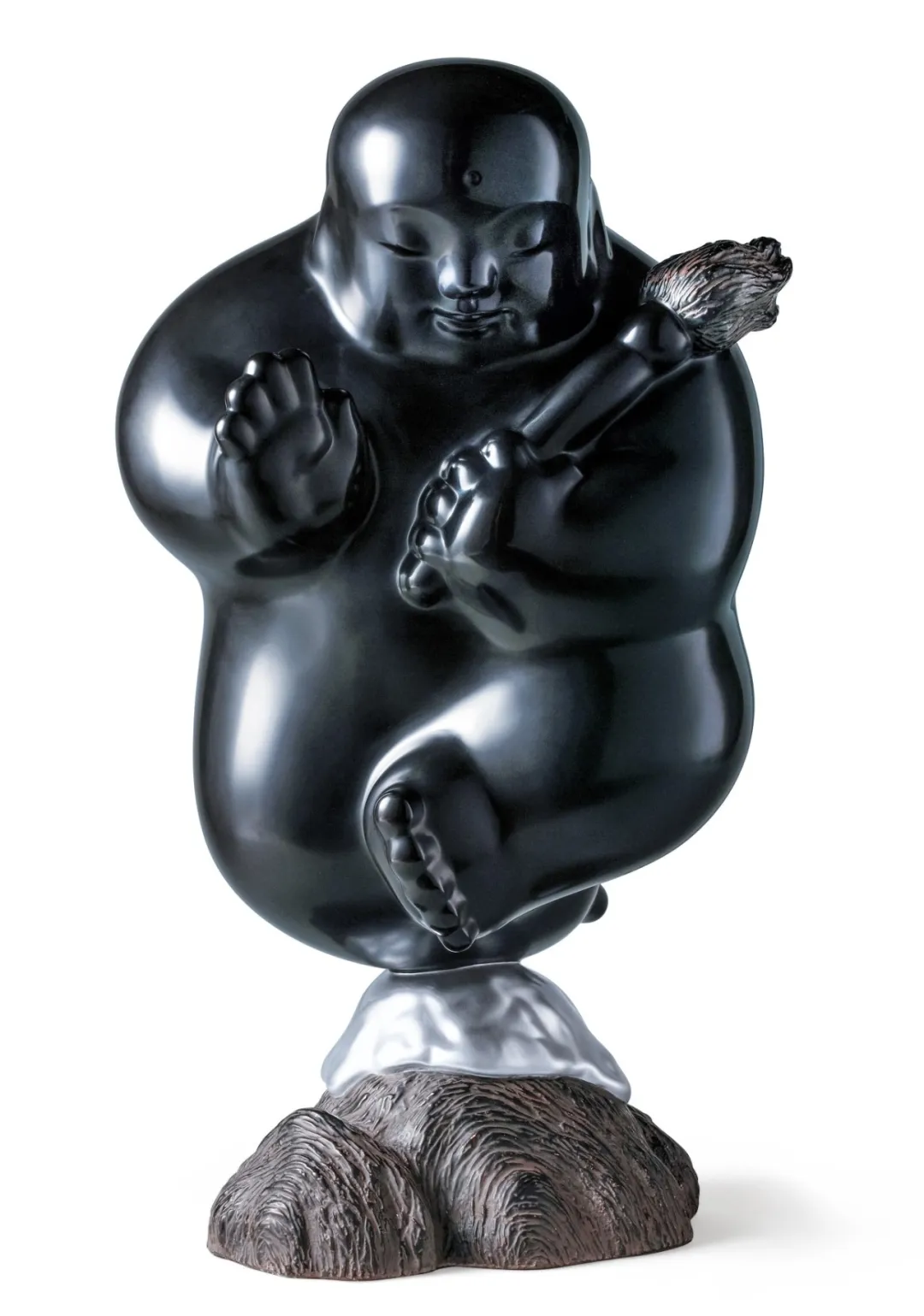
Li Zhen's "Snowy Peak Fairy Tale"
Bronze Sculpture
Version number: 5/8
Written in 2007
101 × 58 × 52 cm.
Estimate: HK$680,000 – 880,000
"Snowy Peak Fairy Tale" is a representative work of Li Zhen's "Grand Journey" series. It is included in four authoritative publications and has received high recognition from the international art world. Its large-scale version was placed in the atrium of a solo exhibition at the Singapore Art Museum and appeared at the 2015 Cannes Film Festival in France.
In this work, Li Zhen incorporates Zhuangzi's philosophy of "Free and Easy Wandering," creating the image of an immortal standing on one leg atop a snow-capped mountain, holding a whisk. The figure's serene expression and leisurely posture symbolize a spiritual transcendence, sweeping away worldly worries and surpassing mundane limitations.It showcases a pure and carefree state of mind, pointing directly to the absolute freedom of the spirit.
The artwork cleverly employs the dialectical aesthetic of "both heavy and light": the protagonist, though physically robust, presents a lightness akin to floating clouds, subverting the viewer's conventional perception of physical volume. In terms of materials, it combines the ethereal, silvery-white charm of snow-capped peaks, the bronze texture of the mountain range at the base, and the smooth, warm black lacquer of the figure.Through the contrast of warm and cool colors, roughness and luster, a strong visual tension is created, allowing viewers to feel the dynamism in the void within the physical sculpture.
018
Embrace the world with a pure heart
Nakamura Moe's Natural Song in Pursuit of Truth
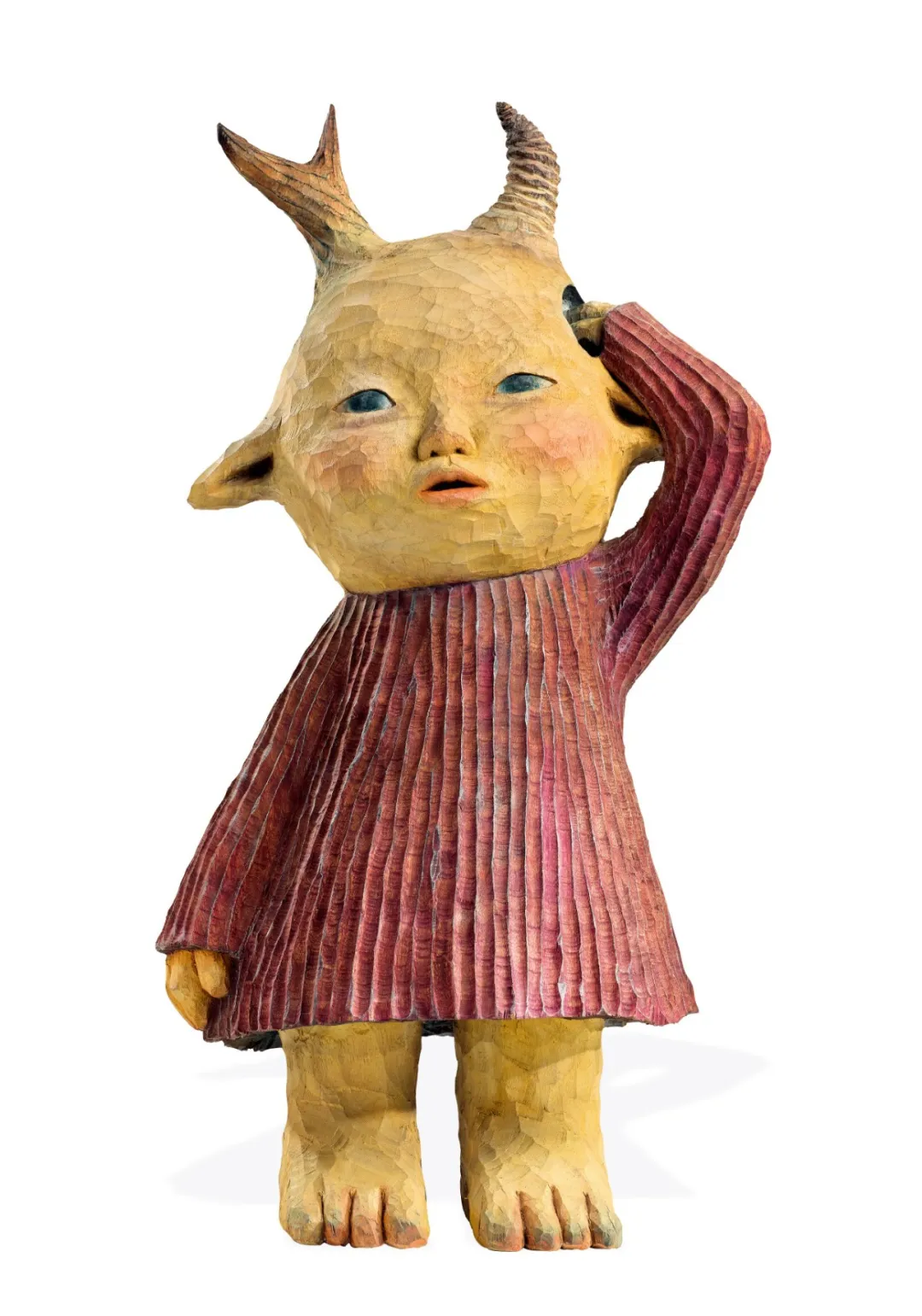
Nakamura Moe, *Unearthing the Truth*
Oil painting wood carving
Written in 2014
65 × 34 × 28 cm.
Estimate: HK$350,000 - 450,000
"Digging for Truth" is a wood carving of a forest spirit by Nakamura Moe. Dressed in a maroon dress, it exudes a sense of warmth and friendliness. The extensive use of red in the artist's work is extremely rare, highlighting its uniqueness.
The intricately carved textures on the protagonist's clothing resemble a condensed record of tree growth, while the two differently shaped horns on its head symbolize the interplay of rational and emotional life energies. The protagonist's hand reaches into the "cave of the soul," a space above its head resembling a tree hollow, symbolizing the inner self's dwelling place. This guides the viewer to explore and listen to their inner voice in tranquility, encouraging us to maintain a childlike curiosity about the world and to pursue the truth of life.
019
The Immortal Flower of Zenzaburo Kojima
"The Camellia" in full bloom, welcoming spring.
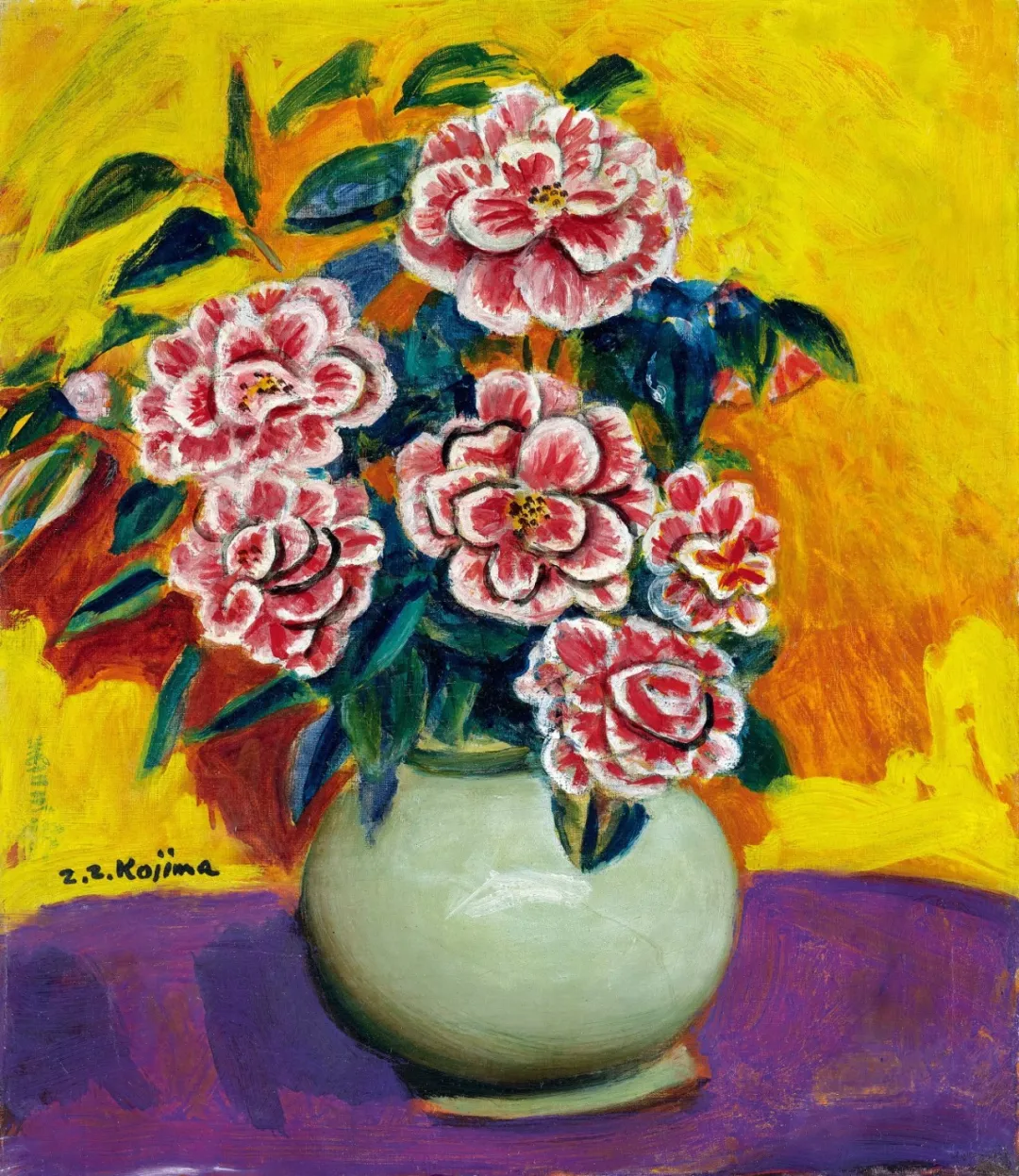
Zenzaburo Kojima's "Tsubaki"
Oil paint on canvas
circa 1940
53.5 × 45.3 cm.
Estimate: HK$190,000 – 250,000
"Flowers" is the main theme of Yoshizaburo Kojima's creative career, and this time two of his representative works of vase flowers from the Kokubunji and Ogikubo periods are presented together.
"Camellia" is titled after the camellia, a "sacred flower" in Japan that symbolizes nobility and courage. This flower, which falls as a whole flower instead of withering in pieces, has long been a symbol of "unyielding integrity." During the flames of World War II, Kojima personally planted and sketched camellias in his garden, infusing his earnest expectations for the future onto the canvas: six camellias bloom in full glory without reservation, with new life budding beside them, echoing his heartfelt sentiment of "hold on to hope, spring will eventually come," showcasing the artist's undying passion for life amidst turbulent times.
The camellias in the painting are in a magnificent pose that echoes the "Camellia Screen" from the Momoyama period, and are deeply imbued with the decorative aesthetics of the Japanese Rinpa school. However, unlike the flatness of traditional paintings, Kojima uses black ink to outline the edges of the flowers and gives the petals a full and three-dimensional feel. The background is also laid out with bold contrasting bright yellow and purple-red colors, perfectly blending the flat decorative nature of the East with the volumetric sense of light and shadow in the West.
020
The Eternity of Souls
The Life Multi-Tone of Lily
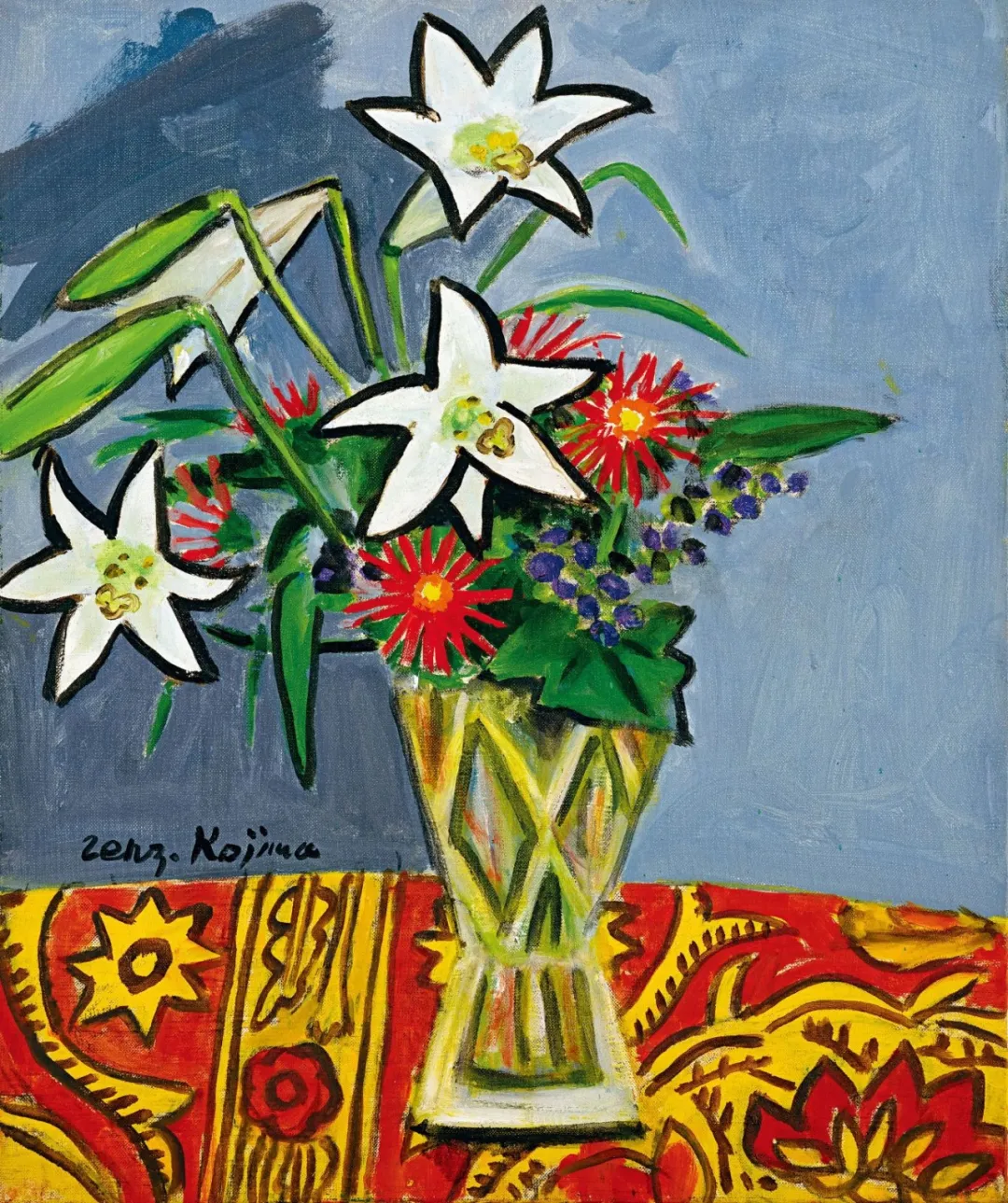
Yoshizaburo Kojima's *Sayuri*
Oil paint on canvas
Written in 1958
45.4 × 37.8 cm.
Estimate: HKD 120,000 – 180,000
"Little Lily" is a masterpiece of composite floral art from Kojima's Ogikubo period.
In the painting, lilies stand tall and proud, gerberas are warm and romantic, and delphiniums are pure and free. The three flowers intertwine with dots, lines, and planes to create a well-ordered symphony of life. Kojima entrusts his personal will to floral art, and through careful arrangement, he ensures that each flower is in its proper place and displays its own spirit, achieving a profound sublimation from "reproducing nature" to "creating life".
The depiction of the tablecloth in the painting is particularly unique, echoing the modern painting aesthetics of Fauvism while also drawing inspiration from the ornate geometric patterns of "Hakata weaving" from Kojima's hometown. From the vibrant bouquet to the fabric imbued with the warmth of her homeland, she fuses cultural roots and life experiences into one in this work, fulfilling her long-cherished wish to "create oil paintings that resonate with the Japanese spirit and are in harmony with the Japanese people."
China Guardian Hong Kong | 2026 Spring Auction
Asian 20th Century and Contemporary Art
Exquisite Exhibition: 2026/3/25 - 27|10am - 6pm
Location: Grand Hyatt Hong Kong, Loft Room
Preview: April 3-5, 2026
Auction: April 8, 2026 | 10:00 AM
Location: Exhibition Hall 5FG, Hong Kong Convention and Exhibition Centre
Please see the online catalog for more auction items.
Stay tuned to ArtPro for the latest updates on the global art market.