
【2023 Autumn Auction】China Guardian Hong Kong Asia 20th Century and Contemporary Art Exhibition will be the first to be unveiled at No. 1 Shenzhen Bay from September 9th to 10th
September 9-10(Saturday to Sunday), China Guardian Hong Kong 2023 Autumn Auction Boutique Exhibition will take the lead inYunsong Charity Concert Hall, 71st Floor, Raffles Hotel Shenzhen Bay 1, presenting the highlights of the "Asian 20th Century and Contemporary Art" section, covering Wu Dayu, Lin Fengmian, Wu Guanzhong, Zao Wou-ki, Chu Dequn, contemporary geniuses Liu Wei, Zhou Chunya, Huang Yuxing, Xuan Shanqin, Japanese avant-garde art godmother Yayoi Kusama, An important masterpiece by Western artist Shara Hughes, this year’s autumn auction focus is “unboxed” for the first time.
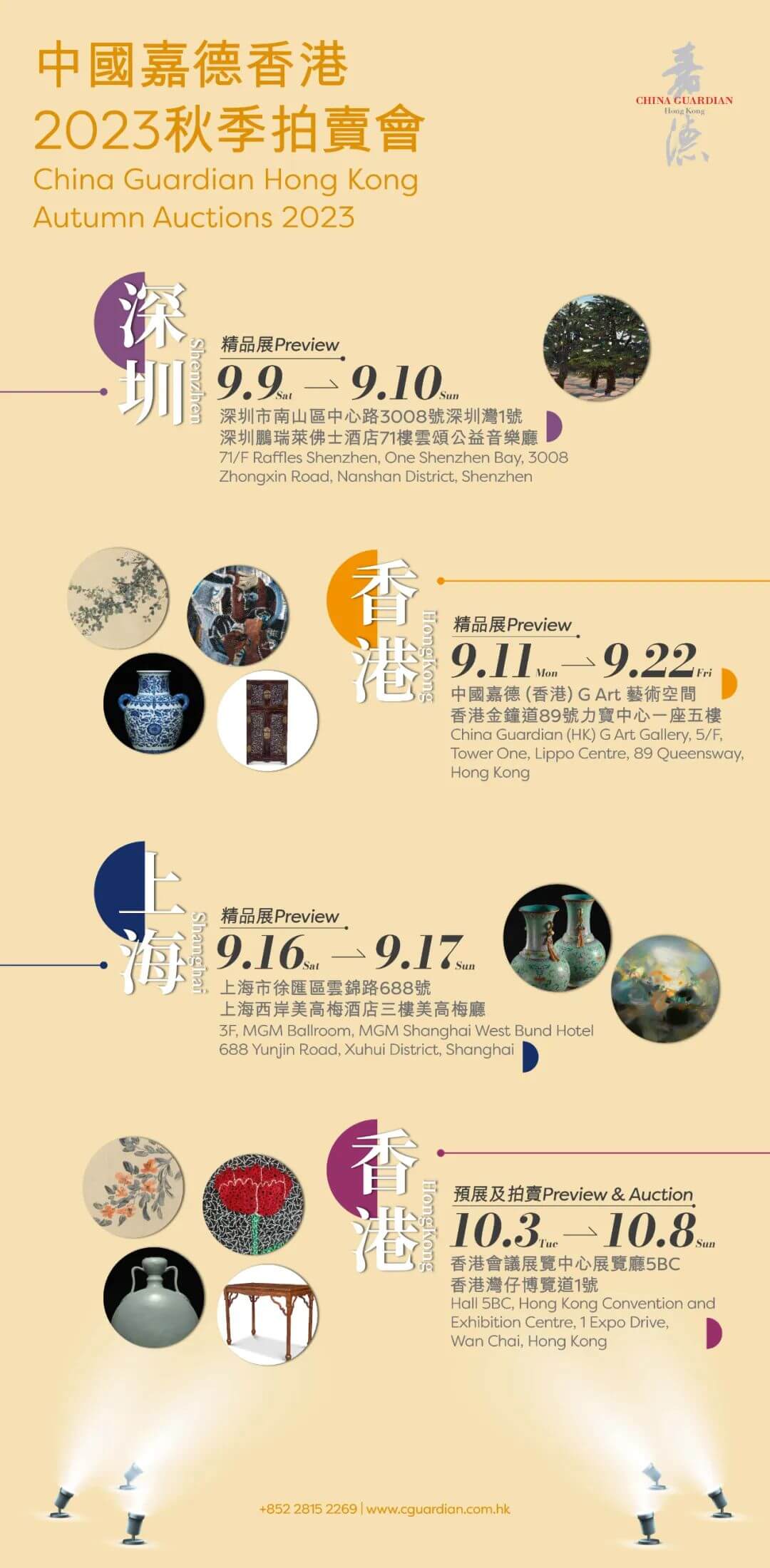
Continuing from Shenzhen, in September, China Guardian Hong Kong will also hold autumn auction boutique exhibitions at G Art Art Space in Hong Kong and MGM Hotel in Shanghai.
China Guardian Hong Kong 2023 Autumn Auction will be heldOctober 3-8 at Hong Kong Convention and Exhibition Center Exhibition Hall 5BCHeld grandly, a variety of exquisite works of art from distinguished sources are solemnly presented.It includes four major sections: Chinese calligraphy and painting, Asian 20th century and contemporary art, porcelain handicrafts and classical furniture, and about 1,500 rare and exquisite products., bringing a top-notch art feast that integrates ancient and modern times, as well as Chinese and foreign art.
Asian 20th Century and Contemporary Art
A square inch can accommodate thousands of realms, and it will illuminate my heart through the ages.
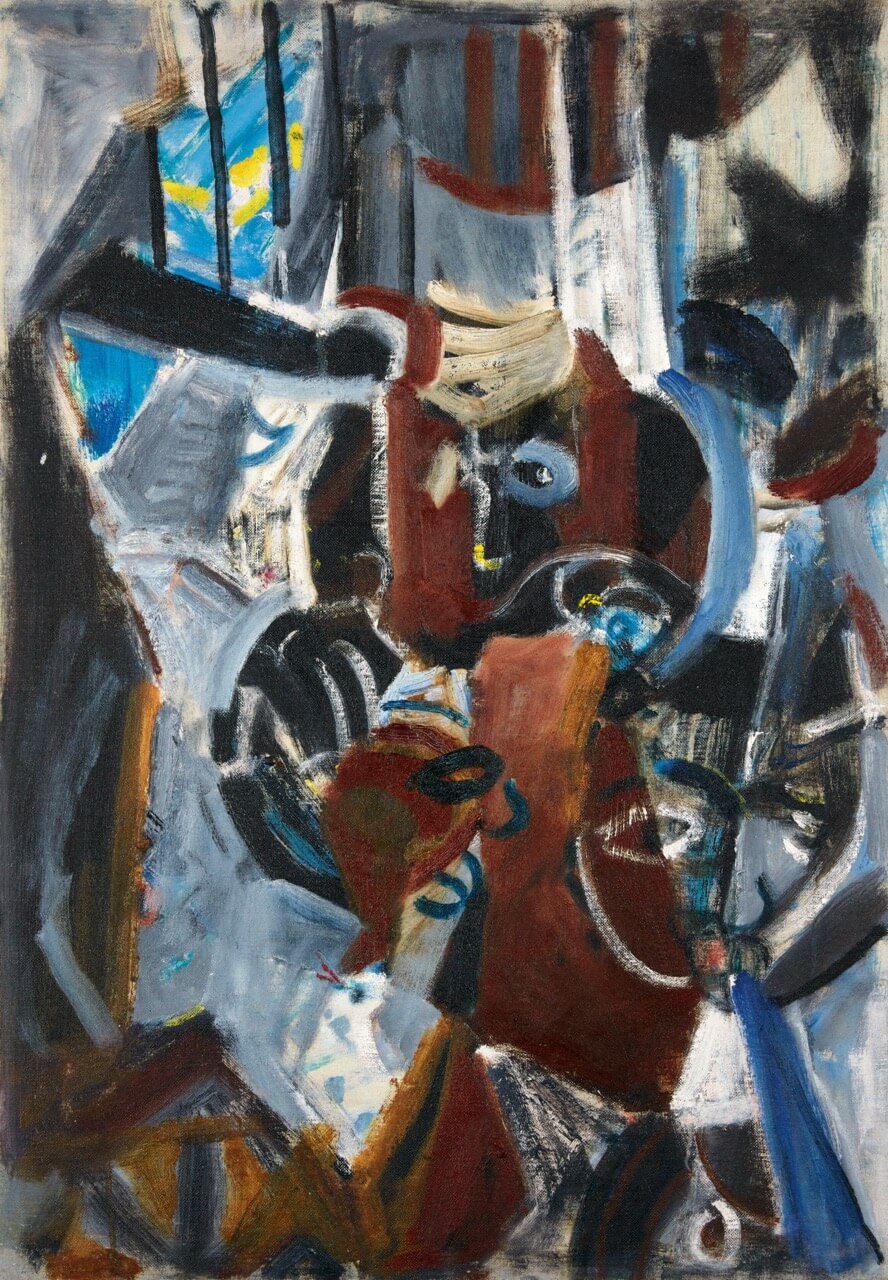
Wu Dayu's museum-level autobiographical masterpiece is shockingly released!
Wu Dayu
Untitled 10
oil on canvas
Written around 1980
76×53 cm.
publishing
2001, "Wu Dayu Art Exhibition: The Pioneering Master of Chinese Oil Painting", National Museum of History, Taipei, page 87
2003, "Wu Dayu, Shanghai Oil Painting and Sculpture Institute", Shanghai Education Press, Shanghai, page 147
2006, "Wu Dayu", Future Gallery Art Co., Ltd., Taipei, page 139
2013, "Wu Dayu - a collection of works of a century-old representative painter of the Shanghai School", Shanghai Painting and Calligraphy Publishing House, Shanghai, page 107
2015, "Collection of Wu Dayu's Works", People's Fine Arts Publishing House, Beijing, page 57
2020, "Flying Feathers across the Sky - Collection of Works of Wu Dayu", The Commercial Press, Beijing, pp. 90, 92-93
exhibition
March 9 to April 8, 2001, "Wu Dayu Painting Exhibition", National Museum of History, Taipei
March 20 to May 8, 2021, "Chinese Abstraction Pioneer - Wu Dayu Solo Exhibition", Geng Gallery, Taipei
source
Taipei Future Gallery
Currently purchased directly from the above sources by important private collectors in Asia
Attached: Certificate of work issued by Taipei Future Gallery
Wu Dayu only made 159 oil paintings during his lifetime, which are hard to find in the auction market. "Untitled 10", completed in the 1980s, is one of only 12 large-sized paintings (over size 20, 76x53cm) in his lifetime, and Breaking away from the composition of his "Beijing Rhythm" series, which generally feature a single or a pair of protagonists, the work depicts as many as four characters for the first time, with a strong autobiographical flavor and spiritual reference. In this painting, Wu Dayu used a brush stained with indigo, ink black and coffee red, and relied on his unique "flying light chewing color charm" and "momentum" aesthetics to blend Western three-dimensionality with Chinese charm and vigorous brushwork. The performance of Pai depicts four figures in a room full of windows and wall structures: a young man in the middle, a woman with red lips, a child holding a book with a bird resting on his chest, and a woman with a glance. urchin. Through the precise use of color, brushwork and the capture of the character's personality, a few strokes reveal all the expressions. For example, the figure in the center has a high nose and a deep outline, which fits Wu Dayu's own resolute and deep image. The person on the right uses white color to outline his big and bright eyes, and the round arc adds a unique feminine softness, which corresponds to the gentleness and virtuousness of his wife Shou Yilin. The book-holding and spiritual bird symbolize his erudite and wise son, while the girl at Cheng Huan's knees has no additional ink except for the eye-catching eyes, but conveys the spiritual expression of her spirited expression. The four figures form a solid triangle in the painting, which is a portrayal of the life of Wu Dayu's family during the Cultural Revolution. Despite the difficult environment, they always stayed together and became each other's strongest backing, embodying the spirit of unity and unity. Towards.
The window lattice in the upper left corner of the background is just like the window sill of his real residence. The clear blue sky and the sea of bright lemon yellow flowers outside the window have become a reference to "hope". An intriguing arm stretches from the outside inward, which is a metaphor for "the power of the outside world" or its own "ultimate belief in art", bringing encouragement and blessings into the small room in the painting like an angel announcing good news, which also echoes Wu After 1978, Dayu regained academic recognition, gained material support, and found a spiritually rich life, which further deepened the meaning of this work. The work has been included in all the artist's published albums and has been collected by an important private collector in Asia for more than 30 years. Now it is released for the first time, making it a once-in-a-lifetime experience!
Heroes dance, gathering together for the ages
Wu Guanzhong’s rare cedar trees and character-themed masterpieces are on display
Wu Guanzhong (1919-2010)
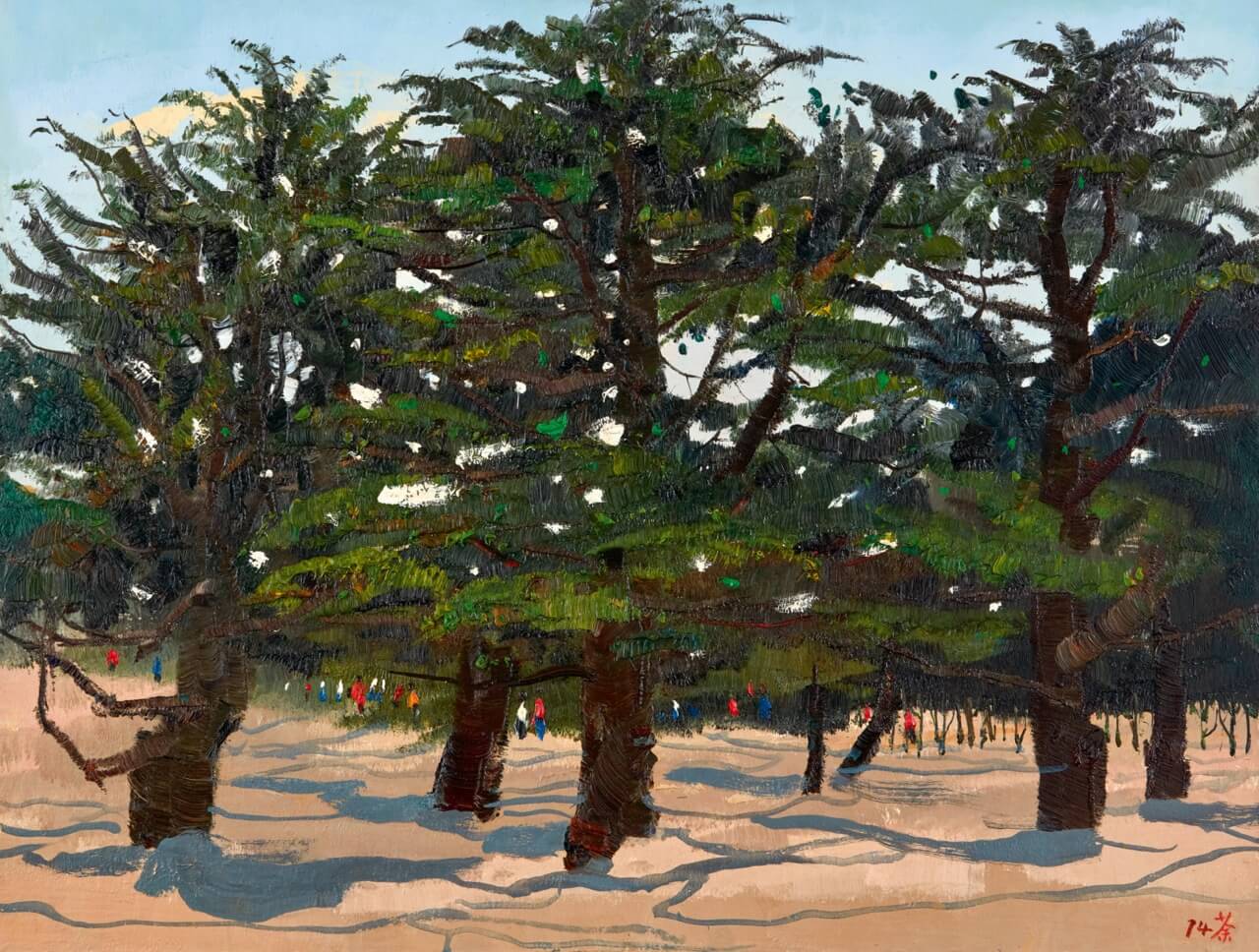
Qingdao cedar
Oil painted wood board
Written in 1974
46×61 cm.
recognition
74 Tea (lower right) Qingdao Cedar Wu Guanzhong (back of painting)
publishing
1996, "Selected Paintings of Wu Guanzhong: 60's-90's", China Three Gorges Publishing House, Beijing, page 87, plate 66
2007, "The Complete Works of Wu Guanzhong: Volume 2", Hunan Fine Arts Publishing House, Changsha, page 267
source
Important Asian Private Collections
"Qingdao Cedar", completed in 1974, is a masterpiece of Wu Guanzhong's golden period. Wu Guanzhong visited Qingdao many times from 1974 to 1998 and painted 11 works in the "Qingdao" series. Among them, "Qingdao Red Mansion" and "Laoshan Pine Stone" have been included in the collections of the China Art Museum in Shanghai and the National Art Museum of China respectively. "Qingdao Cedar" is his first painting with the theme of Qingdao, and it is the only oil painting in his life that depicts "cedar". Here, the artist highlights the two characteristics of cedar, which are "dense" and "thick", and uses vigorous brushstrokes like "iron painting with silver hooks" to display the vigorous, vigorous, soft and strong posture of the pine tree. Seven pine trees with lush branches and pagodas are gradually arranged in a majestic composition that stretches from the ground to the sky. The thick ones are like the backbone of the head and shoulders, supporting the sky and the earth upward, and the slender ones are like green trees that are better than blue. The new hope is leaping into the sky! As the canopy unfolds layer by layer, the dense green branches and leaves rush out in the posture of thousands of troops, or line up vertically, as uniform as soldiers, or tilt up to face the wind, high-spirited and majestic. Showing the words of Shi Tao from the Qing Dynasty: "Its momentum is like a hero dancing, leaning down and squatting, jumping up and down."
As the city tree of Qingdao, the cedar originally grows in the mountains at high latitudes. As its name suggests, it still stands proudly despite being weathered by frost and snow. In ancient Arabic civilization, it represented "spiritual and spiritual power." In China, it shows the high moral integrity and self-reliance of literati. For example, the poet Fan Yunyan of the Southern Dynasties said: "Lingfeng knows the integrity, and bears the snow to see the true heart”, Chairman Mao wrote: “The green pine is angry to the sky" Wu Guanzhong here uses seven cedars as the backbone of the image. He uses the meaning of perfection, nobility and broadness represented by "seven" to describe the character and spirit of the pine trees. From the top, they are towering to the sky, and from the bottom, their roots are connected to the earth. Standing proudly in the sky and earth, it glows with vitality in the green color; and underneath, the bright color spots of red, blue, white and yellow are the finishing touch to describe the people going on an outing. The colors in it are like clusters of fires of life. It expresses the ultimate ideal in the artist's heart - fearless of the changes in the world, fearless of all wind and rain, I can rise from the clouds and stand firm in the world, and the true feelings of art will remain in the world forever. The works are unforgettable.
Wu Guanzhong (1919-2010)
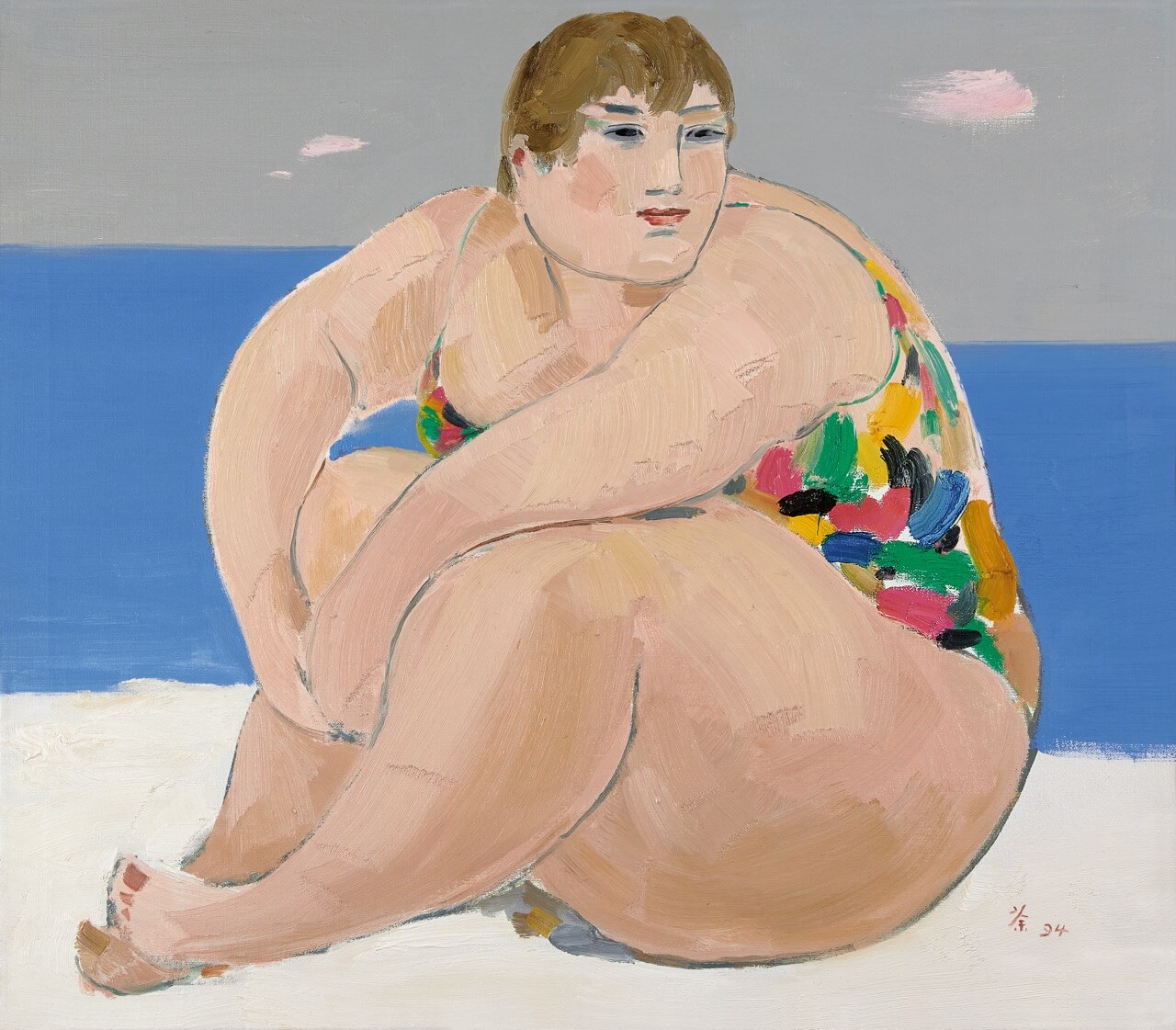
Yang Afu
oil on canvas
Written in 1994
recognition
Tu 94 (lower right) Yang Afu 1994 Wu Guanzhong (back)
publishing
1999, "1999 Wu Guanzhong Art Exhibition Collection", Ministry of Culture of the People's Republic of China and National Art Museum of China, Beijing, page 213
2007, "The Complete Works of Wu Guanzhong IV", Hunan Fine Arts Publishing House, Changsha, page 108
2010, "Wu Guanzhong: Eye Painting", Wenhui Publishing House, Shanghai, page 207
2010, "World Art Master Wu Guanzhong (continued)", Culture and Art Publishing House, Beijing, page 123
exhibition
November 5 to December 2, 1999, "1999 Wu Guanzhong Art Exhibition", National Art Museum of China, Beijing
November 19, 2021 to May 18, 2022, "The Pulse of Modernity - Powerlong Art Exhibition", Powerlong Art Museum, Shanghai
source
Important Asian Private Collections
April 3, 2016, Sotheby's Hong Kong Spring Auction, Lot No. 1037
Important Asian Private Collections
Wu Guanzhong was known for his landscape-themed paintings throughout his life. Due to political factors in his early years, figure oil paintings were rare in his creations, with only 22 pieces. Among them, four works completed between 1994 and 2008 are particularly outstanding. They go against the public's aesthetic stereotypes. They all feature the same plump British woman that the artist saw on the beach in Bali, Indonesia, and highlight the vivid sense of human body size and natural beauty. Draw and write. "Yang Afu" is the first work in the series and is the largest in size. "Peach Color Whirlwind" in the same series has been included in the collection of the National Art Museum of China in Beijing, highlighting the importance and rarity of the previous work. In this painting, the artist boldly divided the background into three equal parts: sea, sky and beach. The minimalist background is like the abstract composition of Western Mark Rothko, but in one fell swoop it makes people feel the boundlessness of the blue sea and the clear sky. Romantic island style with fluttering pink clouds under the sun. In the center of the painting, a pretty short-haired woman sitting on one side, wearing a floral swimsuit outlined with colorful dots, almost fills the entire scene, giving full play to the fullness and dramatic tension of the character, breaking the traditional Oriental aesthetic of "people are thinner than yellow flowers" , conveying the beauty of the human body full of weight, confidence, and cheerfulness to people, which also corresponds to Wu Guanzhong's free and unrestrained state of mind at that time, enjoying life happily. The shape and naming of the work cleverly echoes the Chinese folk clay sculptures with the meaning of "welcoming good luck and receiving blessings" - the "Ni Afu" with a plump face, a full smile, a plump nose, a straight nose and a square mouth, through Wu Guanzhong's superb washing. Using his refined brushwork and bold modern compositions, he demonstrates the harmony of Chinese and Western styles, the comfort of rich life, and the artist's rare and humorous observation perspective. After the creation, the work was first published in the artist's 1999 exhibition at the National Art Museum of China in Beijing, which aroused high resonance.
Peace in the prosperous age, energy flowing through Changhong
Chu Teh-chun's masterpiece about majestic mountains and rivers is presented for the first time
Zhu Dequn
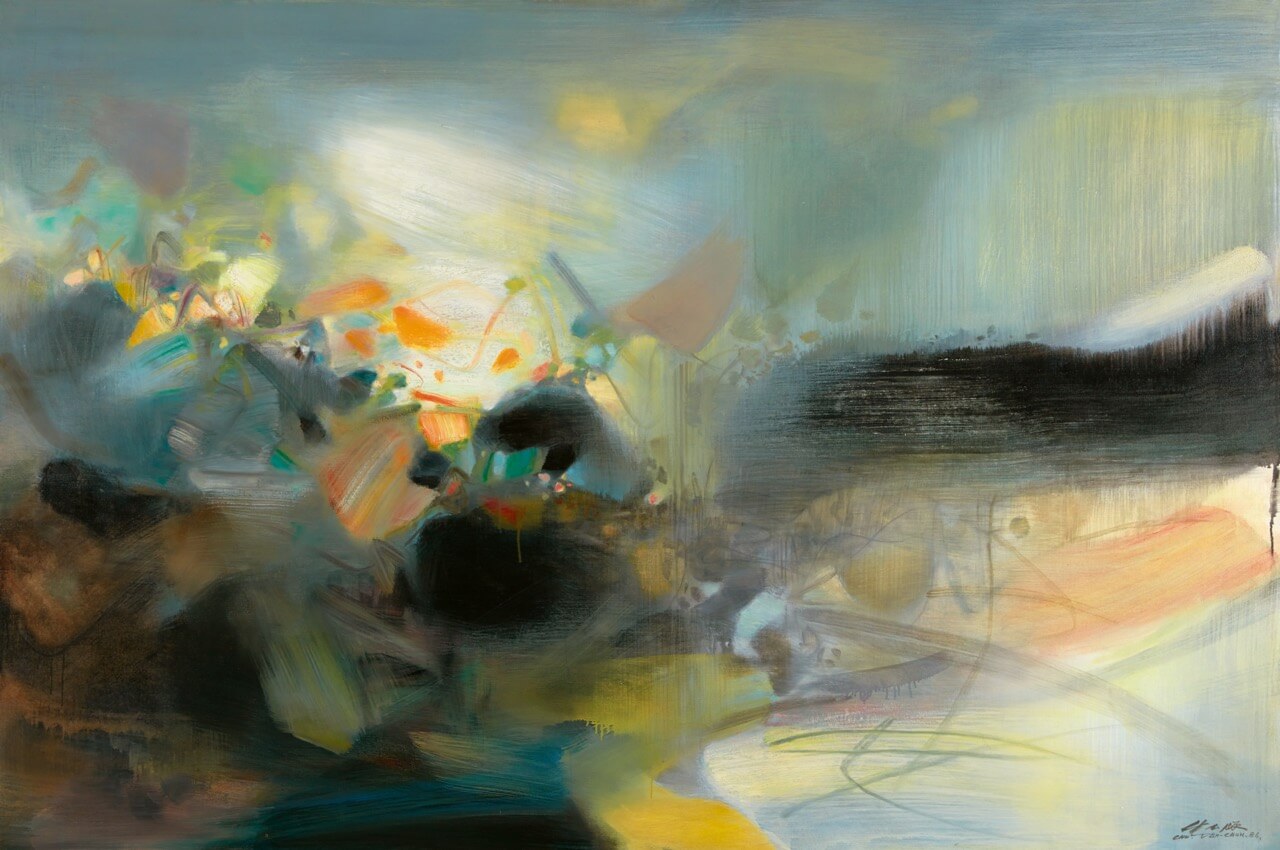
broad
oil on canvas
Written in 1986
130×195 cm.
recognition
Chu Teh-Chun CHU TEH-CHUN 86 (lower right) Amplitude 1986 Chu Teh-Chun CHU TEH-CHUN (back)
publishing
1989, "Collection of Chu Teh-Chun's Paintings", Jinling Art Center, Taipei, pp. 130-131
2005, "Impression Classic IX Chu Teh-Chun", Impression Gallery, Taipei, page 37
exhibition
1988-1989, "Chu Teh-Chun Touring Exhibition", Taichung County Cultural Center, Changhua County Cultural Center, Yunlin County Cultural Center, Taoyuan County Cultural Center, Hsinchu Municipal Cultural Center, Kaohsiung County Cultural Center, Yilan County National Cultural Center, Taipei County Cultural Center, Tainan County Cultural Center, Miaoli County Cultural Center, Taitung County Cultural Center, Tainan Municipal Cultural Center, Nantou County Cultural Center, Keelung Municipal Cultural Center and Taiwan Provincial Museum of Fine Arts
June 2005, "The Painting World of Chu Teh-Chun", Impression Gallery, Taipei
source
Taipei Impression Gallery
Currently purchased directly from the above sources by important private collectors in Asia
Attached: Guarantee of original work signed by the artist opened by Impression Gallery in Taipei
"Broadness" was completed in 1986, when Chu Teh-chun's artistic career was at its peak. At that time, the artist frequently traveled between Europe and Asia. In addition to traveling around the mountains and rivers of his motherland, he also held the largest touring exhibition in fifteen art museums and art institutions in Taiwan from 1988 to 1989. "Broadness" is the highlight of the exhibition's magnificent scale. The work adopts a horizontal perspective and uses an exquisite layout of one east and one west, one dense and one sparse, and one piece and one piece to relax, creating countless mountains and rivers that span the four seas and swallow up all the wilderness.
The work inherits the elegance of the "green landscape" in Chinese ink painting, and unfolds a world with the secret color of the kiln described by the poet Lu Guimeng of the Tang Dynasty, "The wind and dew of Kyushu Island bloom over the kiln, capturing the green color of thousands of peaks." In the center of the left side of the painting, the light source is like opening a treasure box between heaven and earth, and the jade light pours out, spreading the hope of spring and the power of dawn to the world like sweet rain. There are green spots of moss, ochre-like earth, bright orange, crimson, yellow, rose purple and other rich color spots leaping in it. The light and flying white brush strokes seem to imitate the cool water, wandering wind and ethereal nature in nature. The clouds glow with rich visual perception. Under the brilliance, the large, open and closed brushes move vertically and horizontally with the charm of cursive script. Through the changes of the five colors of ink, three-dimensional blocks and overlapping brushes are used to construct thousands of rocks and ravines, making the work It has the unique charm of the mountains in Song Dynasty paintings. On the right side, a powerful stroke of thick ink starts from the right end, stirring up the tension of the rainbow. The gossamer-like flying white is like a flying spring washing jade, flying dragons and dancing phoenixes in the sky and earth, capturing both majesty and freshness. The audience can also follow the brushstrokes in the painting and climb up here to take in a panoramic view of the vast world where the river flows eastward and the rapids echo. What is special among them is that the calligraphy lines in the lower right area of the work reflect the word "peace", which echoes the artist's spiritual feelings after many magnificent trips to the land of China at that time, and embodies the "prosperous peace" of the motherland in his heart. The wish makes the work uniquely meaningful. The work has been collected by an important private collector in Asia for more than thirty years. It is released for the first time and should be treasured by those who know it.
Eternal blooming brilliance, rising female power in the era
Important early masterpieces of Yayoi Kusama appear
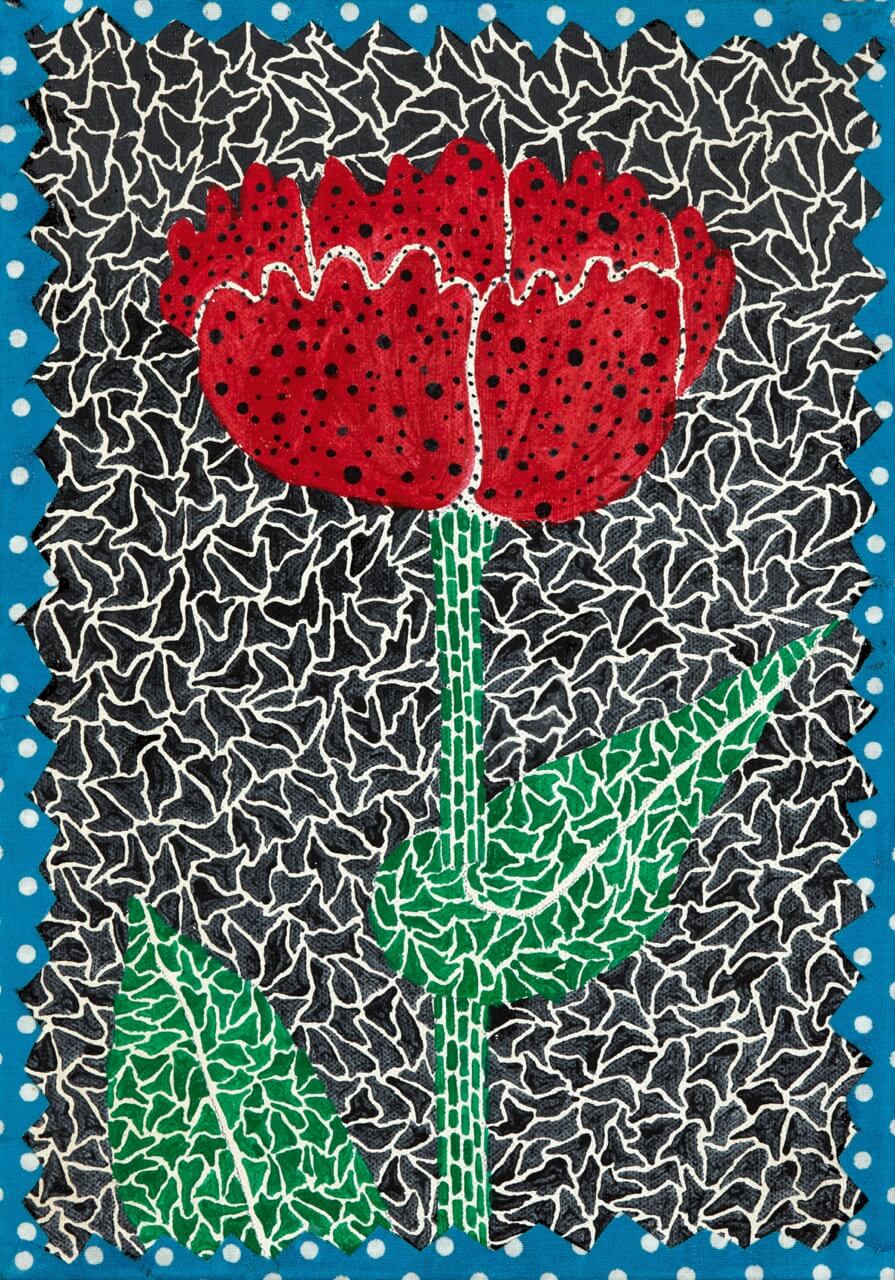
Yayoi Kusama (b.1929)
poppy flower
Acrylic colored fabric canvas
Written in 1982
22.5×16 cm.
recognition
1982 Yayoi Kusama (painted back)
source
Important Asian Private Collections
Attached: Work registration card issued by Yayoi Kusama Studio
"Poppy Flower", completed for the first time at auction in 1982, is an important early masterpiece of the artist using "red flower" as a self-figurative reference. The work combines the artist's signature infinity net, polka dots, and cloth collage to create a beautiful scene before you. The infinite net here is different from the direct depiction in Kusama's works. She rarely uses the original color of the canvas itself, through the delicate overlay of black acrylic colors like filling, leaving a specific white organic mesh pattern. , giving them a strong sense of spatial change, and the rhizomes and leaf veins of the flowers also use the same technique to structure the overall situation. This special and careful expression makes this work outstanding and rare among his works.
The main body of the work is the "red poppy" that the artist has loved since the 1960s. The flower stands upright in the dark night. The blooming petals are like the waves caused by the rotation of a dance skirt, while the black polka dots are like big and small beads falling on the jade plate. As it moves, it dances with the petals to create a natural rhythm. The green rhizomes and leaves appear like cell walls under a perspective lens, giving people a strong sense of the plant's powerful vitality despite its seemingly calm appearance. In real life, although poppies are red and beautiful, they can be refined into poisonous opium. This two-sided characteristic is just like Kusama's definition of a woman or herself - she can be gentle and beautiful, but she can also be strong and independent. world. On the four sides of the painting, she deliberately used a collage of jagged blue cloth with polka dots to highlight the central subject like a frame, making the work a statue of its spirit and life, glowing with infinite tension and vitality. !
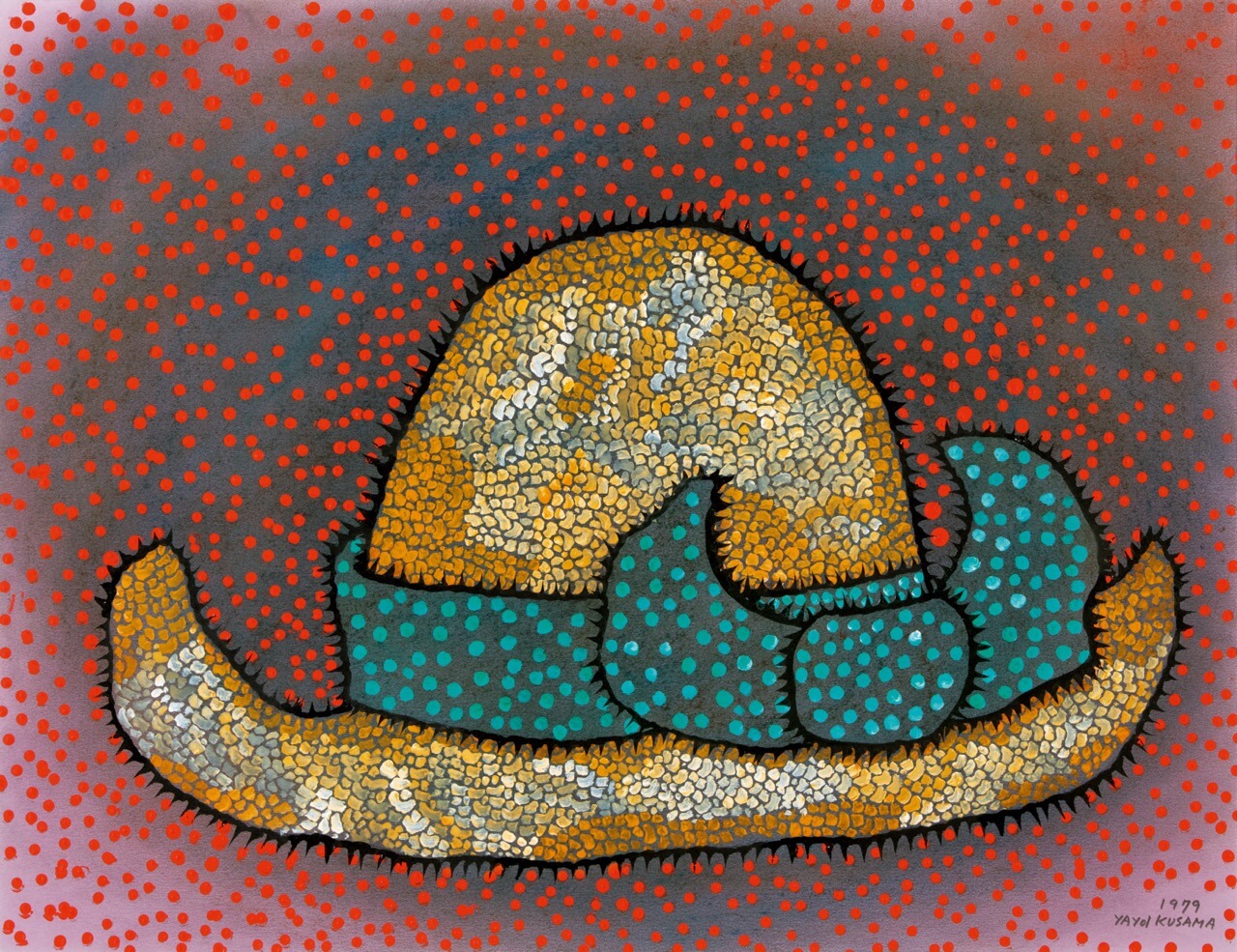
Yayoi Kusama (b.1929)
Hat Anthem
Gouache and pastel ink on paper
Written in 1979
recognition
1979 Yayoi Kusama (lower right) Yayoi Kusama 1979 Hymn to Hats (back)
source
April 1, 2018, Sotheby's Spring Auction in Hong Kong, Lot No. 503
Currently purchased directly from the above sources by important private collectors in Asia
Attached: Work registration card issued by Yayoi Kusama Studio
In addition to using red flowers as a metaphor for herself, Kusama also uses "hats" as an important element in her life. Since she went to the United States in 1957, she often wears hats in performances or attending public events. In addition to being a fashionable dress, it also stands out. own character. "Hymn to Hats" completed in 1979, Kusama transformed this favorite object in life into the protagonist of the painting, and represents a rare large-scale paper creation during his Tokyo period. On a purple-red background full of psychedelic polka dots, a hat falls from the sky. Kusama uses special colors such as gold and silver to depict the fish-scale texture of the hat, which shines with strange brilliance. The bow tie indicates that this is a women's hat. The raised brim of the hat is like a grinning smile, and it is the embodiment of Kusama’s spirit of striving for progress and unyielding will. The outer outline of the entire hat is outlined by zigzag black lines, which not only enhances the volume of the object, but also shows that the seemingly sweet and lovely thing also has aggressive "claws", which to some extent also reflects The atmosphere of the era with the rise of female power at that time made it particularly meaningful.
Tour schedule
September 9-10: Shenzhen Highlights of Asian 20th Century and Contemporary Art Will be the first to debut at Shenzhen Bay No. 1
September 11-22: Hong Kong Chinese calligraphy and painting, Asian 20th century and contemporary art Four major sections: porcelain handicrafts and classical furniture More than 50 highlight items will be auctioned in Hong Kong Appeared at China Guardian Hong Kong G Art Art Space
September 16-17: Shanghai Asian 20th Century and Contemporary Art and Two major sections of porcelain and handicrafts A total of more than 70 important treasures Will be jointly exhibited at Shanghai West Bund MGM Hotel |
Please continue to pay attention to ArtPro for more latest developments in the global art market in 2023.